





Foreign certificates become valid in Spain when they meet the legal requirements of the relevant procedure, which may include an apostille or legalisation and, where applicable, a sworn translation. If you are wondering how to make foreign certificates valid in Spain, it is important to check first what the body you are submitting them to requires, so as to avoid delays or rejections. Read on…
If you have studied, worked or were born outside Spain, you will very likely need to submit foreign certificates for immigration, employment or study procedures. The problem is that bringing the document is not enough: it must meet certain legal requirements to be valid here.
In this article you will learn which steps to follow, when you need a sworn translation and how to avoid mistakes that can delay your process.
Why are foreign certificates not automatically valid?
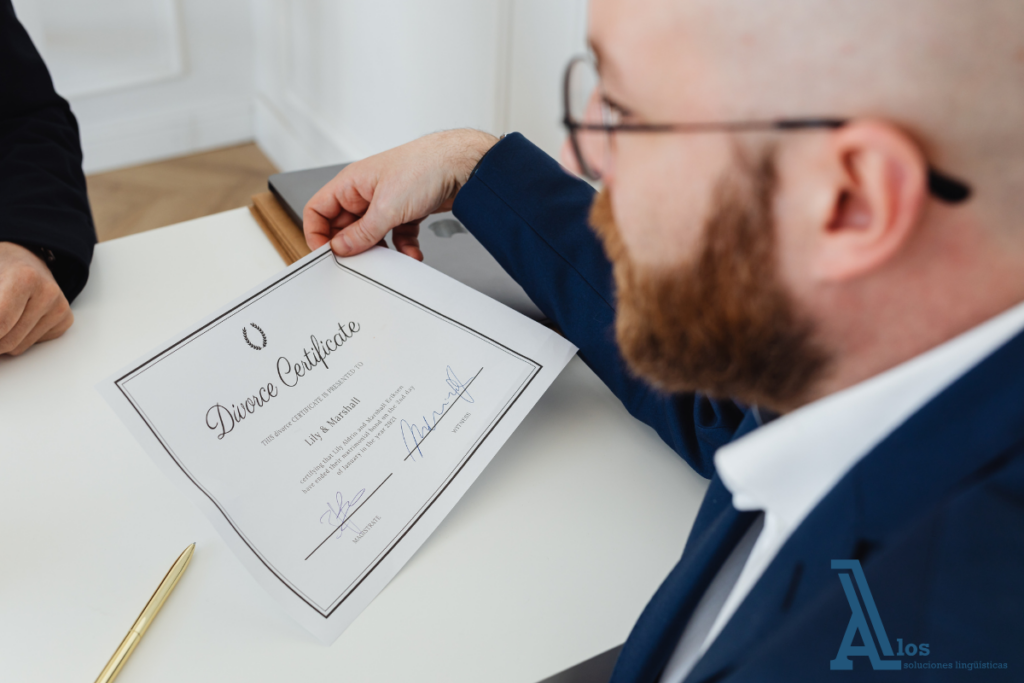
One of the most common mistakes is assuming that an official document issued in another country is directly valid in Spain. In reality, every authority requires assurances about its authenticity and about the correct understanding of its content.
For example, if you submit an Argentinian birth certificate or a Colombian university degree, the Spanish authorities need to check two things: that the document is genuine and that its content can be correctly interpreted in Spanish.
This is where processes such as legalisation, the apostille and sworn translation come into play.
Legalisation and the Hague Apostille: the first step
Before translating any document, you must check whether it needs to be legalised.
What is the Hague Apostille?
It is a certification confirming the authenticity of a public document so that it can take effect in another country that has signed the convention.
If your country is part of the Hague Convention, you will normally need an apostille. If it is not, you will have to go through the corresponding diplomatic legalisation.
This step is essential. A correctly translated certificate can still be rejected if it lacks the necessary prior validation.
Sworn translation: when it is compulsory
Once the document has been legalised, the next step is usually the translation.
Not just any translation will do. In many procedures in Spain a sworn translation is required, that is, one produced by an officially accredited sworn translator.
Common cases where it is required
Citizenship applications
Immigration procedures such as residence, arraigo or family reunification
Recognition of academic qualifications
Marriage or civil registry procedures
For example, if you submit a criminal record certificate in French or a birth certificate in Arabic, a simple translation is usually not enough.
In fact, in procedures involving residence or registration documents, it is worth looking at concrete examples such as the article on empadronamiento (residence registration) in Valencia for foreigners, since it shows real situations in which a badly planned translation can block the whole process.
Which documents usually need validation in Spain

In practice, certain documents come up frequently in administrative and legal procedures:
Birth certificates
Marriage certificates
Criminal record certificates
Academic qualifications
Medical certificates
Contracts or notarial documents
Each document may have different requirements depending on the body receiving it. Submitting a certificate to a university is not the same as submitting it to an immigration office or a civil registry.
What is more, when we talk about documents with legal force, precision is essential. This is easy to see in contexts where ambiguous wording can cause problems, as explained in this article on translating contracts to avoid ambiguity, a useful example for understanding why translating word for word is not enough.
Common mistakes when submitting foreign certificates
Many files are delayed by avoidable errors. These are some of the most frequent.
Not checking whether the document needs an apostille
Some people commission the translation first and then discover that the document should have carried an apostille. That means repeating part of the process and losing time.
Using unofficial translations
A translation done by a relative, a language school or an automatic tool has no legal validity in this context.
Submitting expired documents
Some certificates, such as criminal records, may have a limited period of validity. Even if they are well translated, they may not be accepted once they have expired.
Not adapting the document to the specific procedure
Every procedure has its own requirements. A document that is valid for academic enrolment is not always usable as it stands for immigration or citizenship.
Can documents in English be submitted untranslated?
In some very specific cases, certain private organisations or academic institutions may accept documents in English. However, that is not usual in official procedures.
In immigration, civil registry, citizenship or administrative procedures, documents normally have to be submitted in Spanish and, where applicable, through a sworn translation.
Trusting that “they are bound to accept it” is usually an expensive mistake.
How long does the whole process take?
The timing depends on several factors:
Issuing the document in the country of origin
Obtaining the apostille or legalisation
The sworn translation
The review by the body handling the file
If you have several documents at different stages at once — one awaiting an apostille, another being translated, another ready to submit — a desktop document organiser tray lets you physically separate each stage of the process and see at a glance where each paper stands.
So when a document is needed by a specific deadline, it is best to plan ahead and not leave the translation until the last minute.
How to speed up the process
If you want to avoid unnecessary blockages, the most useful approach is to follow a clear sequence.
Request the original document in good condition
Check whether it needs an apostille or legalisation
Check whether the procedure requires a sworn translation
Make sure names, dates and details match your passport or other official documents exactly
Check the specific requirements of the body you will submit it to
When it comes to important personal documentation, a prior review can save you corrections, rejections or new appointments.
Frequently asked questions
Not always, but it is in most official procedures when the document is in a language other than Spanish. In immigration, citizenship and civil registry matters a sworn translation is very often required.
No, not if the procedure requires legal validity. In those cases the translation must be produced by an authorised sworn translator.
No. They are different steps. The apostille certifies the authenticity of the document and the sworn translation allows its content to have formal validity in Spain.
Most likely your file will be held up, you will be asked to correct the documentation, or the document submitted will simply be rejected.
Making foreign certificates valid in Spain requires a clear process: checking whether they need an apostille or legalisation, translating them correctly where applicable and adapting them to the specific procedure. Getting it right from the start avoids delays and unnecessary problems.
If you need to submit foreign documentation in Spain and want to be sure it meets every requirement, at ALOS we can help you with specialist language services and support you so that the process is clearer and safer.