





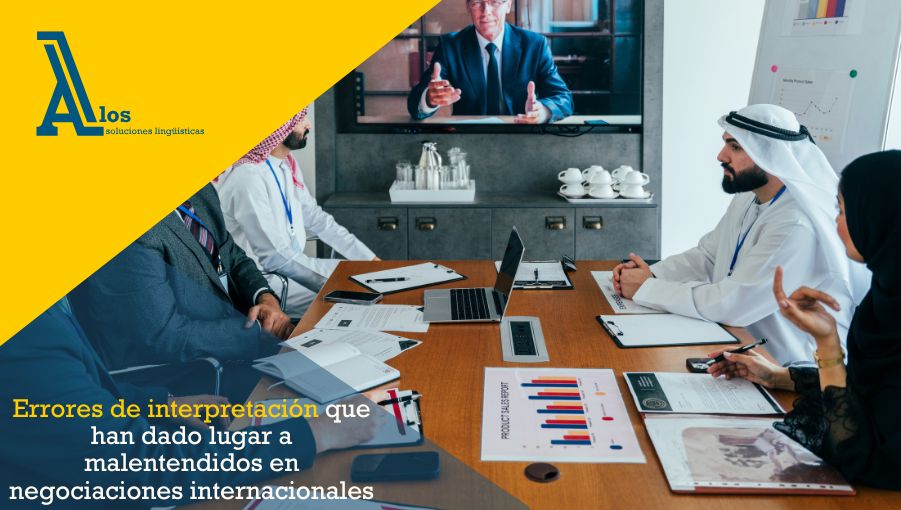
A contract that goes unsigned, a meeting that cools off, an agreement that collapses: in many cases the cause is not strategic but linguistic. Interpreting errors that have caused misunderstandings in international negotiations are still costing companies of every size real money.
In this article you will see real examples, why these failures happen and how to avoid them with practical measures you can apply from today.
When one word changes the course of a negotiation
In international settings, language is not just a tool: it is part of the strategy. A misread nuance can change the entire meaning of a proposal.
A common example involves terms that appear to be equivalents. In English, “eventually” does not mean “eventualmente” in Spanish, but “finally”. False friends of this kind can create mistaken expectations about deadlines or commitments.
The same happens with cultural expressions. In certain English-speaking contexts, “we’ll consider it” can be a polite refusal, whereas a non-native listener may read it as an acceptance in progress.
These small mismatches are among the most common interpreting errors that have caused misunderstandings in international negotiations.
The real cost of language misunderstandings
Beyond the anecdote, interpreting errors have clear financial consequences:
Lost commercial opportunities
Delays to international projects
Damage to the company’s reputation
Contractual disputes
In complex negotiations involving multiple parties and cultures, the margin for error narrows. An ambiguous term in a clause can end up in legal proceedings.
Understanding linguistic risk is therefore not only a communication issue, but a management one.

What causes interpreting errors
Cultural differences in communication
Not every culture communicates directly. In some countries, ambiguity is part of professional language. In others, absolute precision is valued.
When these differences are not taken into account, misreadings follow.
Insufficient command of the language
Getting by in a language is not enough. Negotiations call for a precise command of technical vocabulary and nuance.
A common mistake is relying on literal translations without grasping the real context.
Inappropriate use of automated tools
Machine translation can be useful, but it does not replace human judgement. In commercial or legal texts it can produce critical errors.
If you want to look more closely at how professional interpreting reduces risk in strategic meetings, you can read this article on the role of the interpreter in international negotiations:
https://alosidiomas.com/interpretes-negociaciones-internacionales/
Real examples of errors that have cost money
Confusion over contractual terms
A Spanish company negotiates with a German partner. The contract uses the term “binding agreement”, mistranslated as “indicative agreement”.
The result: one party considers the contract binding, the other does not.
Misreading of deadlines
In a negotiation with British clients, “shortly” is read as “in a few days”, when in fact it implied almost immediate action.
This causes delays and a loss of trust.
Problems in sales presentations
A manager uses overly literal expressions in English, which comes across as hesitant and unclear.
The proposal loses force, even though the product is competitive.
These cases show how interpreting errors that have caused misunderstandings in international negotiations can affect financial results directly.

How to prevent interpreting errors in your company
Invest in specialised language training
It is not just about learning a language, but about mastering it in professional contexts.
Training aimed specifically at international negotiation makes the difference.
When you work with partners, suppliers or external teams, it is also worth establishing clear protocols like those set out in this article on communication with international suppliers:
https://alosidiomas.com/comunicacion-proveedores-internacionales-logistica/
Work with language professionals
Specialist interpreters and translators provide security at critical moments.
Particularly in important meetings, contracts or presentations.
Standardise internal communication
Agreeing common terminology and avoiding ambiguity within the team reduces risk when you work across languages.
Always review key documents
Before sending out proposals or contracts, a professional language review is essential.
It is a minimal investment compared with the cost of an error.
The strategic role of language in negotiation
Language does not only convey information: it builds relationships.
Clear communication generates trust, while errors generate doubt.
In international markets, where competition is fierce, linguistic precision can be a differentiating factor.
Avoiding interpreting errors is not just about correcting mistakes, but about improving your ability to influence, negotiate and close deals.
Frequently asked questions
Mainly because of cultural differences, the use of literal translations and the lack of a professional command of the language. It is not just a matter of vocabulary, but of context.
Not in professional settings. They can serve as support, but they do not guarantee accuracy in negotiations, contracts or strategic communication.
Above all exporters, startups in expansion and organisations working with international clients without specialist language support.
Interpreting errors that have caused misunderstandings in international negotiations are not anecdotal: they are a real risk that affects results, relationships and reputation.
The good news is that they can be prevented with the right training, clear processes and professional support.
If your company works with international clients or suppliers, at ALOS we can help you improve communication and reduce these risks with language training tailored to your team. Get in touch and find out how to turn language into a competitive advantage.