





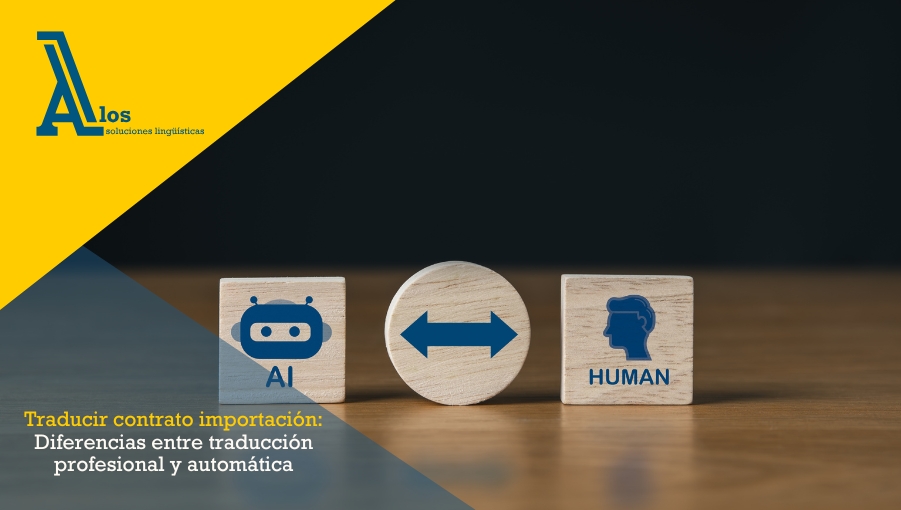
Having an import contract translated by a professional offers greater legal precision, terminological control and guarantees than machine translation. What are the differences between professional and machine translation when it comes to an import contract? Automated tools can be useful for informal texts, but contracts require legal context, specialist review and accountability for the result; read on…
In an increasingly global business environment, companies that import goods need to be sure their legal documents are correctly translated. An import contract, which is central to international commercial relationships, must be clear and precise. The question that arises is this: how do you choose between professional and machine translation? In this article we look at the key differences between the two options and at why professional translation is crucial in protecting commercial interests.
Why does an import contract need translating correctly?
Signing an import contract means entering into a legal agreement that has direct implications for the obligations and rights of the parties involved. Mistranslated wording can give rise to misunderstandings that affect performance of the contract and, in the worst case, lead to costly legal disputes.
For that reason it is essential to have a translation that is not only accurate but also correctly reflects the legal and commercial particularities of the agreement. This raises the question of whether to use machine translation or to engage a professional translator. Below we explain why an expert translator is the better option.
Machine translation: fast but risky
Machine translation tools such as Google Translate have come a long way in recent years. They are fast, accessible and, in many cases, good enough for informal texts or quick messages. Where complex legal documents such as an import contract are concerned, however, machine translation carries several risks.
1. Lack of context
Automated tools cannot grasp the full context of a contract. They can translate words literally, but they do not always pick up the specific legal nuances that may be fundamental to how the contract is interpreted. A term such as “Incoterm” or “force majeure”, for example, could be misread if the tool is not equipped to recognise it in its proper context.
2. Errors of interpretation
Translating a contract is not limited to converting words from one language to another. It requires an understanding of legal terms and of how they apply in the country of origin and the country of destination. A misreading, such as the incorrect use of a clause governing delivery of goods or payment deadlines, can have serious consequences for the company.
3. No accountability
Another drawback of machine translation is the absence of accountability. If an error in the translation affects the validity of the contract, there is no party to take responsibility for it. That can be a considerable risk where legal agreements involve large sums of money and long-term commitments.

Professional translation: precision and reliability
Choosing a professional translator who specialises in legal documents brings key advantages that ensure an accurate, reliable translation. Unlike a machine, a professional translator has the training needed to understand the legal and commercial nuances of an import contract.
1. Adapting to the legal and cultural context
A professional translator does not simply translate words; they adapt the content to the rules and conventions of the destination country. With an import contract, this is essential in order to make sure the terms used are the correct ones in the legal and economic context of both parties.
Terms such as Incoterms (which define the conditions for delivery of goods), for example, are essential in import contracts and must be rendered correctly to avoid misunderstandings. An experienced translator will know how to handle them and will convert them into the appropriate equivalent in the target language.
2. Guaranteed quality and precision
Professional translators review every document thoroughly, making sure the translation is accurate and free of errors. Many legal translation services also include a double review process: first the translator, then a second professional who checks the work. That provides greater assurance that the contract will be correctly understood by both parties.
3. Legal accountability
When you engage a professional translator or a specialist agency, you get an assurance that the work will be done properly. If an error with legal implications occurs, the translator or the agency is responsible for correcting it. That accountability is fundamental where important contracts such as import agreements are concerned.
Professional translators are also generally bound by codes of ethics and professional conduct that guarantee the confidentiality of documents, which matters a great deal when sensitive commercial agreements are involved.

When should you use machine translation and when should you choose a professional?
Although machine translation can be useful for informal communication such as emails or internal memos, it should never be used to translate import contracts or any other legal document. Precision is key in these cases, and quality is not something to compromise on.
Professional translation, on the other hand, should be the preferred option whenever legal documents are involved, particularly when negotiating important agreements with financial commitments, strict deadlines and international regulations at stake. Investing in a quality translation can prevent legal and financial problems over the long term.
Frequently asked questions
It is not advisable. Although automated tools can be useful for informal texts, import contracts require precision and legal context, which automated tools cannot always guarantee.
Professional translators specialising in legal documents review the translation thoroughly and, in many cases, the work goes through a double review process. They also make sure the content is properly adapted to the legal and cultural context of the destination country.
An error in the translation of an import contract can cause significant legal and financial problems. That is precisely why you need a professional translator who guarantees the quality and accuracy of the work. Professional translation agencies also tend to offer a correction guarantee if an error is found.
In short, translating an import contract correctly is essential in order to protect commercial interests and avoid legal problems. While automated tools can be useful in informal situations, legal contracts call for the experience of a professional translator specialising in the field.
If you need import contracts translated accurately and reliably, do not hesitate to contact us. At ALOS we have translators who are experts in legal translation and who guarantee a quality translation, tailored to your commercial and legal needs.