





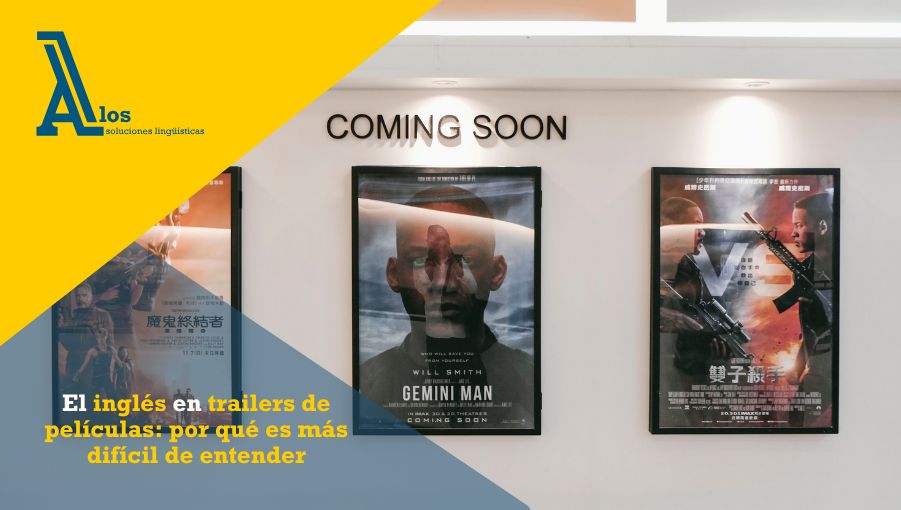
You are watching a trailer in English, the film looks interesting… but you can barely make out what they are saying. Even with a good level, the message escapes you. This situation is far more common than it seems.
In this article you will find out why this happens and how you can turn that difficulty into a useful tool for improving your comprehension of English.
Why trailers sound harder than films
A trailer is not designed for you to understand every word, but to grab your attention in a few seconds. That makes the language more intense and less clear.
Unlike a film:
- The sentences are shorter
- There is less context
- Everything is condensed
For example, a line such as “This ends now” appears with no previous explanation. In a film, that same line would have a context that made it easier to follow.
The problem here is not your level of English, but the format.
The fast pace and information overload
One of the key factors is pace. Trailers combine rapid images, music and dialogue in a matter of seconds.
As a result:
- The audio is harder to process
- You have no time to interpret what you hear
- Your attention is split between image and sound
From a learning point of view, this creates cognitive overload. Your brain is not only translating, it is also trying to follow the visual narrative.
That is why understanding a trailer is not comparable to understanding a real conversation.
The voice-over and its unnatural intonation
Trailers use a very distinctive type of voice: deep, slow and dramatic.
A classic example:
“In a world… where everything changes…”
This kind of delivery:
- Exaggerates the intonation
- Introduces unnatural pauses
- Does not reflect everyday English
The problem is that, as a learner, you expect to recognise a more standard English. But trailer English is designed to stir emotion, not to be clear.
Narrative vocabulary versus real English
Another reason they are hard to follow is the type of vocabulary they use.
Trailers are dominated by words such as:
- revenge
- destiny
- survival
- final mission
This vocabulary belongs to cinematic language. It is not what you would use in a meeting, a call or an email.
If you want to work on your English from a more useful, applicable angle, it is worth combining this kind of content with strategies such as those explained in the ALOS article, which sets out how to get real value out of audiovisual content.
Clipped lines and missing context
In trailers, many lines appear incomplete or disconnected from one another.
Examples:
- “You don’t get it…”
- “It’s too late.”
Without context, these lines can carry several meanings. That forces your brain to interpret well beyond the language itself.
In a real conversation, by contrast:
- There is continuity
- You know who is speaking
- You understand the situation
That makes comprehension far easier.

The role of music and sound effects
Music in trailers has an emotional purpose, but it directly affects comprehension.
There is usually:
- intense music
- explosion or action effects
- overlapping dialogue
All of this reduces the clarity of the message. In real communication settings, by contrast, the aim is exactly the opposite: to be clearly understood.
How to use trailers to improve your English
Difficult as they are, trailers can be a very useful tool if you use them well.
If you practise in desk sessions, a lumbar cushion for your chair helps you keep a comfortable posture while you replay scenes and take notes, especially if you do it after a long day.
Listen without subtitles
First try to grasp the general idea:
- tone
- emotion
- key words
Do not try to understand everything.
Replay with English subtitles
This lets you:
- confirm what you heard
- spot new expressions
Analyse specific lines
Instead of the whole trailer, focus on 2 or 3 lines:
- what they mean
- how they are built
- whether they are useful in real life
Combine it with clearer content
The common mistake is using trailers alone. To really improve your comprehension, you need variety.
For example, you can draw on resources such as the ALOS article on
<a href=”https://alosidiomas.com/como-mejorar-el-listening-en-ingles/”>how to improve your listening in English</a>, which explains more structured methods for training your ear in real contexts.
“Showbiz” English vs real English
This point is key if you want to avoid frustration.
Trailer English is:
- dramatic
- condensed
- short on context
Real English is:
- clear
- direct
- geared towards communicating
Not understanding a trailer does not mean your level is poor. It means you are facing a type of English that hardly represents everyday use.
Frequently asked questions
Yes. They are designed to make a quick impact, not to make comprehension easier.
Yes, but as a supplement. They are useful for training your ear, but they should be combined with clearer, more structured content.
Ideally you combine both: without subtitles for overall comprehension and with subtitles to reinforce vocabulary and structures.
Trailers can seem complicated, but you now know it is not a question of level, but of format and type of language. Understanding that lets you use them strategically, without frustration.
If you want to improve your English in a practical way, focused on real situations, whether at work or in your personal life, ALOS can help you with training tailored to your objectives. Get in touch with our team and take the next step with learning that is useful and effective.