





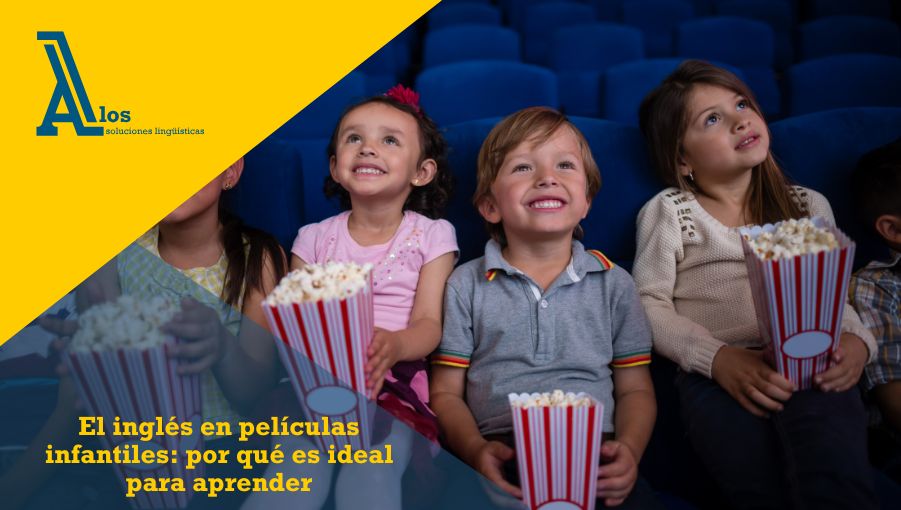
Learning English can become frustrating when the material does not match your level or simply fails to hold your attention. Many people give up because they feel they are not progressing or because the learning becomes too theoretical. Children’s films in the original version offer a practical, accessible and effective alternative. In this article you will find out why they work so well and how to use them to improve your English for real.
Why children’s films make learning English easier
Children’s cinema is made for an audience that is still developing its own language, which means the language used is far clearer and more structured.
The characters use short sentences, simple vocabulary and repeat structures frequently. This makes it easy for learners to spot patterns without having to analyse them consciously.
The pace is also usually slower than in content for adults, which lets you follow the story without constantly losing the thread. That reduces frustration and creates a sense of progress from the start.
A visual context that helps you understand without translating
One of the great benefits of this resource is the constant visual support.
Emotions, actions and situations are clearly represented. If a character is angry, happy or confused, you see it directly on screen. That lets you work out the meaning of many words without having to translate them.
This kind of contextual learning is key to developing a more natural understanding of the language, which is essential for communicating fluently.
Everyday, useful vocabulary from the very first minute
The vocabulary in children’s films centres on real situations: personal relationships, emotions, decisions and everyday actions.
That means you do not just learn words, but expressions you can use every day. Phrases such as “Let’s go”, “Wait”, “I don’t understand” or “Try again” come up constantly and are entirely usable.
If you want to reinforce this kind of practical learning, you can add strategies such as those explained in <a href=”https://alosidiomas.com/blog/como-mejorar-tu-ingles-en-el-dia-a-dia/”>how to improve your English day to day</a>, which works on the language in real contexts.
Better listening without feeling blocked
One of the biggest challenges when learning English is understanding it when it is spoken.
Children’s films help you get past that barrier because the language is clearer, the pronunciation more marked and the pace more manageable. The context also lets you anticipate what is about to be said.
This makes it easier to train your ear without the feeling of understanding nothing, which is essential for staying motivated.
Natural repetition that reinforces learning
Repetition is fundamental to learning a language, but when it is forced it usually becomes tedious.
In children’s films, repetition happens naturally. The characters repeat lines, the structures stay consistent and the messages are reinforced throughout the story.
This lets your brain absorb the language without having to memorise, improving long-term retention.
How to use children’s films to learn English effectively
To get the most out of this resource, it is important to use it actively.
One effective approach is to:
– Watch the film first with subtitles in your own language to follow the story
– Watch it again with English subtitles
– Go back over specific scenes with no subtitles
It is also a good idea to pause, repeat lines out loud and note down useful expressions.
If you want to go deeper into this method, you can apply techniques such as those explained in this article, which sets out practical strategies for improving comprehension and vocabulary.
A method that helps you keep going
One of the biggest problems when learning English is the lack of continuity.
When the method is not enjoyable, it is easy to drop it. Children’s films, by contrast, turn learning into an entertaining activity.
That makes it easier to come back to it, and it is exactly that steady repetition that makes the difference when learning a language.
Frequently asked questions
Not as your only method. They are a very useful resource, but ideally you combine them with speaking practice, reading and structured training.
Yes. Although they are made for children, their clarity and structure make them particularly useful for adults who want to strengthen their foundations.
Twenty to thirty minutes a day is enough if you work actively and consistently.
Children’s films in English are an effective tool for improving comprehension, vocabulary and fluency without creating frustration. Their combination of clear language, visual support and natural repetition makes them a very practical resource at any level.
If you want to progress faster and apply English in real situations, at ALOS we can help you with training adapted to your goals. Contact us and start improving your English in a practical, focused way.