





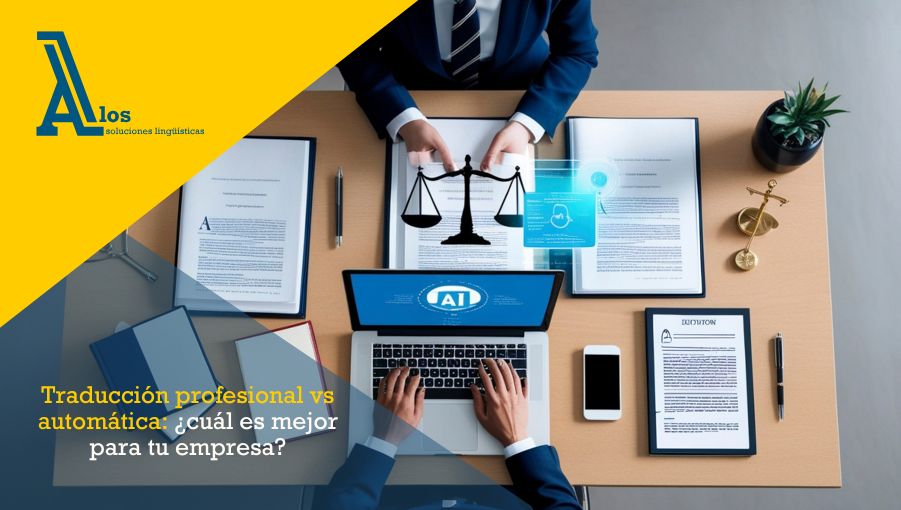
In many purchasing decisions within a company, especially where documents, web content or international communications are concerned, one question comes up again and again: should we use machine translation to save time and money, or rely on professional translation with human revisers? That choice can have a direct effect on how your brand is perceived, on the accuracy of your message and on your business results. In this article we explain the key differences, with practical examples and clear criteria for deciding according to your needs.
Why translation quality matters in business
When a company communicates in another language, it is not simply transferring words: it is conveying ideas, values and professionalism. A poor translation can cause misunderstandings, legal errors or even financial losses. In the field of multilingual marketing, for example, translating a slogan literally without regard for cultural context can strip a message of its impact or, worse, cause it to be misread in another country. In documented cases involving major brands, a single badly translated phrase has damaged a company’s image across entire markets.
Understanding the differences between machine and professional translation will therefore help you make informed decisions, protect your reputation and get the most out of communicating with international audiences.
What is machine translation and when can it be useful?
The technology behind machine translation relies on algorithms and artificial intelligence models to generate translations almost instantly. Platforms such as Google Translate, DeepL or the most advanced AI models can produce results in seconds, which makes them an attractive option for simple or internal texts.
The main advantage of this approach is speed and low cost. If you need to translate informal emails, internal notes or get the general sense of a text in another language, machine translation can be useful as a first pass.
It does not, however, grasp cultural nuance, specific contexts or technical terminology with any precision. In content that calls for cultural sensitivity — social media or marketing campaigns, say — a literal translation can sound artificial or lose the original tone. Studies and the experience of specialist companies show that this tool works best with human oversight in complex or critical texts.
Professional translation: what it offers and why it matters
By contrast, professional translation means that specialist native translators — with experience in your sector or type of document — produce and review the text to ensure accuracy, consistency and adaptation to the target audience. That matters especially in documents requiring technical, legal or commercial rigour.
When working with technical manuals, for instance, a single mistranslated word can create confusion in operating procedures or even put staff safety at risk. Professional technical translation guarantees not only faithfulness to the message, but also the correct rendering of critical terminology.
What is more, when it comes to content that is the public face of your company — websites or sales materials — professional translation can be the difference between connecting effectively with your customers and putting up a barrier that holds back conversions. Human work takes account of cultural aspects, idiom, tone of voice and stylistic fit that a machine cannot capture on its own.
Machine translation with post-editing: a middle way
An intermediate option is machine translation with post-editing, where AI produces a first draft and a professional translator reviews, corrects and adapts it. This combination can be an efficient solution when you are handling large volumes of content that do not need maximum precision from the outset but do need an acceptable final quality.
The approach is particularly useful for extensive content such as knowledge bases, informational articles or internal documentation that will be updated frequently. Human involvement ensures that serious errors are avoided, terminological consistency is maintained and the text reads naturally in the target language.
Common business scenarios: practical examples
Web content and international SEO
When translating your website for new markets, moving text from one language to another is not enough. You need to consider how to translate and rank multilingual content, since each market may use different search terms. Relying on machine translation alone, with no optimisation, can cost you visibility and qualified traffic. A professional approach guarantees contextual and technical adaptation of the content, which improves both the user experience and your search rankings.
Brand and marketing communications
On social media or in digital campaigns, colloquial expressions, humour and cultural references vary enormously from country to country. A literal translation can sound artificial or even create misunderstandings. Working with professionals who understand cultural nuance ensures the message keeps its original intent and resonates with your target audience.
Technical and legal documents
When handling documentation that demands absolute precision — technical reports, legal terms or product specifications — machine translation can be inadequate or even dangerous. In these cases professional translation delivers not only linguistic quality but also compliance with rules and standards, avoiding costly errors or legal consequences.
In processes where accuracy is critical — interviews, technical meetings or reviewing statements for later translation — having a professional digital recorder lets you capture the original content clearly and avoid losing information. In multilingual projects, crisp audio makes both human translation and subsequent review easier, reducing errors and rework.

How do you decide which method to use?
To work out which approach to choose, consider these questions:
- Does the text represent your company to customers or external markets?
- Does it require technical or legal precision?
- Does the audience expect a culturally appropriate tone?
- What would the impact of a translation error be?
If the answer is “yes” in most of these cases, professional translation is the safer option. If, on the other hand, you need speed for internal texts or informal drafts, machine translation with human review may be acceptable.
Not entirely. AI can speed processes up, but it does not understand cultural context or the specific nuances of each sector without human oversight.
Whenever the text has commercial, legal, technical or brand impact. Contractual documents, your corporate website or product materials, for instance, should be reviewed by human experts.
Yes, provided it is combined with professional review (post-editing) to ensure quality and terminological consistency in the final result.
Choosing between machine and professional translation is not only a question of budget or speed: it is a strategic decision that shapes how your company communicates, connects and grows in international markets. If you want to safeguard the quality and effectiveness of your translations, or need advice on a specific project, get in touch with ALOS Soluciones Lingüísticas and find out how we can help you with specialist services tailored to your needs.