





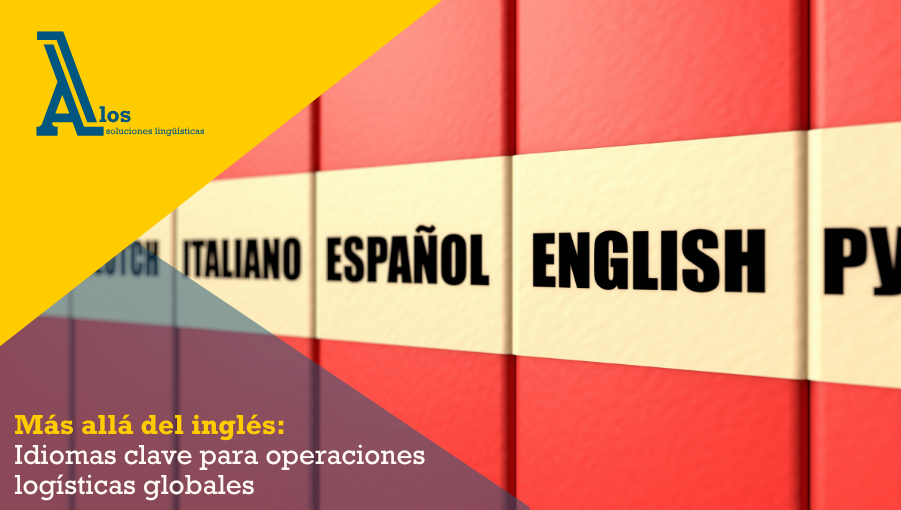
How ready are you to communicate with your logistics partners anywhere in the world? In this post you will find the key languages for global logistics operations.
In an increasingly interconnected world, global logistics operations play a crucial role in international trade. This kind of logistics covers the processes and activities that allow goods, services and information to move efficiently between countries. It goes far beyond simple transport: it involves managing complex supply chains, complying with customs regulations, coordinating suppliers and optimising costs and delivery times.
Unlike international logistics, which focuses on shipping products between countries, global logistics takes a broader view. It means fully integrating internal and external logistics processes on a worldwide scale, taking into account time zones, uneven infrastructure, cultural contexts and local legislation.
Amazon is a landmark case: it has transformed global logistics by digitalising its processes, using artificial intelligence and running a network of distribution centres in more than 185 countries. That capacity lets it offer record delivery times worldwide. The example shows how important effective communication and smooth logistics management are in international settings.
English as the universal language of logistics
English has established itself as the universal language of business and, consequently, of global logistics too. It is the working language of international meetings, commercial contracts, technical documentation, handling instructions and logistics software. By mastering English, logistics professionals can reduce communication errors, close international agreements more easily and improve operational efficiency.
According to a report by EF Education First, countries with the highest level of English also show higher logistics development, because the language allows rapid integration with partners, technology platforms and international regulations. In fact, much of the sector’s terminology is in English, such as FOB (Free on Board), ETA (Estimated Time of Arrival) or B/L (Bill of Lading).
That said, relying on English alone can limit the reach and effectiveness of logistics operations in certain regional contexts. In areas where other languages prevail, or where cultural nuance carries weight in business relationships, knowing other languages makes a strategic difference.
Beyond English
Did you know that speaking only English is no longer enough to succeed in international trade? El País explains that, in a market where every second counts and every word matters, speaking several languages has become a strategic tool for logistics success.
Globalisation has driven not only the exchange of goods but also the need for professionals who can communicate in several languages to keep logistics operations on track. In today’s competitive environment, speaking several languages can be the difference between closing a deal or losing it, between an on-time delivery or a costly delay.
Being able to communicate in the customer’s or supplier’s language not only reduces misunderstandings, it builds trust and improves commercial relationships over the long term. These are some of the languages that make the difference in global logistics operations:
French: the diplomatic language par excellence
For centuries French was the language of international trade and diplomacy. It is still an official language in numerous multilateral organisations such as the UN, the WTO and the EU. It is also key in French-speaking regions of Africa, the Caribbean and Europe. Companies with interests in North and West Africa, Canada or Switzerland can gain a competitive edge from employees who speak fluent French.
German: an industrial and logistics powerhouse
Germany is one of Europe’s main logistics hubs and a world leader in engineering and manufacturing. Mastering German makes it easier to do business with industrial and technology companies, particularly in the automotive, machinery and heavy logistics sectors. Germany also has some of the world’s most efficient ports and airports, which makes it a key node.
Mandarin: the language of the Asian giant
China is the world’s largest exporter and a fundamental part of any global supply chain. Mandarin, spoken by more than a billion people, is essential for reaching Asian markets, negotiating with suppliers and understanding local regulations. English is common in the big cities, but many business relationships inland or in industrial areas require command of the local language.
Portuguese, Japanese and other emerging languages
Brazil is a key logistics player in Latin America, and Portuguese is vital for operating effectively in the region. Japanese, although more limited in use, is relevant for anyone working with Japanese companies known for their culture of precision and efficiency.

How languages affect logistics efficiency
Multilingualism within logistics teams reduces the risk of misinterpretation, improves the negotiation of international contracts and speeds up the resolution of cross-border disputes. It also helps build stronger, more sustainable commercial relationships. Companies that invest in language training for their logistics staff tend to be more competitive and more resilient.
In an environment as dynamic and competitive as global logistics, being able to communicate effectively in several languages becomes a powerful tool for professional success. English remains fundamental, but on its own it does not cover the complexities of international markets. Companies operating across different regions and sectors need professionals who understand not only the language, but also the culture and local business conventions.
Speaking the language of your customer, supplier or business partner does more than smooth transactions: it conveys respect, interest and commitment. In a world where strategic alliances depend as much on trust as on efficiency, command of several languages becomes a key differentiator.
If you are a professional looking to grow internationally, or a company seeking to strengthen its presence in new markets, investing in language training is more than an advantage: it is a necessity. We encourage you to take that decisive step towards internationalisation with stronger, more effective multilingual communication. That is why, at Alos we recommend complementing professional training with language courses tailored to specific sectors.
Frequently Asked Questions (FAQs)
International logistics focuses on moving products between countries, while global logistics involves a comprehensive, coordinated view of processes worldwide.
Because it is the most widely used language in international trade, technical documentation and logistics software systems.
French, German, Mandarin and Portuguese, depending on the target market and geographical region.
At Alos we offer specialised language training for professionals in the logistics and legal sectors.
It improves operational efficiency, reduces communication errors and strengthens relationships with international partners.