





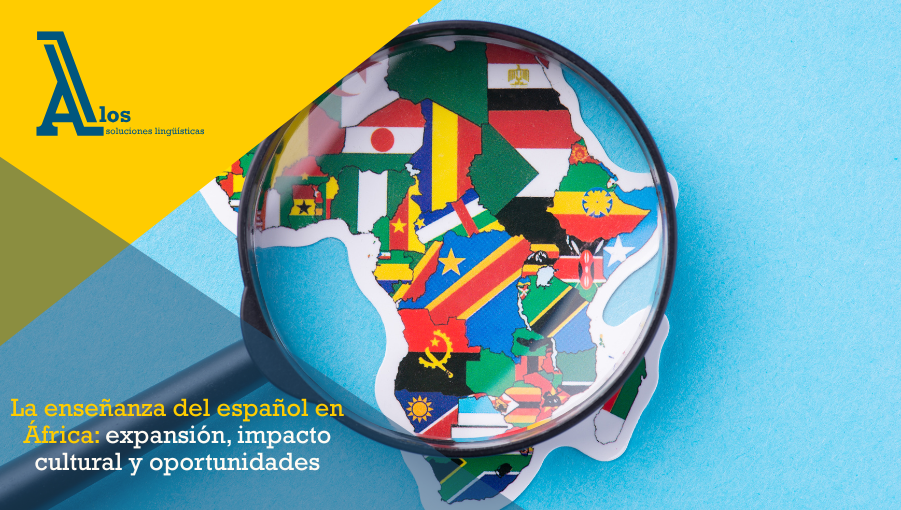
Spanish is one of the most widely spoken languages in the world, with more than 500 million native speakers, and ranks second by number of first-language speakers. Traditionally associated with Latin America and Spain, the language of Cervantes has been spreading into new territories, among them the African continent. This development, little known in many circles, represents a significant linguistic and cultural shift for Africa.
A textbook case is Equatorial Guinea, where Spanish has been an official language since 1968 and is spoken by 87% of the population, according to Instituto Cervantes figures. Countries such as Senegal, Côte d’Ivoire, Cameroon and Benin are also introducing Spanish into their education systems, with exponential growth in the number of students and teaching centres. In Senegal, for example, more than 50% of secondary school pupils choose Spanish as their optional foreign language (Wikipedia).
The growing presence of Spanish in Africa has several dimensions: educational, cultural, diplomatic and economic. In this article we look at how Spanish is gaining ground in African countries, the challenges and opportunities this brings, and the cultural implications of the phenomenon.
General data on the growth of Spanish in Africa
The table below sets out estimated figures for the number of Spanish learners in several African countries:
| Country | Spanish learners |
|---|---|
| Côte d’Ivoire | 200,000+ |
| Senegal | 100,000+ |
| Cameroon | 76,000+ |
| Madagascar | 8,000+ |
| Equatorial Guinea | 1,000,000+ |
| Estimated total | More than 1.5 million |
Source: Instituto Cervantes and studies in African Hispanic scholarship
These figures show sustained growth, driven by international cooperation, the cultural appeal of the Spanish-speaking world and the opportunities that knowing Spanish opens up in the global job market.
Relevant national contexts
In Equatorial Guinea, Spanish is not only the official language but also the working language of education, public administration and the media. The country has become a natural bridge for the spread of Spanish across the continent.
In Cameroon, Spanish has been taught since 1951. Universities such as Yaoundé I and Dschang have very active Spanish departments. Many Cameroonian students also take postgraduate courses at Spanish and Latin American universities.
In Côte d’Ivoire, interest in Spanish has grown considerably. According to the Instituto Cervantes, more than 200,000 Ivorians study Spanish. The University of Cocody in Abidjan offers a degree in Hispanic language and literature, and Spanish is present in many secondary schools.
Benin and Gabon have also seen rising demand for Spanish studies, in both religious and academic settings. In Benin, the University of Abomey-Calavi has a well-established Hispanic studies programme.
| Country | Level of Spanish in education | Estimated learners | Institutional presence |
|---|---|---|---|
| Equatorial Guinea | Official and working language | 1,000,000+ | National institutions |
| Côte d’Ivoire | Secondary and university | 200,000+ | University of Cocody |
| Senegal | Optional at secondary level | 100,000+ | Aula Cervantes Dakar |
| Cameroon | Secondary and university | 76,000+ | University of Yaoundé I |
| Benin | Secondary and university | 30,000+ | Univ. of Abomey-Calavi |
Cultural implications
The advance of Spanish in Africa has profound cultural implications. It is not merely a matter of learning a language, but of joining a cultural community that spans three continents. The literature, cinema, music and customs of the Spanish-speaking world are beginning to permeate African cultural spaces, enriching the local linguistic and artistic landscape.
One of the great benefits is a stronger multilingualism. Spanish is added to local languages, French, English and Portuguese in several national contexts, which helps produce citizens who are more open and better prepared for globalisation.
Spanish also acts as a tool for social mobility, opening access to international scholarships, cooperation programmes and jobs in embassies, NGOs, multinational companies and tourism, establishing itself as a bridge to new opportunities. The Equatoguinean writer Donato Ndongo-Bidyogo, one of the most representative voices of African Hispanic writing, sums it up clearly:
“Spanish is part of our African identity; it is not an imposed inheritance but a tool we have made our own in order to communicate, create and think about the world from Africa.”
— Donato Ndongo-Bidyogo
Challenges
The growth of Spanish in Africa is not without difficulties, however. One of the main challenges is the shortage of qualified teachers. Many of them have no specific training and no access to up-to-date teaching materials.
Syllabuses also need to be adapted far more closely to African cultural contexts. To be genuinely effective, Spanish teaching has to take account of the linguistic, social and economic reality of the countries where it takes place.
Finally, there is an urgent need to strengthen educational infrastructure: libraries, resource centres, internet access and cooperation between African universities and those of the Spanish-speaking world.

Opportunities
Despite the challenges, the growth of Spanish in Africa is a strategic opportunity to strengthen ties between Africa, Spain and Latin America. Setting up cultural centres such as those of the Instituto Cervantes, partnerships between universities and student exchanges are effective ways of consolidating that relationship.
Initiatives such as conferences on African Hispanic studies and translation and interpreting projects also encourage the professionalisation of Spanish in Africa.
Success stories
Several successful programmes have been developed in recent years. One is the Aulas Cervantes project, which has established Instituto Cervantes sections in African universities such as the one in Dakar, Senegal.
The MAEC-AECID scholarship programme also stands out, allowing African students to take higher education courses in Spain. These programmes not only consolidate the prestige of Spanish, they also create a network of skilled African Spanish speakers who drive the language forward in their own countries.
Music, cinema and television have also helped to popularise Spanish. In countries such as Mali and Burkina Faso, Latin American soap operas have brought Hispanic expressions and customs into everyday life.
The future of Spanish in Africa
Long-term projections suggest that Africa will be a key territory for the growth of Spanish. The youth of the African population, together with rising interest in the language, points to a period of consolidation.
The possibility of adopting Spanish as a language of instruction in more African universities is being discussed in several international forums. At the same time, the job market in sectors such as tourism, diplomacy and international services continues to demand Spanish language skills.
The future of Spanish in Africa
Closing thoughts and prospects for the future of Spanish in Africa
Spanish in Africa has gone from being a peripheral language to becoming a tool of international communication, a route to educational development and a growing form of cultural expression. The phenomenon reflects not only linguistic change but wider geopolitical, economic and social shifts.
For this growth to be sustainable, it will be essential to invest in quality education, in teacher training and in solid cooperation programmes between Africa and the Spanish-speaking countries.
How can Alos Soluciones Lingüísticas help you?
At Alos Idiomas we promote the teaching of Spanish and other languages such as French in African contexts, opening access to educational, cultural and professional opportunities through quality language training tailored to each setting.
- We adapt our Spanish courses for foreign learners to each student’s needs.
- We use communicative methods and culturally contextualised content.
- We have expert teachers and offer classes in person or online.
- We also offer French and English courses, which are very useful in Africa given how widely they are spoken.
- We support the process with personalised follow-up and up-to-date resources.
Frequently asked questions (FAQ)
For educational, cultural, diplomatic and economic reasons. Spanish offers professional and academic advantages in a globalised world.
Equatorial Guinea, Senegal, Côte d’Ivoire, Cameroon, Benin and Gabon.
Yes, particularly in Equatorial Guinea, where it is an official language. In other countries Spanish is taught as a second or third language.
The Instituto Cervantes, local universities and bodies such as AECID (Agencia Española de Cooperación Internacional para el Desarrollo, the Spanish agency for international development cooperation).