





The Olympic Games are a global event that brings together athletes, coaches, journalists and spectators from all over the world. With more than 200 countries taking part, the linguistic diversity is immense. Interpreting and translation play a crucial part in making communication work.
Since the founding of the International Olympic Committee (IOC), French and English have been the official languages of the Games. The language of the host country is added as a third official language. At the Paris 2024 Games, for example, French is both an official IOC language and the language of the host country (jrlanguage.com).
A notable example of the importance of interpreting came during the Munich 1972 Olympic Games, when the Israeli hostage crisis required precise communication between the authorities and the international media. The recent film “September 5” highlights the essential role of interpreters in crisis situations (latimes.com).
Why interpreting matters at the Olympic Games
Interpreting at the Olympic Games is not confined to translating words; it means conveying emotions, intentions and cultural contexts. Interpreters work in a range of settings:
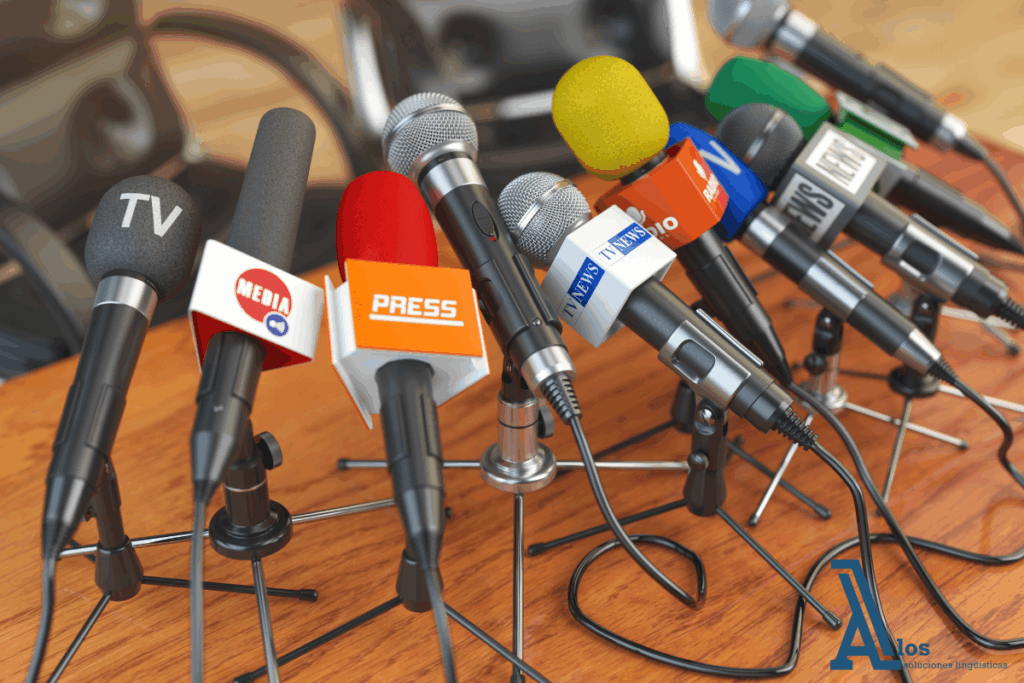
- Press conferences and interviews: they make communication possible between athletes and media from different countries.
- Official ceremonies: they ensure that speeches and announcements are understood by everyone present.
- Mixed zones and competition areas: they allow athletes, coaches and officials to interact.
During the Tokyo 2020 Games, more than 800 interpreters were deployed to cover the event’s language needs (abroadlink.com).
Challenges interpreters face
Olympic interpreters face a number of challenges:
- Specialist terminology: they have to be familiar with technical terms from a range of sports.
- Time pressure: simultaneous interpreting demands both speed and accuracy.
- Cultural diversity: they must be alert to cultural differences to avoid misunderstandings.
The COVID-19 pandemic also created a need for remote interpreting, which added technical complexity to the process (t-works.eu).
“Interpreting is not just translating words, it is translating intentions, emotions and cultures.”
-Anonymous
The invisible yet essential role of the Olympic interpreter
Often invisible to the cameras, interpreters are the people who make sure the most moving moments and the most important statements reach a global audience clearly. At press conferences these professionals must not only translate accurately but also convey the emotional nuances of what athletes say. Think of a medallist dedicating her victory to her family or her country: the tone, the pauses, even the tears have to be interpreted with cultural sensitivity. Any error of interpreting could lead to misunderstandings or even to diplomatic incidents.
The specialist training of Olympic interpreters
The interpreters who work at the Olympic Games are not general translators; they need specific training in sports terminology as well as knowledge of institutional protocol and of how to handle live situations. Before each edition of the Games, many take intensive courses in which they practise with real audiovisual material, simulate interviews and hone their reaction speed. Some are former athletes or experts in particular disciplines, which helps them grasp the context. Their preparation also covers the geopolitics and customs of the athletes’ countries, so as to avoid mistaken or culturally insensitive renderings.
Interpreting in crisis situations
Not every Olympic moment is a celebration. During the Atlanta 1996 Games, the Centennial Park bombing made it necessary to deploy communication teams in several languages to coordinate efforts between security agencies, the media and foreign delegations. In situations like these, interpreters become vital links for issuing official statements, easing tensions and channelling urgent information. This critical side of their work is rarely mentioned, yet it is as important as interpreting on the medal podium.
Multilingualism within sporting delegations
Although the Games have their own institutional interpreters, many delegations bring their own translators and interpreters. That is the case, for example, with China, Japan and Germany, whose Olympic committees often hire personal interpreters for their highest-profile athletes. This allows for more controlled media coverage, more precise statements and greater protection of the athlete’s image. Some interpreters even become unofficial spokespeople, as happened with the swimmer Sun Yang at Rio 2016, whose interpreter played an essential part in the athlete’s media defence after doping accusations.
The media impact of poor interpreting
In 2012, during the London Games, a misinterpretation during a post-competition interview led to an incident between a British journalist and a South Korean athlete. Confusion over the use of an idiomatic expression resulted in mistaken headlines and a diplomatic response from the South Korean committee. The episode shows how poor interpreting can escalate to an international level. That is why the interpreter’s role must not be underestimated or replaced by automated tools alone, which lack contextual and emotional understanding.
Technology and the future of interpreting at sporting events
Technology has begun to play a part in sports interpreting:
- Real-time translation apps: they make basic communication between participants easier.
- Remote interpreting: it allows interpreters to work from locations away from the event.
Human interpreting, however, remains irreplaceable in situations that call for deep cultural and emotional understanding (thespanishgroup.org).
Beyond the medals: the value of understanding one another
Interpreting at the Olympic Games is essential to effective communication between participants from all over the world. Interpreters do not merely translate words: they build cultural and emotional bridges.
Interested in improving your language skills or in need of translation services?
Frequently asked questions (FAQ)
The official languages are French, English and the language of the host country. Interpreting services are, however, provided in many other languages as required.
Mainly simultaneous and consecutive interpreting at press conferences, ceremonies and competition areas.
They receive specialist training in sports terminology and in the cultural practices of the participating countries.
Technology can help, but human interpreting remains essential to effective and culturally sensitive communication.
You can contact specialist agencies that offer services tailored to international events.