






Did you know that companies encouraging their staff to learn languages increase their international expansion opportunities by up to 25%? Globalisation is an established fact, yet many organisations still treat language training as a soft “benefit” rather than a strategic investment. Studies by the British Council and Harvard Business Review have shown that language skills do more than reduce communication errors: they also raise productivity, employee engagement and global competitiveness.
Beyond English, the universal corporate language, knowing German, Mandarin or Brazilian Portuguese is a real competitive advantage in key markets. In a world where 56% of consumers say they think more highly of companies that communicate in their own language, language training stops being a luxury and becomes a strategic asset.
For many organisations the challenge is not recognising that language training is useful, but measuring its impact. How do you know whether what you have spent really translates into tangible business benefits? Can you calculate the return on investment (ROI) on something as “intangible” as language skills? In this article we show you how, step by step.
What is ROI on language training?
The return on investment (ROI) — in full: Return on Investment) — is a metric widely used in business to assess how profitable an investment has been. Its purpose is to answer one fundamental question: how much value has an investment generated compared with what it cost? The formula has traditionally been applied in areas such as sales, marketing and finance, but in recent years it has become relevant in training too, and particularly in language training.
When we talk about ROI on language training, we mean the relationship between the tangible and intangible benefits a company obtains by training its staff in foreign languages and the cost of providing that training. The analysis does more than justify budgets: it supports informed strategic decisions about how training programmes are designed, delivered and scoped.
The general ROI formula:
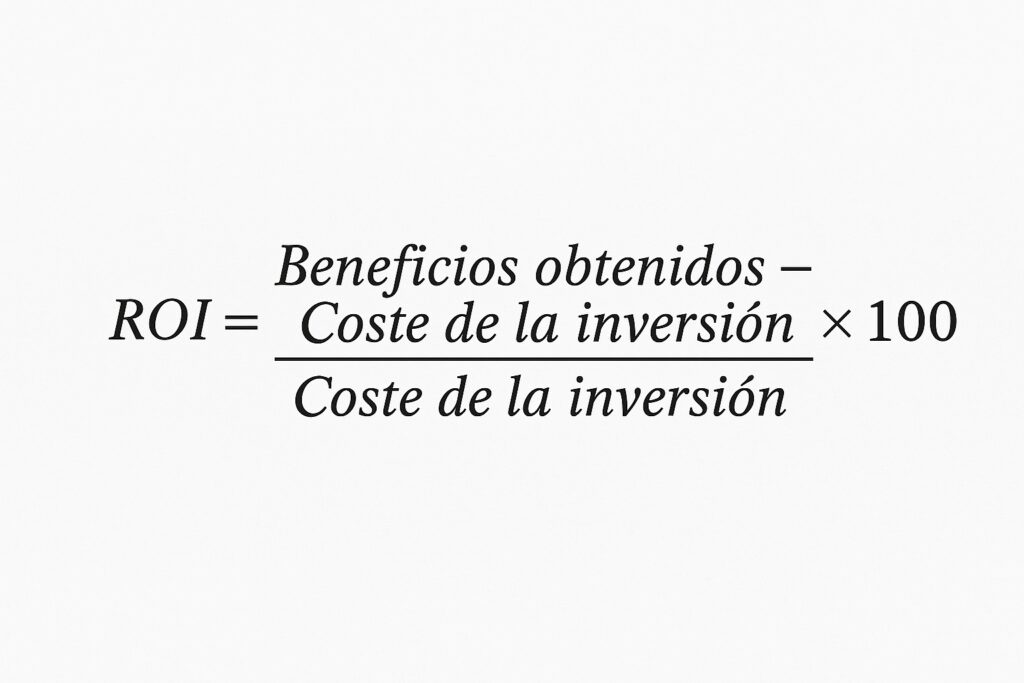
The equation produces a percentage showing whether the investment has been positive (ROI > 0), neutral (ROI = 0) or negative (ROI < 0). An ROI of 120%, for example, means that every euro invested has produced 1.20 euros of net benefit.
Applied to language training, what does each element cover?
1. Benefits obtained:
They take many forms, and not all are directly monetary. Some examples:
- Higher sales thanks to better communication with international customers.
- Savings on external translation or language editing.
- Greater efficiency in multinational teams.
- Better talent retention (lower turnover and the costs that go with it).
- Fewer administrative errors caused by language misunderstandings.
- Higher satisfaction among foreign customers (perceived value).
2. Costs of the investment:
These include both direct and indirect costs:
- Payments to teachers, academies or online platforms.
- Purchase of teaching materials.
- Working hours spent on training (the employee’s time).
- Logistical costs where training is delivered in person.
Why does it matter?
Many organisations face the dilemma of justifying training spend when results are not immediately visible. Measuring ROI brings clarity and objective evidence, allowing you to:
- Demonstrate the real value of language learning.
- Compare different programmes or providers.
- Optimise resources by identifying which training works best.
- Persuade senior management to continue or extend the investment.
ROI on language training is much more than a financial figure. It is a key tool for connecting talent development with business results and for ensuring that learning not only enriches employees but strategically drives the organisation forward.
Measurable benefits of language training
One key to calculating ROI is correctly identifying the impact indicators. Here is a visual list of the most relevant benefits, grouped by category:
| Category | Impact indicators |
|---|---|
| Productivity | – Shorter response times – Fewer misunderstandings – Faster international meetings |
| Sales and expansion | – Higher international sales – Better negotiation with foreign clients |
| Human resources | – Better talent retention – Improved workplace atmosphere – Greater employee commitment |
| Operating costs | – Less need for external translation – Fewer administrative or legal errors |
| Corporate image | – Positive global perception – Positioning as an inclusive, global company |
Quantifying these elements means establishing a baseline and tracking progress after the training.

How to measure ROI step by step
Calculating the return on investment in language training can look daunting, not least because it involves both tangible and intangible benefits. With a systematic approach, however, it is perfectly possible to assess the impact rigorously. Here is a process in five key steps that will let you do it effectively, aligning results with your organisation’s strategic goals.
1. Define clear objectives aligned with business strategy
Before starting any language programme, it is essential to set specific objectives that answer a real business need. The point is not simply to improve “the level of English”, but to establish how that learning will help solve a problem or seize a specific opportunity..
Examples of well-defined objectives:
- Cut errors in legal documentation written in English by 30% over the next quarter.
- Raise the satisfaction score among French-speaking clients from 7.2 to 8.5 out of 10 within six months.
- Increase sales in Portuguese-speaking markets by 20% through a better trained sales team.
These objectives should meet the SMART criteria (specific, measurable, achievable, relevant and time-bound) and be aligned with departmental or corporate goals.
2. Establish a baseline with pre-training data
Once the objectives are set, you need initial data (a baseline) so that you can compare and measure progress. This stage is critical and is often skipped. Recommended actions include:
- Running level tests with the participants.
- Using self-assessment surveys and assessments by managers or internal clients.
- Measuring key indicators: number of errors, response times, customer satisfaction, sales and so on.
- Documenting current spending on translation or external support that could be replaced by in-house skills.
The more complete the baseline, the more reliable the later impact analysis will be.
3. Calculate the real cost of the investment
The next step is to account for every cost associated with the training. Here it is important to consider both direct costs and indirect costs.:
| Type of cost | Examples |
|---|---|
| Direct costs | – Teachers’ fees – Platform or software licences – Teaching material |
| Indirect costs | – Working hours spent on training – Logistical costs (rooms, travel) – Supervision and administrative management of the programme |
A realistic estimate of these costs allows an accurate ROI calculation and shows whether the return justifies the money spent.
4. Measure the impact after the training
After a period of implementation, usually between three and twelve months, it is time to evaluate the results. At this stage you repeat the initial measurements and compare the data:
- Has the language level improved? (comparing tests before and after)
- Have communication errors fallen, or has efficiency improved?
- Have the specific objectives been met?
- What impact has the training had on business indicators?
For a fuller picture, you can combine quantitative and qualitative methods::
- Written and oral assessments
- Performance indicators (sales, satisfaction, retention)
- Interviews, focus groups or 360° surveys on how the change is perceived
5. Apply the ROI formula
With the data in hand, you can apply the standard ROI formula:
ROI formula:
ROI = (benefits obtained – cost of the investment) / cost of the investment × 100
Worked example:
- Estimated benefits (savings + additional sales + fewer errors): €20,000
- Total cost of the training: €8,000
Example:
Benefits obtained = €20,000
Cost of the investment = €8,000
ROI = (€20,000 − €8,000) / €8,000 × 100 = 150%
This means that every euro invested has produced €1.50 of net benefit. Alongside the figure, it is worth producing a short report with conclusions, lessons learned and recommendations for future initiatives.
Extra: consider the qualitative ROI
Quantitative ROI is the most direct and convincing argument for the finance function, but intangible benefits matter too. A better workplace atmosphere, greater employee confidence or a stronger employer brand are hard to express in euros, yet their organisational value is considerable. Include them in a separate section of the analysis so that they do not drop off the radar.
Recommended tools and practices
To make ROI measurement easier, the following tools and strategies come highly recommended:
Tools:
- LMS (learning management systems): for tracking attendance, progress and assessment.
- 360° surveys: to gauge changes in perception among teams and managers.
- Integrated KPIs: built into performance appraisal systems.
Key practices:
- Link training objectives to strategic business KPIs.
- Involve managers in tracking progress.
- Use real success stories as a reference (benchmarking).
Languages that drive results
Language training can no longer be seen purely as a wellbeing benefit or a CV extra. It is increasingly a strategic tool for business growth. Measuring its ROI is not only possible but necessary in order to align the investment with corporate objectives.
Some benefits, such as a better organisational culture or a more motivated team, are hard to put into figures, but their long-term effect is unquestionable. With the right tools and methods, companies can justify their investment and keep backing a better prepared, better connected and more competitive workforce.
In short, investing in languages is not just profitable; it is far-sighted. Measuring the real impact of that investment lets you make informed decisions and plan sustainable, well-founded global growth.
See also our articles on related topics:
- FUNDAE: language training for employees… free of charge!
- FUNDAE: free corporate language classes (FAQ)
- The five courses most often funded by FUNDAE (the Spanish state training foundation): why languages are key for your company in Valencia and online
Frequently asked questions (FAQ)
Yes, you can. Some benefits, such as motivation or a better workplace atmosphere, are intangible, but there are plenty of measurable indicators: fewer errors, higher sales, better customer service, savings on translation or efficiency gains. With well-defined objectives and a baseline, ROI can be calculated quite accurately.
It depends on the starting level, the language and how often training takes place. In corporate settings, though, many companies start to see significant changes in communication and performance after three to six months of structured training. The most visible results tend to appear when the language is tied to real tasks in the role.
Any company with international dealings: exporters, importers, global service firms, multilingual contact centres, technology, pharmaceuticals, tourism and logistics, among many others. Even local companies working with foreign suppliers or customers benefit enormously.
LMS platforms (learning management systems) such as Moodle, TalentLMS or Docebo let you integrate KPIs, track progress by competence, run automatic tests and generate reports. Tools such as Google Sheets or Power BI can also help you visualise the data simply and effectively.
It depends on the company’s internal resources. In-house training can be more cost-effective where qualified staff are available, while an external academy brings experience, methodology and structured follow-up. In both cases the key is to choose a provider or approach aligned with your strategic objectives and to measure results from the outset.