






Have you ever wondered what interpreters are writing down while they listen to long, complex speeches? Did you know that a consecutive interpreter can retain and reproduce up to 10 minutes of information using special systems of symbols and note-taking? Or that consecutive interpreting is the oldest mode of all, already in use in ancient Rome, where interpreters helped diplomats and rulers communicate with foreign envoys? In this article you will discover how this fascinating technique works, what sets it apart from other modes, and why it remains essential for multilingual communication in legal, diplomatic and business settings.
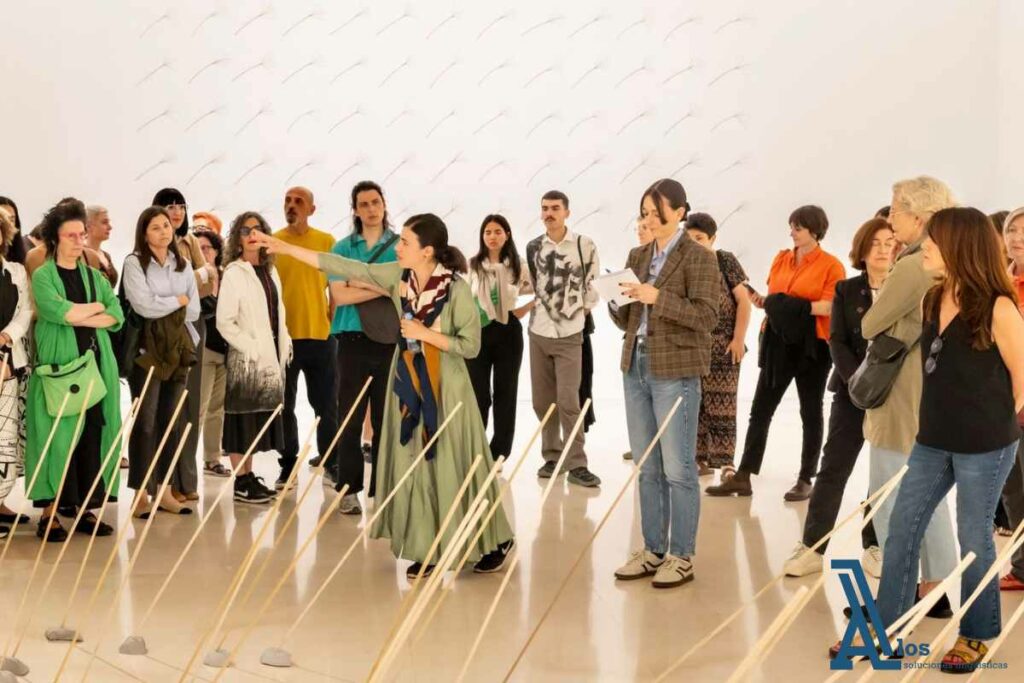
The essential differences between the main interpreting disciplines
Interpreting is key to communication across languages at international, legal, diplomatic and corporate events. Not all modes of interpreting are the same, however: the main ones are simultaneous interpreting, consecutive, liaison and chuchotage.
- Simultaneous interpreting: the interpreter translates in real time while the speaker is talking, supported by specialist technology such as booths and headsets. It is the preferred method at large congresses and in international organisations.
- Consecutive interpreting: the interpreter listens to a section of the speech, retains it or takes notes, and then reproduces it in the target language. It calls for memory and advanced note-taking techniques. It is ideal for meetings, negotiations, court hearings and small or medium-sized events.
- Liaison interpreting: a less formal mode, used in bilateral encounters or small meetings, where the interpreter facilitates communication in both directions.
- Chuchotage: simultaneous interpreting whispered in the ear, without equipment, for one or two listeners. Common on guided tours or in very small meetings.
In this article we focus on consecutive interpreting, a traditional technique that remains essential in many professional settings.
Not sure which interpreting service is right for your event? Ask us, with no obligation!
Our expert team will help you choose the right mode to guarantee effective, professional communication.
Historical origins and curious facts about consecutive interpreting
Consecutive interpreting has deep historical roots and has been an essential practice in multilingual settings since antiquity. Although there was no formal framework like today’s, the need for linguistic intermediaries was already recognised in a range of civilisations.
In ancient Rome
During the Pax Romana (27 BC – AD 180), the period of the Roman Empire’s greatest territorial expansion, linguistic diversity was considerable. To facilitate communication between Rome and the conquered peoples, use was made of the interpretes publici, officials charged with linguistic mediation in administrative and diplomatic settings. These interpreters were essential in conveying the central government’s decisions to the provinces and vice versa.
Figures such as Gaius Acilius, a senator and historian of the second century BC, also played key interpreting roles. Acilius acted as an interpreter in the Roman Senate during the embassy of Greek philosophers in 155 BC, facilitating communication between cultures and underlining the importance of interpreting in Roman diplomacy.
In the Middle Ages
With the fall of the Roman Empire and the political fragmentation of Europe, the need for interpreters persisted, especially in relations between the Christian and Islamic worlds. This gave rise to the figure of the trujamán (from the Arabic turgumān), an interpreter who facilitated communication in commercial and diplomatic dealings between different cultures.
These interpreters were essential in negotiations between Christian and Muslim kingdoms, acting as linguistic and cultural bridges. Although their training was not formalised, their role was crucial to the diplomacy and trade of the time.
The great innovation came at the Nuremberg Trials (1945-1946), where consecutive interpreting, though still in use, showed its limitations for proceedings that were so long and so multilingual. To speed up the pace and make it easier to handle several languages at once, simultaneous interpreting was developed and applied for the first time, thanks to the engineer Ralph Bunche and the technical system he devised so that interpreters could translate in real time from soundproof booths. Simultaneous interpreting was thus born as the answer to a practical need, while consecutive interpreting remained essential in settings with no access to technology or where a slower, more detailed rendering was required.
Types of interpreting and the key features of the consecutive mode
Unlike simultaneous interpreting, where the translation takes place while the speaker is talking, consecutive interpreting requires the interpreter to:
- Listen to complete sections of the speech, which may last between 2 and 10 minutes.
- Memorise or record the main ideas through structured note-taking.
- Reproduce the message in the target language clearly and faithfully to the original.
The key to consecutive interpreting lies in note-taking, which is not a word-for-word transcription but a system of symbols that captures ideas, logical relationships, emphasis and sequences in time.
Note-taking techniques in consecutive interpreting: principles and practical examples
Note-taking is the central skill in consecutive interpreting. Since the interpreter has to listen to speeches that may last several minutes, memorising everything word for word is impossible. Hence the use of a structured system of symbols, abbreviations and graphic outlines that capture the essential ideas, the logical relationships and the sequence of the speech.
According to the European Commission’s official document on note-taking in consecutive interpreting, these are the keys to effective note-taking:
- Capture main ideas, not literal words. The aim is to represent concepts, not to try to write down the whole speech.
- Use of symbols and abbreviations. Universal graphic symbols are used (arrows for cause and effect, lines for relationships, mathematical signs and so on) along with abbreviations to speed up writing.
- Structured organisation. Notes are organised hierarchically, with symbols representing the relationship between main and secondary ideas, which makes it easier to reconstruct the speech.
- A customisable system. Each interpreter adapts the system to their own style, context and language.
Learning and refining these techniques takes practice and knowledge of the specific discourse, but the basic structure helps improve memory and accuracy.
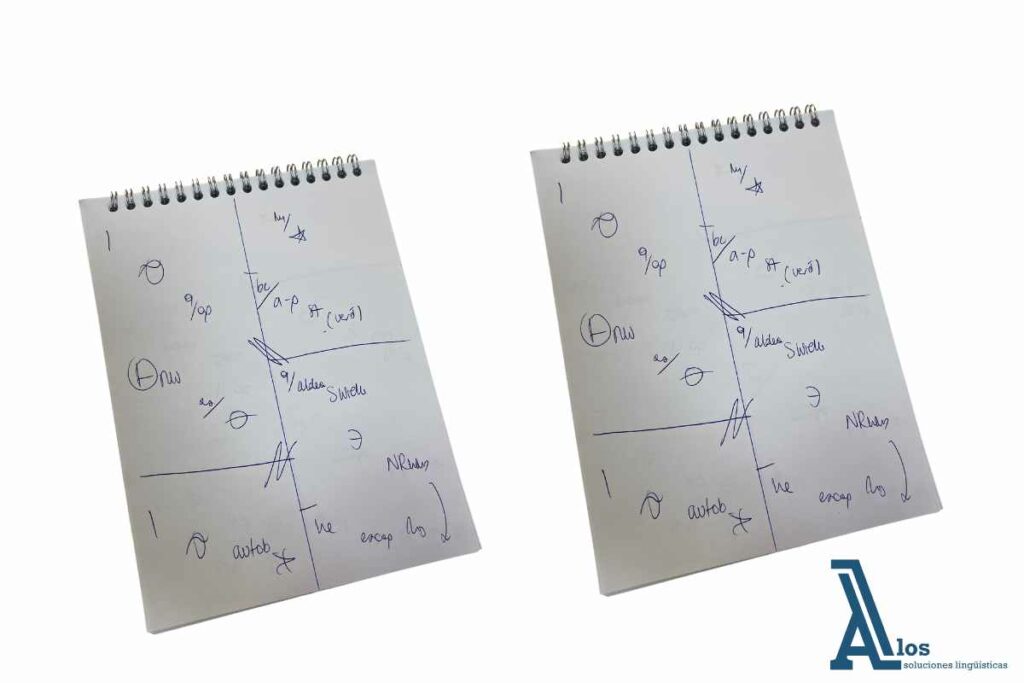
As a practical example for interpreters looking to enrich their symbols, there is the platform Symbol Tree Web, where professionals can look up and share a range of symbols used for note-taking. This resource supports the customisation and continuous development of graphic systems adapted to different settings and speeches. You can take a look here: Symbol Tree Web.
Settings and events where consecutive interpreting works best
Consecutive interpreting is the preferred mode in settings where:
- Precision and clarity are essential, as in court hearings and legal proceedings.
- A smooth but unhurried dialogue is sought, as in business negotiations or diplomatic meetings.
- At events with a small audience or in formal situations, such as interviews, press conferences and academic conferences.
Although slower than simultaneous interpreting, consecutive interpreting allows the interpreter to convey the complete message, capturing important details and nuances.
Curious facts and relevant data about consecutive interpreting
- Documented findings on consecutive interpreting
- A range of studies have shown that consecutive interpreting places heavy cognitive demands on the interpreter, who has to listen to, understand, store and reproduce long sections of speech while taking supporting notes. According to the study published in Frontiers in Psychology by Wang, Wang and Li (2018), specific training in this mode significantly improves working memory, which suggests a direct relationship between professional training and cognitive performance in real interpreting settings. See the study.
- Another relevant article, published in Frontiers in Psychology (Zhao et al., 2023), examined the impact of factors such as language competence, working memory and anxiety on the errors made during consecutive interpreting. The results show that the cognitive load of this mode is comparable to that of other highly demanding executive tasks. See the study.
- Although no specific documentation has been found setting out average note-taking speeds or the exact durations retained in consecutive interpreting, it is recognised that strategic graphic notation, taught at schools such as the European Commission’s DG SCIC, is essential for handling speeches lasting several minutes. See the European Commission’s official guide to note-taking
Consecutive interpreting: key to overcoming barriers
Consecutive interpreting is not just about translating words, but about capturing the speaker’s context, intention and emotion in order to convey them in another language faithfully and precisely. This mode combines linguistic skill, advanced note-taking techniques and memory to guarantee effective communication.
If you want to break down language barriers at events, court hearings or meetings, consecutive interpreting is your best ally in ensuring clarity, professionalism and a genuine connection.
Do you need professional interpreters for your events or legal proceedings? Get in touch today and guarantee impeccable communication in any language.
Overcome barriers, connect cultures and make your message come across loud and clear with expert consecutive interpreting!
(FAQ) Frequently asked questions about consecutive interpreting
Consecutive interpreting is a mode in which the interpreter listens to a section of the speech, takes notes or memorises the information, and then reproduces it in another language when the speaker pauses.
The length varies with the event, but the segments the interpreter renders usually last between 2 and 10 minutes, with pauses for the translation. In general, it is ideal for short to medium-length events such as meetings, interviews or court hearings.
Consecutive interpreting suits small or medium-sized events where precision and detail are the priority and where there is no technical equipment for simultaneous work. It is also preferred at court hearings, negotiations and presentations that call for clarity and pauses.
You need to weigh up the size of the audience, the length of the event, the type of content, the budget available and whether there is technical infrastructure (such as booths). Simultaneous interpreting is better for large congresses; consecutive interpreting for events with pauses.
They use a graphic symbol system made up of arrows, abbreviations and signs that represent ideas and logical relationships. This allows them to reconstruct long speeches without losing key details.
They do not write word for word, but note main ideas, names, figures, cause-and-effect relationships and sequences in time, using symbols and abbreviations to aid memorisation.
The price varies with the length, the specialisation required, the language and the location. On average it may range from 300 to 700 euros per day. It is important to request a tailored quote.
They need university training in interpreting, specialising in note-taking and memory techniques, as well as constant practice in real settings and an advanced command of at least two languages.
Yes: at hybrid events or ones with different formats, consecutive interpreting can be used for specific sessions or short contributions, and simultaneous interpreting for long speeches or panels.
You can hire professional consecutive interpreters through specialist agencies and certified companies that guarantee experience and quality. If you are looking for a reliable service for your events, court hearings or presentations, get in touch with us at AlosIdiomas.com and we will advise you on the best solution for your needs.