






International arbitration can decide a company’s future: multi-million contracts, complex commercial disputes or conflicts between shareholders. In that setting, interpreting is not simply linguistic support; it is central to everyone in the room understanding exactly what is happening.
When interpreting fails, the consequences can be serious: legal misunderstandings, loss of credibility or even decisions based on incorrect information. In this article we look at why a specialist interpreter in international arbitration hearings matters, what risks arise when it is not managed well and how to avoid common errors.
The interpreter’s role in an international arbitration hearing
An international arbitration involves lawyers, experts, witnesses and company representatives from different countries. Even where the proceedings have an official language, many contributions are made in other languages.

The interpreter is responsible for rendering every contribution accurately, while maintaining:
- Correct legal terminology
- Nuances of the speech
- Absolute neutrality
- Clarity in technical or financial contexts
It is not just a matter of translating words. The interpreter has to grasp the legal logic of the proceedings, the rhythm of cross-examination and the implications of each expression used.
A minimal difference between “contractual obligation” and “contractual expectation”, for example, can change the meaning of a statement.
What can go wrong when interpreting is inadequate
Many companies underestimate this point and appoint interpreters with no specific arbitration experience. The result can cause problems that go well beyond language.
Misunderstandings during testimony or cross-examination
In cross-examination, every word counts. If the interpreter simplifies an answer or loses a nuance, the testimony can appear contradictory or incomplete.
That can directly affect how the arbitral tribunal assesses it.
Loss of legal precision
International legal terminology has very specific equivalents between languages. A generalist interpreter may translate correctly from a linguistic point of view, but not from a legal one.
For example:
- “Damages” is not always equivalent to “daños”.
- “Liability” can imply a specific legal responsibility.
An error in these terms can alter the meaning of the argument being put.
Delays or interruptions in the hearing
Lack of preparation leads to constant pauses, unnecessary clarifications and reformulations. That slows the process and comes across as unprofessional.
In international arbitrations, where each hearing day can carry high costs, such delays are especially problematic.
The importance of preparing in advance
Professional arbitration interpreters do not walk into the room unprepared. Before the hearing they usually work with key case documentation.
The most common materials include:
- statements of claim and defence
- the contracts in dispute
- expert reports
- glossaries of sector-specific terminology
This preparatory work makes it possible to anticipate technical terminology and understand the context of the dispute.
At ALOS, for example, it is standard practice to prepare specific glossaries for each set of proceedings. That reduces risk and improves the flow of the interpreting.
If you would like a clearer picture of how this process is organised, on our blog we also explain how interpreting works in complex legal settings, a fundamental consideration where several languages and legal frameworks are involved.
Simultaneous versus consecutive interpreting in arbitration
Not every arbitration uses the same mode of interpreting. The choice depends on the format of the hearing and on the tribunal’s requirements.
Simultaneous interpreting
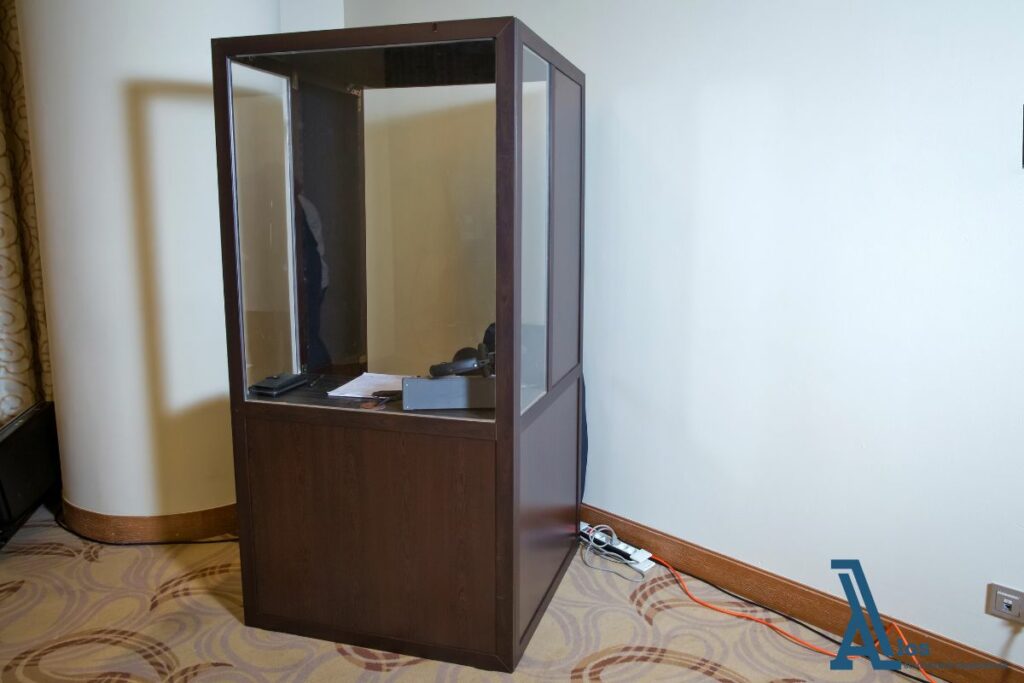
This is used where the hearing is conducted mainly in one language, but there are participants who need to follow it in another.
The interpreter works from a booth and delivers the rendering in real time.
Advantages:
- It does not interrupt the rhythm of the hearing
- It allows the proceedings to be followed naturally
- It is more efficient in long sessions
Consecutive interpreting
This is frequently used in cross-examination or witness testimony.
The interpreter listens to a segment of the contribution and then renders it in the other language.
Advantages:
- Greater precision in complex statements
- More control over questions and answers
Many arbitrations combine both methods depending on the stage of the proceedings.
What a good international arbitration interpreter needs
Linguistic experience is only part of the profile required. In proceedings of this kind, other factors carry particular weight.
Legal knowledge
The interpreter has to be familiar with concepts of commercial, contract and international law.
They do not need to be a lawyer, but they do need to understand how legal arguments are constructed.
Experience in high-pressure settings
Hearings can run for many hours and demand constant concentration.
The pace also tends to shift during cross-examination or exchanges between counsel.
Confidentiality and professional ethics
Arbitrations usually involve strategic company information: contracts, patents, financial figures or shareholder disputes.
Confidentiality is therefore an essential requirement.
Why many companies only realise when it is too late
In some cases, interpreting is treated as just another logistical detail in organising the hearing.
Yet when a language problem arises mid-proceedings, correcting it is difficult.
The arbitrators have already heard the interpreted version. If that version does not faithfully reflect the original contribution, the damage may be irreversible.
That is why more and more law firms and companies work with providers specialising in legal language services, particularly in international arbitration.
Frequently asked questions
It depends on the language of the proceedings and the parties involved. If any participant does not have a command of the official language of the arbitration, an interpreter is essential to guarantee that they can take part fully.
In simultaneous interpreting, at least two interpreters per language usually work together so they can alternate and maintain quality over long sessions. In consecutive interpreting a single interpreter may suffice, depending on duration.
Not necessarily. Even where a translator has legal knowledge, interpreting requires specific skills: memory, speed of processing, note-taking technique and experience of real-time oral communication.
International arbitration is a complex process in which every word counts. Interpreting is not just a question of language, but of legal precision, clarity and trust between the parties.
Working with specialist interpreters reduces risk, prevents misunderstandings and allows the proceedings to run with the professionalism that disputes of this kind demand.
If your company or firm is involved in international proceedings and needs specialist language support, ALOS offers professional interpreting services adapted to legal and arbitration settings. Contact our team to discuss your case and find the most suitable solution.