






When a company enters international arbitration proceedings, every word counts. In hearings involving lawyers, arbitrators, experts and executives from different countries, an interpreting error can change the meaning of a statement or weaken a legal argument.
In this article we look at how an interpreter works in an international arbitration hearing, what situations actually arise in proceedings of this kind and what companies should bear in mind when they need professional interpreting services in commercial disputes.
The interpreter’s role in an international arbitration
International arbitration is one of the most demanding settings an interpreter can work in. Unlike other business contexts, several critical factors converge here:
- specialist legal terminology
- complex technical or contractual documentation
- procedural pressure during the hearings
- statements given under cross-examination
The interpreter acts as an immediate linguistic bridge between the parties. Their role is not to explain or summarise, but to render precisely the content of every contribution: counsel’s questions, witnesses’ answers, interventions by the arbitral tribunal or statements by experts.
Most hearings use two modes:
Simultaneous interpreting
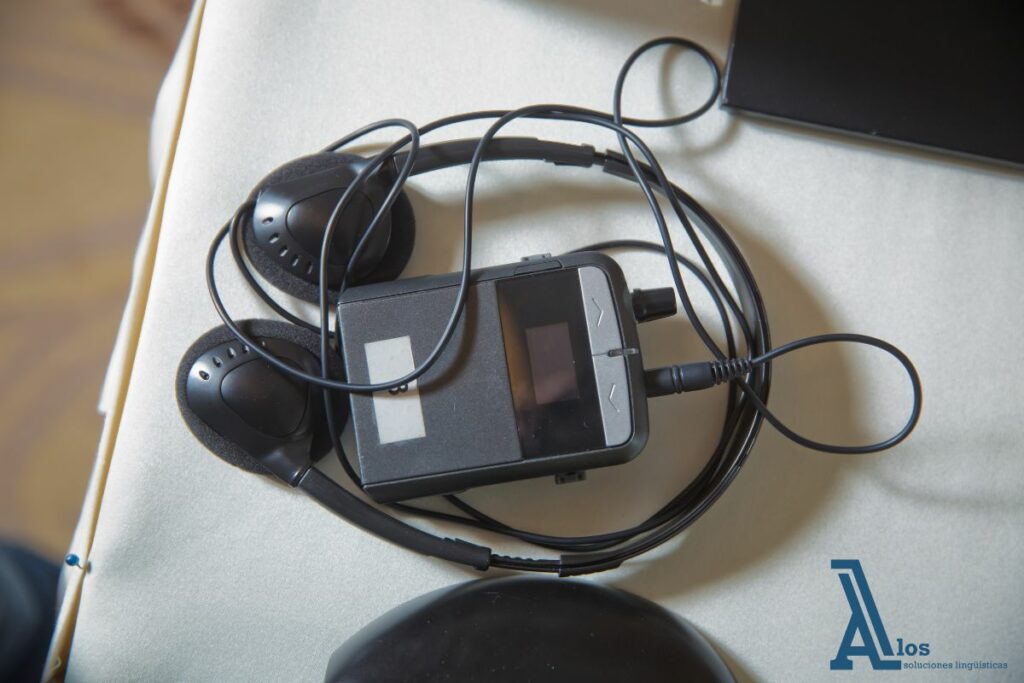
This is used where several attendees do not share a language. The interpreter works from a booth and delivers the content in real time through headsets.
Consecutive interpreting
This is used particularly in cross-examination or witness statements. The speaker talks for a few minutes and the interpreter then renders the complete message.
The choice depends on the format of the hearing and the number of participants.
Real situations where interpreting is critical
In international arbitration, interpreters face very specific scenarios. These are some of the most common in disputes between companies.
Testimony from corporate witnesses
Executives or project leads frequently appear as witnesses to explain strategic decisions, negotiations or contract performance.
A typical example:
a Spanish technology company gives evidence in an arbitration against an Asian supplier for breach of contract. The operations director has to explain the software implementation deadlines and the penalty clauses.
The interpreter has to render terms such as these precisely:
- contractual milestones
- deliverables
- late delivery penalties
- partial performance of the contract
A terminological error can change the meaning of the statement.
Cross-examination by counsel
Cross-examination in arbitration can be intense and strategic. Lawyers put carefully designed questions to expose contradictions or reinforce their arguments.
In this context, the interpreter has to:
- keep the same tone as the question
- preserve legal nuance
- avoid any subjective interpretation
For example, it is not the same to render:
- “did you confirm that decision in writing?”
as - “did you send an email confirming that decision?”
In legal proceedings, differences of that kind can have significant consequences.
Presentation of technical expert evidence
Many arbitrations involve specialist experts in engineering, finance, energy or construction.
In a dispute over an industrial plant, for instance, the expert may explain:
- budget overruns
- construction delays
- design faults
- calculations of financial loss
The interpreter has to understand the technical context in order to convey it correctly to the arbitral tribunal.
This is where preparation in advance becomes essential.
Preparing in advance: the key to reliable interpreting
In an arbitration hearing, the interpreter’s work begins long before the hearing itself.
Professional teams request documentation in advance, such as:
- the parties’ memorials
- relevant contracts
- expert reports
- case chronologies
- terminology glossaries
This makes it possible to prepare the terminology specific to the case.
In international arbitrations it is also usually necessary to coordinate with:
- legal teams in different countries
- other interpreters working in the booth
- sound engineers and interpreting systems technicians
Proper preparation reduces risk during the sessions.
If you would like to understand better how interpreters prepare for complex professional settings, you can read more in this article on how interpreters prepare professionally for specialist settings on the ALOS blog.
What companies should consider when hiring interpreters for arbitration
Not every interpreter is equipped for demanding legal settings. Companies involved in international arbitration tend to look at three key aspects.

Experience in legal settings
Legal interpreting requires familiarity with procedural concepts, cross-examination strategy and contractual documentation.
An interpreter with experience in conferences or corporate meetings is not always prepared for an arbitration hearing.
Command of the sector’s terminology
Many arbitrations revolve around technical sectors such as:
- energy
- construction
- technology
- pharmaceuticals
- transport
The interpreter has to be able to understand the content in order to convey it correctly.
Working alongside law firms and arbitral tribunals
Arbitration proceedings usually involve coordination with:
- international law firms
- arbitral institutions
- tribunal secretariats
- technical interpreting teams
A specialist language provider makes this coordination easier and reduces incidents during the hearing.
Current trends in international arbitration and language services
More and more arbitrations are conducted in hybrid or remote formats, especially where the parties are on different continents.
This brings new challenges for interpreting:
- videoconferencing platforms
- multichannel audio management
- coordination between interpreters in different locations
- adapting the dynamics of cross-examination
Companies involved in proceedings of this kind tend to turn to providers with specific experience in interpreting for international hearings.
Frequently asked questions
Two modes are normally used: simultaneous interpreting for general contributions and consecutive interpreting for cross-examination or witness statements.
It is not always compulsory, but it is strongly advisable. Interpreting in arbitration requires familiarity with legal terminology, procedure and the dynamics of cross-examination.
In simultaneous interpreting there are usually two interpreters per booth, alternating every 20 to 30 minutes because of the cognitive load of the work.
Yes, and in fact it is essential. They normally receive case documentation in order to prepare terminology, proper names, chronologies and technical concepts.
International arbitrations bring together legal teams, executives and experts from different countries. In that context, professional interpreting is not just linguistic support: it is a key element in allowing the process to run with clarity and precision.
Working with interpreters who specialise in legal settings prevents misunderstandings, guarantees the fidelity of statements and makes communication between all parties easier.
If your company is involved in international arbitration or needs interpreting services in complex legal settings, at ALOS we can help with language solutions adapted to each set of proceedings.
You can contact our team for advice on professional interpreting services or specialist training for international settings.