





Many companies invest in language training for months without reaching the level of fluency their teams actually need. International meetings, negotiations and presentations remain a challenge.
Against that background, corporate language immersion courses have become a highly effective way to accelerate learning. In this article we look at how they work, when they make most sense and how to fit them into a corporate language training plan.
What corporate language immersion courses are
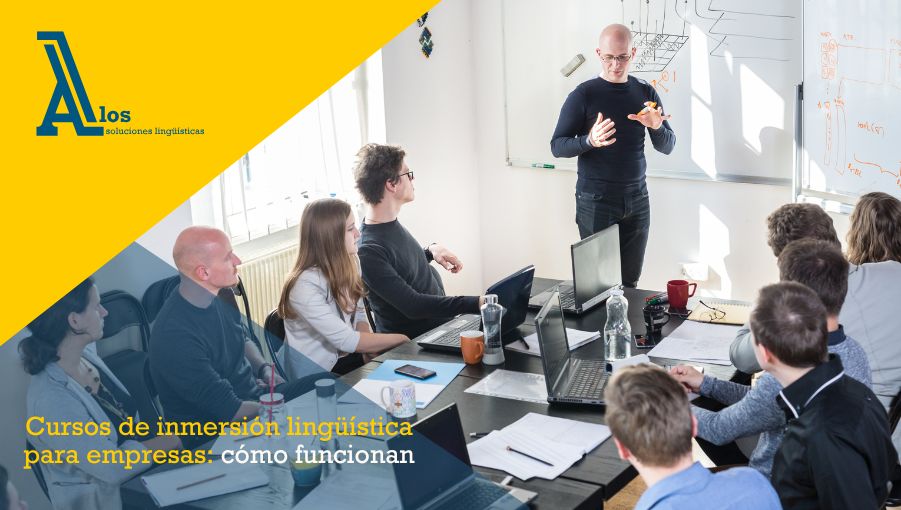
A course in corporate language immersion is intensive training in which participants use the target language throughout the whole training day.
The key is the environment: for several days or weeks, the language becomes the only means of communication within the training. That creates far more exposure than a traditional course of a few hours a week.
In a corporate context, these programmes usually focus on real work situations, such as:
- meetings with clients or suppliers
- project presentations
- commercial negotiation
- internal communication with international teams
A sales team that needs to improve its English in order to close international deals, for example, can take part in an intensive programme over several days focused exclusively on selling and negotiating situations.
When language immersion is worth the investment
Not every company needs this kind of training. Language immersion tends to be particularly useful when certain circumstances apply.
The need to improve communication quickly
When a company opens up a market in another country or starts working with international clients, the team needs to become comfortable fast.
An intensive course concentrates many hours of practice into a few days, which accelerates both confidence and communication skills.
In many international expansion processes, the language ends up becoming an operational obstacle. This happens frequently when companies try to open new markets without first preparing their teams to communicate in another language, as explained in the article My company wants to go international but language is holding us back.
Preparation for international projects
Before launching an international project or relocating employees to another office, companies commonly organise language immersion programmes.
These courses help prepare participants for the real situations they are about to face at work.
Teams that already have a basis in the language
Immersion works particularly well when participants are already at intermediate level. In those cases the main aim is not to learn grammar from scratch but to gain fluency and confidence when speaking.
How a corporate language immersion course is organised
Although every company can adapt the format to its needs, most programmes share a similar structure.

Intensive training over several days
These are normally programmes of between three and five full days, though they can also run over one or two weeks.
The sessions include:
- classes focused on professional communication
- role-played meetings or presentations
- work in small groups
- constant feedback from the trainers
The aim is for participants to use the language continuously.
For teams travelling to immersion programmes outside their own city or country, a cabin suitcase is an investment that pays for itself on the very first business trip.
A real professional context
Unlike other courses, the training is adapted to the company’s working environment.
For example:
- sales departments work on negotiation and selling
- technical profiles practise explaining projects
- directors work on leadership and strategic communication
This means the training can be applied immediately.
Small groups
For immersion to work, groups are usually small. That way each participant gets plenty of opportunities to speak and be corrected.
This kind of dynamic creates a far more active environment than a traditional class.
Real benefits for the company
When it is well designed, language immersion offers clear advantages for organisations.
Rapid improvement in fluency
The main benefit is the number of practice hours concentrated into a short period. Participants speak far more than on a weekly course.
That usually translates into more confidence when communicating.
More confidence in professional situations
Many people have theoretical knowledge of the language but struggle to apply it in meetings or calls.
Immersion lets them practise precisely those situations.
A more motivated team
Intensive programmes tend to be highly dynamic. Participants see rapid progress, which increases their motivation to keep improving.
What is more, when the training is built around real work challenges, the learning feels far more relevant.

How to fit immersion into a language training plan
Powerful as it is, language immersion works best as part of a broader training strategy.
Many companies, for example, combine:
- regular training throughout the year
- professional conversation sessions
- occasional intensive immersion programmes
In this way the team develops the language continuously and uses the intensive programmes to give their progress a boost.
It is also important to review periodically whether the training is producing real results. When participants do not apply what they have learned in meetings, emails or calls, it is a sign that the approach needs adjusting, something examined in depth in the article
When language training stops working.
If you would like other strategies for building language skills in a corporate setting, you can also read the specialist content on the ALOS blog about corporate language training:
https://alosidiomas.com/blog/
Frequently asked questions
The most common format is a programme of between three and five intensive days, although longer formats can be designed depending on the company’s objectives and the participants’ level.
Yes. To get the most out of immersion, at least an intermediate level is normally recommended. Otherwise it can be difficult to keep up with the pace of the training.
Yes. In corporate programmes, the content is designed around the participants’ professional context: meetings, negotiation, presentations or technical communication.
Well-designed Corporate language immersion courses are a highly effective tool when the aim is to improve communication in another language quickly and practically.
By concentrating many hours of real language use into a few days and working with specific professional situations, teams can gain fluency and confidence in a short time.
If your company needs to improve its teams’ international communication, ALOS designs language training programmes adapted to each organisation. Get in touch with our team for advice and to plan tailored training.