





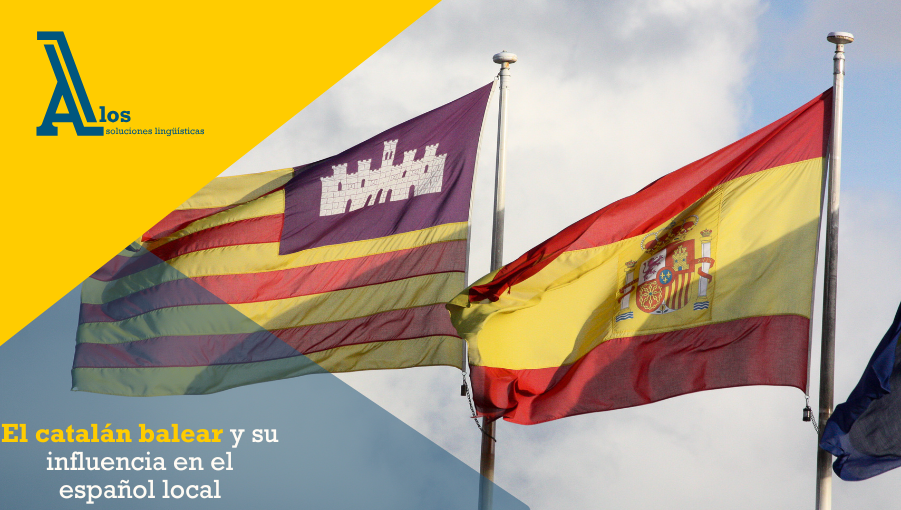
In the Balearic archipelago, language and identity have been intertwined for centuries. Balearic Catalan, also known simply as Balearic, covers three main varieties: Mallorcan, Menorcan and eivissenc (Ibizan), each with its own phonetic, morphological and lexical features. These dialect forms have survived thanks to oral use, transmission within the family and a strong sense of local identity. In a setting where Spanish is also present, the relationship between the two languages has produced mutual influence, which is particularly visible in the Spanish spoken by islanders.
According to the thesis by Simone Huurman (2014), the use of both languages varies by domain and by generation, with an everyday Spanish peppered with Catalan forms. For example, saying “fer feina” instead of “trabajar” (to work) or “anar a peu” instead of “ir a pie” (to go on foot) has become common practice among bilingual speakers.
Characteristic phonetic traits, such as a weakened final /r/ or the use of the salty article (“sa casa” for “the house”), have also filtered into Balearic Spanish, especially in informal settings. This linguistic overlap is nothing new: it is the result of centuries of coexistence on islands with strong social and cultural cohesion.
Features of Balearic Catalan
Balearic Catalan has a set of distinctive traits that set it apart both from Spanish and from other varieties of Catalan. Phonetically, it stands out for its open vowels and a clear distinction between sounds such as /o/ and /u/, which other varieties may neutralise. The weakening of final consonants and a more musical intonation are also typical, and both carry over into the Spanish spoken by islanders.
One of the most emblematic features of Balearic Catalan is the salty article: “es”, “sa”, “ses” instead of the standard articles “el”, “la”, “els” and “les”. This trait is seen as a deeply rooted marker of cultural and linguistic identity, especially in Mallorca and Ibiza. For instance, instead of “el coche” (the car) people say “es cotxe”.
As for vocabulary, Balearic preserves archaic words from old Catalan that have been lost in central Catalan. It has also taken in loanwords from Spanish, Italian and Arabic, a reflection of the islands’ history. Common examples include “bona nit” (good night), “cossi” (bucket) and “berenar” (to have an afternoon snack).
Would you like to speak Balearic Catalan with confidence, or do you need your documents translated accurately? Request your free quote now and find out how we can help you.
Phonetic, morphosyntactic and lexical influences on local Spanish
The phonetics of Balearic Catalan, more conservative in some respects than other varieties of Catalan, have left their mark on local Spanish. This is especially noticeable in rising intonation, the voicing of sibilants and the open realisation of vowels. The loss or weakening of intervocalic /d/ is also frequent, and some speakers have carried it over into Spanish (for example, “cansao” instead of “cansado”, meaning tired), adapting to Balearic sound patterns. The result is a variety of Spanish that is grammatically correct yet sounds distinctly different from mainland Spanish.
At the morphosyntactic level, there are calques from Catalan, such as “hacer una foto” (from Catalan “fer una foto”) instead of “tomar una foto” for taking a photo. Structures such as “tener calor/frío” rather than “sentir calor/frío” for feeling hot or cold have also been documented and are very frequent among speakers of Balearic origin (Liana Hotarova, 2021). Word order in some sentences may also show Catalan influence, such as the emphatic placement of the subject at the end: “Lo ha hecho ella” (she did it) may appear as “Ha hecho ella lo”.
The lexicon reveals this influence too: words such as “panxa” (belly), “senalla” (basket), “al·lot” (boy), “xereca” (shell) or “cati” (girl) appear in Spanish conversation untranslated. This enrichment of vocabulary is common in family and community settings, and younger generations often absorb these words as a natural part of their speech. The same positive interference shows in the adoption of Catalan diminutives such as “-et” or “-eta” instead of “-ito” or “-ita” (for example, “tasseta” instead of “tacita”, a little cup).
Valuing linguistic diversity
Balearic Catalan is a linguistic treasure not only for its internal variety, but also for its influence on local Spanish, which it makes richer and more expressive. This constant interaction creates a linguistic identity that is unique within the Spanish-speaking world, where the coexistence of two languages has produced a singular and valuable way of communicating.
Preserving that coexistence calls for mutual respect and knowledge. Promoting the learning of co-official languages, particularly from a dialectal perspective, strengthens community ties and prevents misunderstandings that, as we have seen, can be trivial and yet go viral. It also brings visibility to cultural and expressive forms of the islands that often go unnoticed from a purely mainland perspective.
In an increasingly globalised world, where linguistic homogenisation is a constant threat, valuing and promoting dialect varieties such as Balearic Catalan is also a form of cultural resistance. Encouraging its study, use and dissemination benefits not only its speakers but enriches everyone’s intangible heritage.
You can carry on exploring related topics on our blog:
- Is it possible to be 100% bilingual?
- The 10 hardest languages for Spanish speakers: challenges and benefits
- Las Fallas de Valencia: history, culture and language
Frequently asked questions (FAQs)
It is a variety of Catalan spoken in the Balearic Islands that includes three subvarieties: Mallorcan, Menorcan and eivissenc. Each has its own phonetic, lexical and grammatical features that set it apart from both standard Catalan and Spanish.
? Through loanwords, syntactic calques and phonetic traits that work their way into the everyday speech of bilingual speakers. Examples include expressions such as “fer feina”, words such as “al·lot” and intonation patterns typical of Balearic.
Because many of those words are part of speakers’ everyday repertoire, and they use both languages routinely. This constant contact makes it easy for terms to transfer and be adopted.
We offer specialist Balearic Catalan courses, along with resources on our blog exploring the linguistic, cultural and historical aspects of this dialect variety.