






The pre-eminence of English in global marketing

Have you ever wondered why there are so many English abbreviations in marketing? In the vast, fast-moving world of marketing, English stands as the lingua franca running through strategies, communications and documents worldwide. This pre-eminence is no accident; it stems from historical, economic and cultural factors that have made English the dominant language of business and, by extension, of marketing.
The world’s leading advertising and marketing groups, such as WPP, Publicis and Omnicom, have made English their corporate language, making it easier to coordinate operations across many countries and to manage multicultural teams, according to the sources consulted. WPP, for example, headquartered in the United Kingdom, is the largest marketing corporation in the world in terms of revenue, clients and staff, operating in more than 100 countries and employing some 130,000 people.
English also dominates the digital ecosystem, being the main language on most social media platforms, websites and online content. That dominance translates into a wider audience and greater reach for marketing campaigns, especially in key markets such as the United States and Europe, where consumption of digital content in English is predominant.
Acronyms and abbreviations are everywhere in English-language marketing

Marketing, as a constantly evolving discipline, has built up a vocabulary of its own, packed with acronyms and abbreviations intended to simplify and speed up communication between professionals. The phenomenon is particularly marked in the English-speaking world, where economy of language and the rapid transmission of ideas are highly valued.
Using acronyms such as KPI (Key Performance Indicator) or ROI (Return on Investment) allows marketing professionals to refer to complex concepts concisely and efficiently, making analysis easier in fast-moving workplaces. In a globalised context, these standardised English abbreviations also ensure consistent communication and prevent misunderstandings between teams in different regions.
A list of common abbreviations in English-language marketing
Below is a list of English acronyms and abbreviations used in marketing, together with their meaning and examples of use:
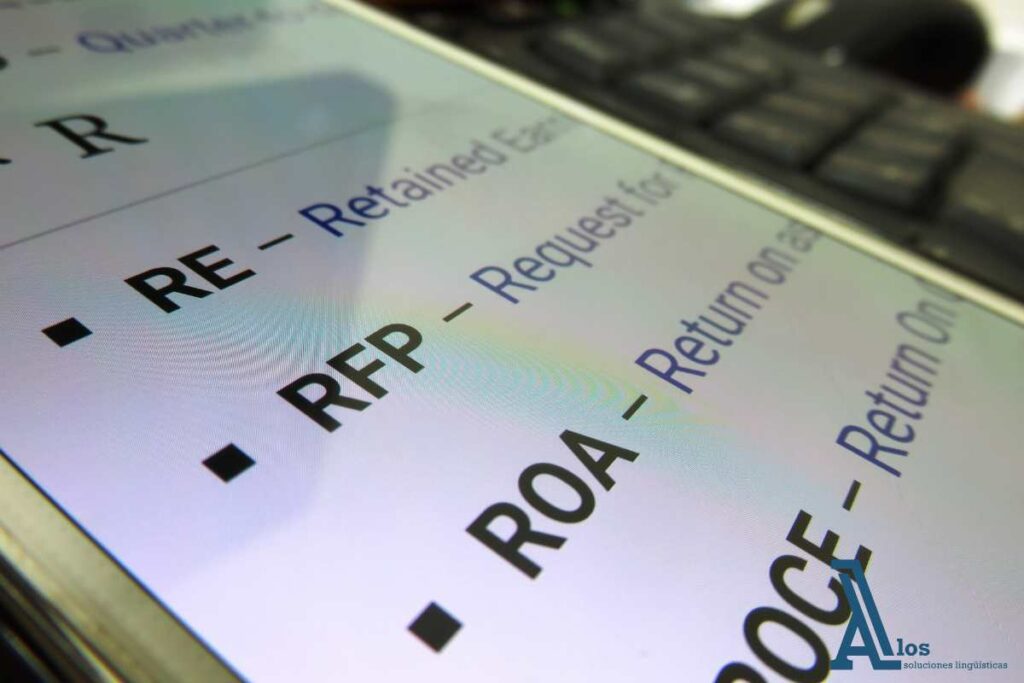
- API (Application Programming Interface)): a programming interface that allows different software systems to interact.
- “Our new marketing tool integrates with Facebook’s API for better ad targeting.”
- “Our new marketing tool works with Facebook’s API to target ads more accurately.”
- B2B (Business to Business)): a business model in which transactions take place between companies.
- “Our B2B marketing strategy focuses on LinkedIn advertising.”
- “Our B2B marketing strategy centres on advertising on LinkedIn.”
- B2C (Business to Consumer)): a business model in which companies sell directly to the end consumer.
- “B2C companies rely heavily on social media for customer engagement.”
- “B2C companies depend heavily on social media to engage with customers.”
- BR (Bounce Rate)): the percentage of visitors who leave a website after viewing only one page.
- “Our website’s bounce rate dropped after optimizing the landing page.”
- “Our website’s bounce rate fell after we optimised the landing page.”
- CMS (Content Management System)): a content management system that makes creating and administering digital content easier.
- “WordPress is the most popular CMS for blogging.”
- “WordPress is the most popular CMS for blogs.”
- CPA (Cost Per Action)): an advertising model in which the advertiser pays for a specific action taken by the user, such as a purchase or a sign-up.
- “We optimized our campaign to lower the CPA.”
- “We optimised our campaign to bring the CPA down.”
- CPC (Cost Per Click)): an advertising model in which the advertiser pays for every click the advert receives.
- “Google Ads works on a CPC basis.”
- “Google Ads runs on a CPC model.”
- CPL (Cost Per Lead)): the cost of each prospect or potential customer generated.
- “We measure our campaign’s success based on CPL.”
- “We measure the success of our campaign by CPL.”
- CPM (Cost Per Mille)): the cost per thousand impressions of an advert.
- “CPM is commonly used for brand awareness campaigns.”
- “CPM is commonly used in brand awareness campaigns.”
- KPI (Key Performance Indicator)): a key performance indicator that measures the success of a specific activity or strategy.
- “Increasing engagement is our main KPI this quarter.”
- “Increasing engagement is our main KPI this quarter.”
- PPC (Pay Per Click)): an advertising model in which the advertiser pays for every click the advert receives.
- “Our PPC strategy includes Facebook and Google Ads.”
- “Our PPC strategy takes in Facebook and Google Ads.”
- ROI (Return On Investment)): return on investment, which measures the profitability of an investment or campaign.
- “We evaluate our ROI monthly.”
- “We review our ROI every month.”
- SEM (Search Engine Marketing)): search engine marketing, which covers strategies for increasing visibility on results pages.
- “We are investing in SEM to drive traffic.”
- “We are investing in SEM to increase traffic.”
- SMM (Social Media Marketing)): social media marketing, which uses social platforms to promote products or services.
- “SMM is essential for brand awareness.”
- “SMM is essential for brand awareness.”
- UX (User Experience)): user experience, which assesses usability and satisfaction when interacting with a product or service.
- “Good UX design improves customer retention.”
- “Good UX design improves customer retention.”
- WOM (Word Of Mouth)): word-of-mouth marketing, based on recommendations from satisfied customers.
- “WOM is a powerful organic marketing tool.”
- “WOM is a powerful organic marketing tool.”
Transcreation: beyond literal translation

In international marketing, simply translating content may not be enough to capture the essence and impact of a message in different cultures. This is where transcreationcomes in: a process that goes beyond literal translation and creatively adapts a message so that it resonates effectively in the target market.
Transcreation involves a deep understanding of the cultural subtleties, emotions and local references of the target audience. A slogan that works in an English-speaking country, for example, may not have the same effect in a Spanish-speaking culture if it is translated literally. In such cases, transcreation makes it possible to change the structure and tone of the message without losing its original intention.
A telling example of transcreation is the adaptation of Pepsi’s campaign in China. Its original English slogan “Come alive with the Pepsi Generation” was translated literally as “Pepsi brings your ancestors back from the dead”, which caused confusion and had a negative impact in Chinese culture. To solve the problem, transcreation was applied and the message was reworked with cultural sensitivity in mind, producing an effective adaptation for the market.
In digital and advertising marketing, transcreation is used in adverts, branding campaigns, slogans and multimedia content to ensure that the message is not only understood, but also produces the same emotional and commercial response in every language and culture.
If your company wants to take its message beyond language barriers with a strategy that respects the brand’s identity and resonates with the target audience, we offer specialist transcreation and marketing translation services. Do get in touch for more information on how we can help you expand your global presence.
If I’m selling to you, I speak your language. If I’m buying, dann müssen Sie Deutsch sprechen.
— Willy Brandt
A translation agency in Valencia specialising in marketing
At Alos, our translation agency in Valencia, we have a team of professionals specialising in marketing translation and transcreation, offering high-quality services to companies looking to extend their global impact. Translating advertising and commercial content is key to connecting with the target audience in each market, ensuring that messages are not only understood but also resonate culturally and drive conversion. If you need a creative, adapted translation that preserves the essence of your brand in any language, get in touch and we will help you drive your international marketing strategy forward.
Professional translation services
Why English and its abbreviations matter in global marketing: the key to communication and business success
Understanding and using English abbreviations confidently, whether in digital marketing, data analysis or the design of multichannel campaigns, can make the difference between a message that connects… and one that gets lost in translation.
If your company wants to improve its teams’ language skills in this area, at Alos Idiomas we offer specialist training in corporate and marketing English. Our courses are designed around the LSP (Languages for Specific Purposes)approach, which allows us to tailor every programme to the real needs of the workplace, whether that means improving sales presentations, understanding KPIs or writing SEO-optimised content.
Mastering the language of marketing means speaking the language of success
In an environment as globalised as today’s, good ideas are not enough: you also need to know how to communicate them in the language the industry speaks. Familiarity with the key abbreviations and terms of marketing in English lets you fit into international teams, read reports without missing a detail and move confidently through meetings, briefings and digital campaigns.
And if you work professionally in marketing, communication or business strategy, investing in specific training in English can mark a turning point in your career.
At Alos Idiomaswe help you achieve exactly that with tailor-made courses designed for professionals and companies like yours.
📩 Would you like to know how to get started?
Discover our approach to language training for specific purposes or get in touch with us and we will advise you with no obligation.
🧠 Boost your professional English with Alos
Do you work in marketing, communication or sales? Master the English of your sector with a course tailored to you or your team.
((FAQ) Frequently asked questions about English in the world of marketing
Because it makes global communication easier, it is the language of business and it dominates the digital ecosystem.
Some of the most common are SEO, PPC, ROI, KPI and CTA.
It is the creative adaptation of a message so that it fits a specific culture and market without losing its original impact.
It is the creative adaptation of a message so that it fits a specific culture and market without losing its original impact.
While traditional translation focuses on conveying the literal meaning of a text, transcreation adapts the message with cultural, emotional and commercial factors in mind, so that it works effectively in another language and context.
You can look at our courses for specific purposes at our language academy in Valencia, Alos Idiomas, available both online and in person.