





Did you know that every time you say “ojalá” you are invoking an Arabic phrase with more than a thousand years of history? The Spanish language is a mosaic of historical influences, and one of the deepest is undoubtedly Arabic. During almost eight centuries of Muslim presence on the Iberian Peninsula (711-1492), continuous contact between Arab and Christian communities produced a profound cultural and linguistic symbiosis. The result: more than 4,000 words of Arabic origin in Spanish vocabulary, many of them still in use today.
According to the Royal Spanish Academy and etymological research, 8% of Spanish vocabulary comes from Arabic. Not only everyday words — such as “aceituna” (olive) or “almohada” (pillow) — but also place names and agricultural, scientific and architectural terms. This influence is not evenly spread: in the south and east of Spain its roots run far deeper.
One curious detail is how some words have changed meaning or been adapted phonetically into Spanish. The word “asesino” (assassin), for example, comes from the Arabic “ḥaššāšīn”, which referred to a sect that consumed hashish before committing murders.
The coexistence that created a hybrid language
During the Middle Ages, the Iberian Peninsula was a melting pot of cultures. Christians, Muslims and Jews shared territories, knowledge and ways of life, especially in the taifa kingdoms and in what became known as “the Spain of the three cultures”. This contact fostered not only scientific and cultural advances but also a linguistic symbiosis. Arabic, the language of culture and administration in al-Andalus, became interwoven with the expanding Romance vernaculars, giving rise to a hybrid vocabulary in which farming, daily life and administration were all coloured by Arabic roots. Many of these words were adopted without translation, shaping the Spanish spoken today.
Words of Arabic origin in Spanish and where they are used
Over centuries of coexistence between Christian, Jewish and Muslim cultures on the Iberian Peninsula, Arabic left an indelible mark on Spanish vocabulary. Some words feel so familiar that their exotic origin is easily forgotten. The table below sets out a selection of terms used every day, alongside their original Arabic form and the regions where they are most common or most significant. It is also a journey through the history, landscape and customs that have shaped the Spanish language.
| Spanish word | Original Arabic word | Meaning | Regions where it is most used |
|---|---|---|---|
| Aceituna | الزيت (az-zayt) | Fruit of the olive tree | Andalusia, Extremadura, Castilla-La Mancha |
| Albahaca | الحبق (al-ḥabaq) | Aromatic plant (basil) | Valencian Community, Andalusia, Murcia |
| Ajedrez | الشطرنج (aš-šaṭranj) | Strategy game (chess) | Nationwide, Aragon, Castile |
| Acequia | الساقية (as-sāqiya) | Irrigation channel | Valencian Community, Murcia, Aragon |
| Albañil | البنّاء (al-bannāʼ) | Building worker, bricklayer | All of Spain |
| Alhaja | الحاجة (al-ḥāǧa) | Jewel, valuable object | Andalusia, Castilla-La Mancha |
| Ojalá | إن شاء الله (in shā’ Allāh) | Expression of hope | All of Spain |
| Almohada | المخدة (al-mujádda) | Object used to rest the head (pillow) | All of Spain |
| Azúcar | السكر (as-sukkar) | Sweet substance (sugar) | All of Spain |
| Jirafa | الزرافة (az-zarāfa) | Mammal (giraffe) | All of Spain |
| Alcázar | القصر (al-qaṣr) | Castle, fortress | Castilla-La Mancha, Madrid, Andalusia |
| Guadalquivir | الوادي الكبير (al-wādī al-kabīr) | Andalusian river | Andalusia |
| Noria | النّاعورة (an-nāʻūra) | Water-raising wheel | Valencian Community, Aragon |
| Almazara | المعصرة (al-maʻṣara) | Olive-oil mill | Andalusia, Extremadura, Murcia |
| Azulejo | الزليج (az-zulayj) | Decorative tile | Valencian Community, Andalusia |
| Alquería | القرية (al-qarya) | Country house, farmstead | Valencian Community, Murcia |
| Rabal | ربض (rabaḍ) | Outlying district | Catalonia, Valencian Community |
| Jabalí | جبل (ǧabal) | Wild animal / wild boar | Castile and León, Galicia, Navarre |
| Zoco | سوق (sūq) | Traditional market | Andalusia, Ceuta |
| Acelga | السلق (as-salaq) | Leafy vegetable (chard) | Navarre, La Rioja |
| Tahona | الطاحونة (aṭ-ṭāḥūna) | Traditional bakery | Castilla-La Mancha, Andalusia |
| Jarabe | شراب (šarāb) | Medicinal solution (syrup) | All of Spain |
| Alcalde | القاضي (al-qāḍī) | Public official (mayor) | All of Spain |
| Guadiana | وادي يانا (wādī Yāna) | River (place name) | Extremadura, Castilla-La Mancha |
| Alfiler | دبوس (dabbūs) / الإبرة (al-ibra) | Small pin | All of Spain |
| Zanahoria | السُّنَّارِيَّة (sunnāriyya) | Edible root vegetable (carrot) | All of Spain |
| Ahorro | حرز (ḥirz) o حَرَّ (ḥarra) | The act of saving money | All of Spain |
| Atún | التونة (aṭ-ṭūna) | Edible fish (tuna) | Andalusia, Murcia, Canary Islands |
| Barrio | ربض (rabaḍ) / برية (barriyya) | Urban district | Nationwide |
| Ajedrea | السعتر (as-saʻtar) | Aromatic plant (savory) | Aragon, Catalonia |
| Alhóndiga | الفنْدَق (al-funḍuq) | Grain store | Castile and León, Andalusia |
| Halal | حلال (ḥalāl) | Religiously permitted | Ceuta, Melilla |
| Haram | حرام (ḥarām) | Religiously forbidden | Ceuta, Melilla |
| Guadarrama | وادي الرمال (wādī ar-raml) | Place name: river of sand | Madrid, Castile and León |
| Alquimia | الكيمياء (al-kīmiyāʼ) | Early proto-scientific practice (alchemy) | Nationwide |
| Cifra | صفر (ṣifr) | Number, mathematical sign | All of Spain |
| Alcohol | الكحل (al-kuḥl) | Chemical substance | All of Spain |
| Berenjena | الباذنجان (al-bādhinjān) | Vegetable (aubergine) | Andalusia, Murcia |
| Califa | خليفة (khalīfa) | Islamic title (caliph) | Andalusia, historical use |
| Azafrán | الزعفران (az-zaʻfarān) | Spice (saffron) | Castilla-La Mancha, Navarre |
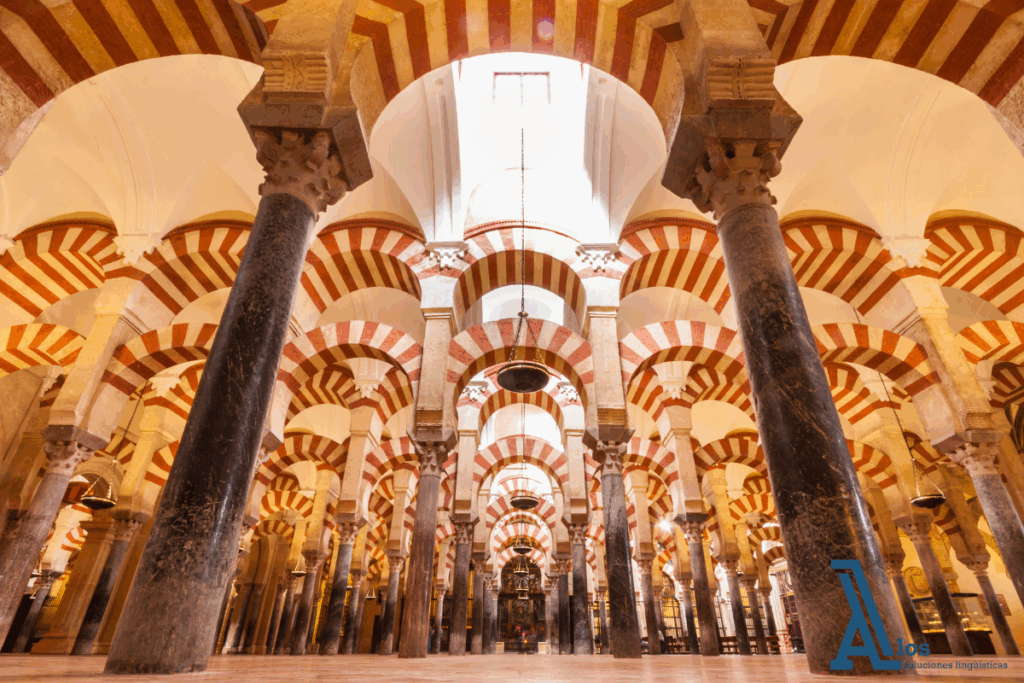
| Mezquita | المسجد (al-masjid) | Place of prayer (mosque) | Andalusia, Ceuta |
| Almenara | المنارة (al-manāra) | Watchtower | Andalusia, Valencian Community |
| Tambor | طبل (ṭabl) | Percussion instrument (drum) | All of Spain |
| Azimut | السمت (as-samt) | Angle used in navigation | Scientific use |
| Cuscús | كسكس (kuskus) | Traditional dish (couscous) | Ceuta, Melilla, Canary Islands |
| Maroma | مرمى (marma) | Thick rope | Extremadura, Andalusia |
| Aduana | الديوان (ad-dīwān) | Border control (customs) | Ceuta, Melilla |
| Naranja | نارنج (nāranj) | Citrus fruit (orange) | All of Spain |
| Alambique | الإنبيق (al-inbīq) | Distilling apparatus (alembic) | Galicia, Castile and León |
| Almotacén | المحتسب (al-muḥtasib) | Market inspector | Andalusia, historical use |
Arabic influence on science, technology and culture
Beyond everyday Arabisms — such as “almohada” or “azúcar” — the Arabic legacy in Spanish extends to loftier fields of knowledge. Between the eighth and thirteenth centuries, the Islamic world was the most scientifically advanced civilisation. From Córdoba, Baghdad and Damascus, Greek, Persian and Indian learning was translated, systematised and expanded in Arabic. Through al-Andalus and contacts between Muslims and Christians, this knowledge was passed on to the rest of Europe — and many words travelled with it.
That is how terms entered Spanish such as “alquimia” (al-kīmiyāʼ), the forerunner of modern chemistry, or “azimut” (as-samt), used in astronomy and navigation. The Arabic numeral system — more efficient than the Roman one — arrived with words such as “cero” (ṣifr, which also gave rise to the term “cifra”) or “álgebra” (al-ǧabr), the foundations of modern mathematics.
Terms from medieval Arabic medicine also reached Spanish: “jarabe” (šarāb, a medicinal drink), “almizcle”, “elixir” and even “alcohol”, which originally referred to the very fine powder used in medicine and cosmetics. Botany, developed in great detail by Muslim scholars, left us words such as “albahaca”, “azafrán”, “alcachofa” and “berenjena”, all common in Spanish cooking.
This adoption of scientific and cultural terms was consolidated by the translation of Arabic works into Latin at centres such as the Toledo School of Translators, where Christians, Jews and Muslims worked side by side to recover classical learning and pass it on to the rest of Europe.
Why do some regions keep more Arabic words?
The geographical spread of Islamic rule on the Iberian Peninsula largely explains why certain regions retain more Arabisms in their everyday vocabulary. Al-Andalus, the territory governed by Muslims from 711 to 1492, covered much of the south, east and centre of the peninsula for centuries. The present-day regions of Andalusia, Murcia, Castilla-La Mancha, Extremadura and the Valencian Community were key areas under Muslim rule for longer, which allowed a deeper and more lasting influence on local culture.
This heritage is not only linguistic. In many rural areas, Arabic terms describing farming activities, irrigation systems, building structures or customs are still in use. The word “acequia” (irrigation channel), for instance, is still alive in the fields of Valencia and Murcia, while “almazara” (olive-oil mill) is common across the olive-growing areas of Andalusia. In some regions, words such as “alcázar”, “alhaja”, “tajine”, or “zoco” survive both in speech and in the names of neighbourhoods, monuments and markets.
In northern regions such as Galicia, Asturias or Cantabria, by contrast, where the Christian reconquest was consolidated before the tenth century, Arabic influence was far more indirect, filtered through an already Arabised Castilian. That explains why many words of Arabic origin are used throughout the country but carry less cultural weight in the north.
Another factor was the way the reconquest and the subsequent resettlementtook place. In areas such as Castilla-La Mancha and Extremadura, resettled by Castilians after the fall of Muslim rule, many Arabic words remained as part of material culture: utensils, cooking customs, farming organisation and even religious expressions. That is how Arabic left an uneven yet deep and lasting imprint.
A cultural legacy that is still alive
The Spanish language is a living testament to centuries of shared history, and Arabic influence is one of its richest and most enduring chapters. From words used every day to scientific terms and ancient place names, Arabic has left a deep mark on Spanish vocabulary and cultural identity. That heritage is found not only in books but in the streets, the flavours, the customs and the voices of every corner of Spain. Knowing where these words come from also means recognising the diversity that shapes us. In the end, speaking Spanish also means — in part — speaking Arabic.
See also, if you enjoyed this article:
Frequently asked questions (FAQ)
More than 4,000 words in present-day Spanish are estimated to be of Arabic origin.
Because of the Muslim presence on the Iberian Peninsula for almost 800 years.
Andalusia, Murcia, the Valencian Community and Castilla-La Mancha.
Yes, it comes from “in shā’ Allāh”, meaning “God willing”.
Yes, such as Guadalquivir, Almería, Guadiana and Alcalá.
No, it is also found in architecture, farming, music and customs.