





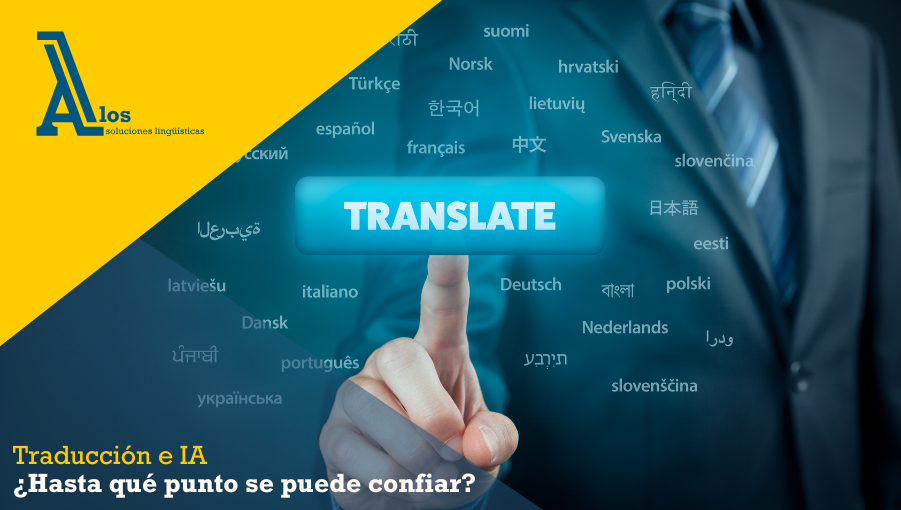
Can we really trust AI translation? Is a machine capable of understanding and accurately translating the richness and subtlety of our languages?
In earlier posts we already discussed machine translation, which has come a long way since Google Translate appeared in 2006. In its early days, the tool caused unease among translation professionals, who feared that automation might replace their work. Over time, however, it has become a complementary working tool that, alongside human input, improves efficiency and accuracy when translating texts.
Today, artificial intelligence (AI) has taken an even bigger leap with the development of neural translation models such as DeepL and ChatGPT, able to interpret whole sentences with surprising fluency. These systems do not just translate words: they try to understand the context, the tone and even the intention behind the message. This has allowed many companies, media outlets and private users to speed up their translation processes and cut costs, especially on high-volume or low-creativity tasks. Even so, these advances have also revived the debate about how far AI can be fully trusted to translate complex or sensitive texts, where cultural and emotional nuance remains exclusively human territory.
The progress of AI has led to more sophisticated models, such as Meta’s SEAMLESSM4T, capable of speech-to-speech translation in 36 languages in barely two seconds, and speech-to-text in 96 languages. This system not only delivers more accurate translations, it also preserves emotion and tone in real time, which marks a milestone in intercultural communication.
However impressive the advances in AI may be, relying on it alone to translate can be risky, especially when a brand’s image is at stake. A subtle mistake, a badly chosen word, an expression taken out of context or a tone that does not suit the target audience can affect how the message is perceived and even cause cultural or commercial misunderstandings.
This is where the work of the professional translator remains irreplaceable. It is not simply a matter of mastering two languages, but of interpreting, adapting and conveying with sensitivity and precision. Translators do not only translate texts: they translate intentions, emotions and values. Their role is key to ensuring that the message keeps its essence, its impact and its consistency, whatever the language. Indeed, Ruiz Casanova (2023) argues that «the path of Artificial Intelligence lies far from the intellectual self and from the practice of translation, because it is “a deeply human gesture”». You can read his full article on literary translation and AI here.
The best-known controversies
Despite these advances, AI translation still faces challenges. For example, in the South Korean series Squid Game (2021), the machine translation of the subtitles and its subsequent post-editing caused controversy because of errors that affected understanding of the plot. You can read the story here.
Likewise, the publisher HarperCollins was criticised for using AI in the Spanish translation of the romance novel The Pumpkin Spice Café (2023) by Laurie Gilmore. Readers and translators criticised the result for its artificial language, tonal errors and meaningless sentences. Despite later corrections, the case sparked intense debate in publishing about the quality of AI translation in literature. Discover the controversy by clicking here.
The figures speak for themselves
According to recent data, the use of machine translation tools has grown significantly across a range of sectors, above all in technology and e-commerce. But even the experts acknowledge that human input remains key, especially when it comes to adapting to cultural and contextual nuance.
«Artificial intelligence is a wonderful tool, but it is still just that: a tool. Using it without judgement is like letting a hammer write poetry.»
— Stephen Fry, writer
To understand the current impact of AI translation better, let us look at these two tables with recent data:
Estimated use of AI translation by sector
| Sector | Estimated use of machine translation (%) |
|---|---|
| Education | 70% |
| Tourism | 65% |
| E-commerce | 80% |
| Technology | 90% |
| Legal | 40% |
| Publishing | 55% |
Human, AI and hybrid translation compared
| Aspect | Human translation | AI | Hybrid model |
|---|---|---|---|
| Accuracy | High | Medium | High |
| Speed | Medium | High | High |
| Cost | High | Low | Medium |
| Cultural adaptation | High | Low | High |
| Ideal for | Literary and legal texts | Bulk translation, drafts | Web content, marketing |
Tips for using AI responsibly in translation
- Do not blindly trust the first version
Always review and correct the text translated by AI. Use it as an initial draft, not as the finished product. - Provide context whenever you can
AI systems improve a great deal when you give them information about the audience, the tone, the format or the purpose of the text. - Read it with human eyes
Read the result aloud or with a critical eye: does it sound natural? does it make sense? does it fit the target culture? - Beware of cultural nuance
AI does not always pick up irony, cultural references or double meanings. If the text contains these elements, human input is essential. - Assess the type of text before using AI
Translating a technical manual is not the same as translating a novel or an advertising campaign. The more creative or emotional the content, the greater the risk of using AI alone. - Be transparent if you use AI to translate professionally
If you deliver translations to clients or to the public, make clear whether you have used AI and whether a human has reviewed it. - Keep learning
Learn to use new tools, but also keep your linguistic and cultural training up to date. AI changes, but human judgement remains key. - Put yourself in the hands of a translation professional
Review by a professional translator guarantees that the message is clear, accurate and appropriate for its audience.
At Alos Soluciones Lingüísticas we have a team of professional translators who combine experience, judgement and cultural knowledge to offer you high-quality translations, adapted to your sector and your objectives. Whether the content is corporate, legal, technical or creative, we are here to help you communicate with precision and confidence in any language.

Confidentiality at risk: is it safe to translate with AI?
Although machine translation tools have proved useful and efficient, a serious concern arises when sensitive or confidential information is involved: data privacy.
When you use an AI-based machine translator — such as ChatGPT, Google Translate or DeepL — the texts you enter may be stored, processed and used to train the models. Although some platforms offer stricter privacy policies, many free versions do not guarantee confidential treatment of the data. This means that if you enter contracts, medical reports, personal data or business strategies, there is a risk that this information will be stored or circulated beyond your control.
For example, Samsung banned its employees from using ChatGPT in 2023 after discovering that internal technical data had been uploaded to the system. The case became emblematic of the dangers that irresponsible use of AI can pose in professional settings.
So, if you are going to translate sensitive documents, the best advice is to:
- Avoid free or public platforms for this kind of content.
- Check whether the machine translation provider offers a secure option (such as DeepL Pro, which does guarantee confidentiality).
- Work with a professional translator or a trusted agency operating under non-disclosure agreements (NDAs).
Ultimately, however advanced the technology may be, discretion and responsibility remain human tasks. Do not put your company or your data at risk to save a few minutes or a few euros.
AI translates, but judgement is still human
Artificial intelligence has transformed the world of translation, speeding up processes and cutting costs. Its ability to produce instant translations is valuable, especially for simple or internal texts. Relying on it entirely without human input, however, can carry risks: loss of nuance, errors of tone, or even legal and reputational problems when sensitive content is involved.
As we saw in the previous section, one of the most serious dangers concerns confidentiality. Sending private documents to free translation platforms can compromise the security of your information. And that is where the real value of a professional comes in: they not only translate with accuracy and cultural sensitivity, they also guarantee secure and ethical handling of your texts.
In short, the key is knowing when to use AI and how to combine it with human judgement. Using tools responsibly, with professional review and an awareness of privacy, is the best strategy for communicating with quality and confidence in any language. If you are still wondering whether machine translation can be trusted, read our blog article on the pros, cons and analysis of free translation tools.
If you are looking for a quality translation produced by professionals who understand both the language and the context, or if you want to improve your language skills to advance your career or your studies, at Alos Soluciones Lingüísticas we can help you. We offer specialist translation services and language courses tailored to your needs. Do not leave your communication to chance: contact us for a no-obligation quote, or find out about our training programmes designed to help you master any language with confidence.
(FAQ) Frequently asked questions about AI in translation
No. Although AI translations have improved a great deal, they can still make errors of context, tone or culture. Human review is always advisable, especially for important texts.
Post-editing means having a human translator review and correct that translation so that it meets quality standards.
No. AI is a useful tool, but it lacks intuition, cultural sensitivity and creativity. Translators will remain key to guaranteeing quality and consistency.
We have professional translators who combine technology with human judgement to give you accurate translations, adapted to your sector and rigorously reviewed. We also offer tailored language courses.
It depends on the type of text. For technical or repetitive content, AI can be useful. But for texts with cultural nuance, creative texts or important ones, the human translator is irreplaceable.
Not always. Free versions may store the data. To guarantee confidentiality, it is best to use professional services or tools with encryption and guaranteed privacy.
Use it for quick drafts, internal content or simple texts. Avoid it for contracts, legal or literary texts, or any document that represents your brand publicly.
It can be detected by errors of context, a lack of naturalness, literal translations or misused idioms. A professional can identify it quickly.
Because professional translators bring accuracy, cultural adaptation, consistency and confidentiality. They can also correct the errors that AI fails to spot.
As we were saying, machine translation with artificial intelligence is here to stay, but it must be used consciously, strategically and under supervision. While these tools can speed up processes and cut costs, only human judgement can guarantee translations that are accurate, natural and adapted to the cultural and communicative context of each text. So if you need quality, confidentiality and effective communication in other languages, working with professionals such as those at Alos Soluciones Lingüísticas is the best decision. Because translating well means understanding not just the words, but the world behind them.