





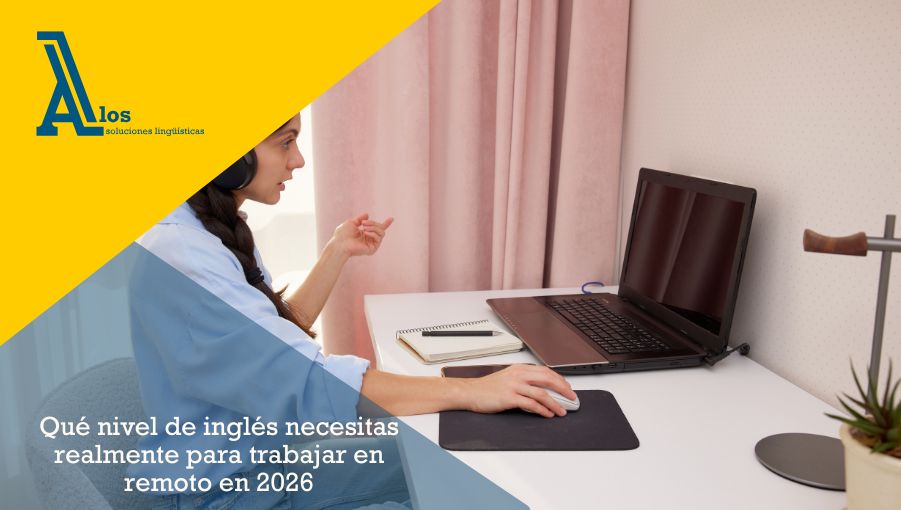
Working remotely for international companies has become increasingly common, but many professionals wonder what level of English is really needed to cope effectively. It is not just about being able to read emails: meetings, calls, technical documentation and client communication all play a part. In this article you will find out what level of English you need for your role and how to prepare in practical terms.
Not every remote job requires the same level of English
One of the most frequent misunderstandings is assuming that any international remote post demands advanced English. The reality is more nuanced: the level you need depends on your responsibilities and on the kind of interaction you will have with colleagues or clients.
For example, a developer writing code for an international team can work at an intermediate level as long as they handle the technical documentation. An account manager dealing with clients directly, on the other hand, will need a higher level in order to communicate clearly and inspire confidence.
A practical classification of levels by role
Intermediate level (B1-B2)
Ideal for roles with limited or internal interaction:
- Reading and understanding emails in English
- Taking part in team chats and messaging platforms
- General understanding of technical documentation
For example, a remote graphic designer coordinating deliveries with an international team can handle day-to-day work at B2, although it is advisable to build up specific professional vocabulary.
Advanced level (C1)
Necessary for roles involving direct client communication, presentations or negotiation:
- Frequent virtual meetings
- Support or sales calls
- Writing documents, reports and proposals
An account manager looking after clients in the United States or the United Kingdom needs to feel comfortable expressing complex ideas and picking up cultural nuances.
Expert level (C2)
Recommended for strategic, leadership or training positions:
- Conferences, webinars and public presentations
- Managing international teams
- Writing content that requires linguistic precision
For example, a project manager or senior consultant who takes part in strategic decisions and coordinates multidisciplinary teams needs fluent, confident English that conveys authority.
Beyond grammar: the key skills
It does not all come down to your level on paper. To work remotely and be effective, some practical skills make the difference:
Listening comprehension and quick responses
In virtual meetings there will not always be subtitles. Being able to understand different accents and respond clearly avoids misunderstandings and improves productivity.
Professional writing
Clear, precise and concise emails are essential. Mastering professional formulas and common structures helps you keep communication effective and come across as professional.

Cultural adaptation
English is not just a language, it is also a working culture. Understanding idiomatic expressions, turns of phrase and communication conventions speeds up interaction and reduces mistakes.
Strategies to improve your English according to your role
Courses focused on professional English
There are specific programmes for remote roles, from customer service to programming. These courses combine technical vocabulary, written and spoken communication, and simulations of real situations.
Active practice with colleagues or mentors
Taking part in mock calls, email exchanges and practice meetings helps you gain confidence and spot areas to improve before you face real clients.
Additional resources
Listening to podcasts, reading specialist articles or taking part in international forums helps you get familiar with the terms and expressions used in your sector.
If you want to go deeper into practical strategies for mastering English at work, you can look at the ALOS blog, with resources for professionals.
Frequently asked questions
It depends on the post. For internal or technical tasks it may be enough, but for client-facing work or presentations C1 is recommended.
Yes. Combining structured training with daily practice in meetings and emails speeds up your learning and keeps it relevant to your role.
It depends on the post. In support, marketing or project management roles both matter, but written English is often the basis of effective communication.
There is no single level of English needed for remote work: it varies with your role, your contact with clients and the kind of tasks you do. The key is to assess your real needs, identify the key skills and practise consistently. With a tailored plan, you can make fast progress and work confidently in international teams.
At ALOS we help you improve your professional English in a practical way, tailored to your role and your working context. Get in touch and make the most of your opportunities working remotely for international companies.