





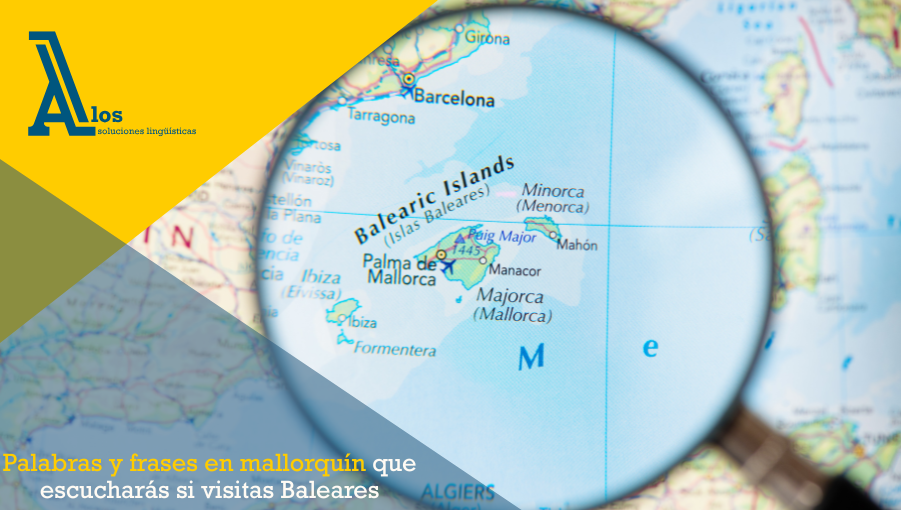
The Balearic Islands are home to one of the most fascinating varieties of Catalan: Mallorcan. This linguistic variety is far more than a simple regional dialect. Mallorcan belongs to Eastern Catalan and is marked by its own distinctive phonetic and lexical features. According to figures from the Spanish National Statistics Institute (INE), 59.5% of the population of the Balearic Islands say they speak Catalan well. This bilingual reality makes the islands a territory where Spanish and Balearic Catalan coexist harmoniously.
The best-known move to protect Mallorcan came in 2018, when the Balearic Government approved Decree 49/2018, which regulates the use of the official languages in the Administration of the Autonomous Community of the Balearic Islands. This decree establishes Catalan as the language of the Balearic Islands and guarantees its use in public administration, education and the media.
In addition, the Linguistic Normalisation Act 3/1986 recognises Catalan as the language of the Balearic Islands and guarantees everyone’s right to know and use it. These measures reflect the commitment of the Balearic institutions to preserving and promoting Mallorcan as an integral part of their cultural heritage.
Features of Mallorcan that will surprise you
Expressions unique to the archipelago
Some expressions are exclusively Balearic and their originality will surprise you:
- “Anar més just que sa pell des nas”: to be extremely pressed for time, the equivalent of “by the skin of your teeth”.
- “Això és mel”: literally “this is honey”; used to say that something is very good or delicious.
- “Batualmon sagrat”: an exclamation of surprise, similar to “good heavens!” or “well I never!”.
- “Da-li cebes”: literally “give it onions”; used to encourage someone to try harder.
- “Embafa”: the feeling of being stuffed or overfull, especially after eating too much.
- “Mesclar ous amb caragols”: to mix unrelated things, like “comparing apples and oranges”.
- “Somiar truites”: literally “to dream omelettes”; to have unrealistic expectations.
- “Estar més perdut que l’Onso”: to be completely lost (a legendary reference).
- “Fer-se el suec”: to play dumb (literally “to play the Swede”).
- “Tenir més coll que una girafa”: to be very cheeky.
- “Mem” (or “meam”): a very characteristic Mallorcan expression that is hard to translate; it is said just before you start speaking, while you think about what you are going to say, and means something like “let’s see”.
- “Daixonar” and “això”: When a word escapes us in Mallorca, we use the all-purpose això, for example: dona’m es d’això would be “give me that”. And we can even turn it into a verb: daixonar, when no other word comes to mind, for example: Daixonem sa sal would be “pass me the salt”.
- “Mos deim coses”: literally “we say things to each other”, meaning something close to “see you around” or “let’s keep in touch”.
- “Xubec”: the typical drowsiness or grogginess that follows lunch, so the best remedy for xubec is a siesta.
- “Cercar a na Maria per sa cuina”: the literal translation would be “to look for Maria in the kitchen”, but what it really means is to make life needlessly complicated.
- “Gat”: gat for Mallorcans does not mean “cat” (“cat” is moix”), but refers to being “drunk”, “plastered” and so on. The expression would be: vaig gat or quin gat que duc or gatera, that is, “I’m very drunk”.
- “Cap de fava amb orelles”: this is one of the many expressions used to call someone “silly” or “a fool”, and it literally means “broad-bean head with ears”.
- “Capfico”: a dip in the sea, and the phrase you hear most in spring and summer is anam a pegar un capfico?, “shall we go for a dip?”.
- “Uro!”: it has no translation at all and conveys surprise and exaggeration; it would be like “wow!”.
- “Quin cristo…”: used to refer to something out of place, in an alarmed tone.
Do you want to connect properly with your customers in the Balearic Islands? Request your quote for translation into Catalan now, or sign up for our tailored classes and master the local language with confidence.
The future of Mallorcan
The future of Mallorcan sits at a crossroads that combines tradition, cultural identity and the challenges of globalisation. While it is still used daily in family and rural settings, recent decades have seen a slight decline in the level of language competence among younger generations, particularly in urban and tourist areas. This trend has prompted both concern and concrete action from institutions, educators and social movements.
Teaching Mallorcan in the state school system, driven by the Government of the Balearic Islands through language immersion programmes, remains a key pillar of its preservation. The regional media, such as the IB3 network, also help to normalise its use in modern contexts: television, radio and digital channels.
One of the main challenges facing Mallorcan is adapting to technical and professional language. Initiatives such as digitising content in Mallorcan, producing audiovisual material in the Balearic variety and creating online language resources are essential steps towards keeping it current. At the same time, there is growing public awareness of the language’s heritage value, not only as a means of communication but as a tool for community cohesion and local pride.
The future of Mallorcan will depend largely on its ability to remain functional and appealing in new social spaces: education, business, sustainable tourism and technology. If its use becomes established as added value in Balearic identity, beyond folklore, Mallorcan will not merely survive: it will evolve, grow richer and find its place in the twenty-first century.
Why Mallorcan matters to your Balearic experience
Knowing even the basics of Mallorcan completely transforms the experience of visiting the Balearic Islands. It is not only about communicating, but about building a genuine connection with island culture and traditions. Locals greatly appreciate visitors who make an effort to engage with their language, and that often translates into richer, more authentic experiences.
Mallorcan is far more than a means of communication; it is the vehicle of an ancient culture that has adapted to modern times without losing its essence. From traditional recipes passed on by word of mouth to the seafaring expressions that reflect an age-old relationship with the sea, every Mallorcan word tells a story.
For professionals, especially in the legal field, who work in the Balearic Islands or with Balearic clients, command of Balearic Catalan is not merely a competitive advantage but a professional necessity. The Balearic public administration operates in Catalan, and many official documents require specific knowledge of legal terminology in this language. Discover our specialist courses and take a look at our legal translation services to make your professional practice in the Balearic archipelago more effective. You can also read our articles on:
- Translation and interpreting in Valencia’s museums: culture without borders
- Is it possible to be 100% bilingual?
- The 10 hardest languages for Spanish speakers: challenges and benefits
Frequently asked questions (FAQs)
It is not necessary, but knowing a few basic words and phrases will enrich your experience considerably. Most of the population speaks Spanish, but locals appreciate the effort to communicate in their own language.
Mallorcan is a variety of Eastern Catalan with phonetic, lexical and morphological features specific to the Balearic Islands. They share the same basic grammar but differ in pronunciation and in some vocabulary.
No. There are variations between Mallorca, Menorca, Ibiza and Formentera, although the differences are minor and do not prevent mutual understanding.
The reaction is generally very positive. Balearic people appreciate respect for their culture and are usually patient and helpful with pronunciation and vocabulary.