





Companies are investing more and more in online training, particularly to upskill teams and refresh capabilities in a digital environment. But there is one technical detail that HR departments tend to overlook: the audio in online classes. Sound quality affects not only how well the content is understood, but also engagement, how professional the trainer appears and, ultimately, the return on the training investment.
In this article you will learn what to look for in a microphone for online training — and why this detail can make the difference in internal development programmes.
Why audio matters in online training
Imagine your team is attending a virtual session on business English run by ALOS Idiomas. If the trainer uses a poor microphone, some of the key concepts are lost, participants switch off and the learning experience falls flat. That not only reduces the effectiveness of the training, it can also mean less of it is applied in daily work.
The clarity of the sound has a direct effect on learners’ attention. In language classes, for example, where pronunciation and fine sound distinctions matter, the audio equipment becomes as essential a component as the content itself.
How to choose a microphone for the way it will be used
1. Microphones for individual or one-to-one sessions
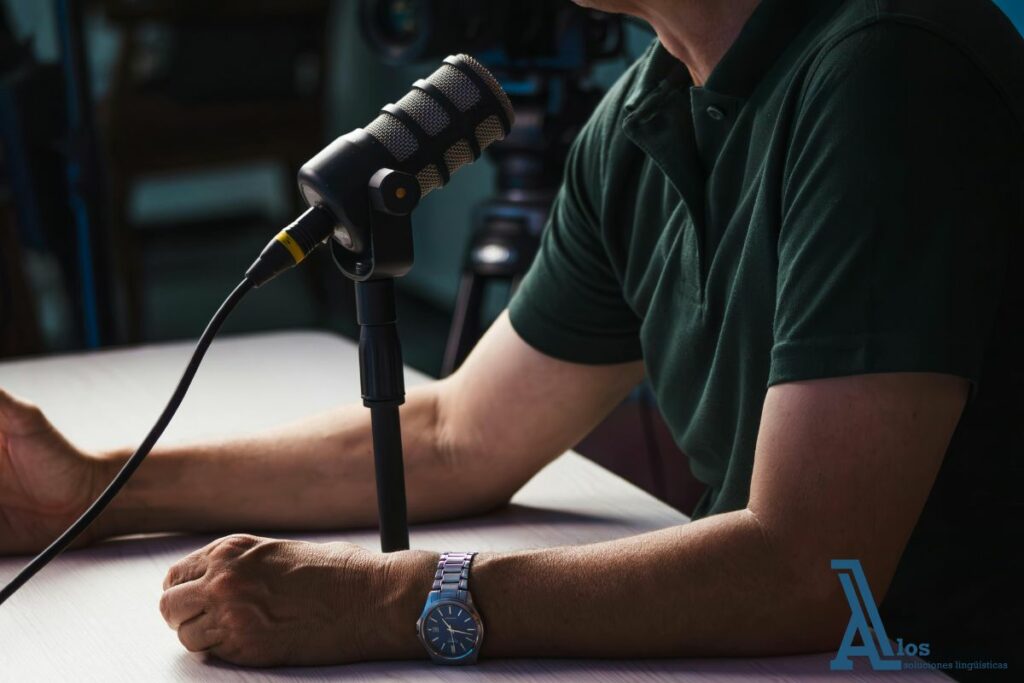
For individual sessions, such as personalised English or French tutoring, a USB condenser microphone can be ideal. These models are simple to use (plug and play) and capture the voice well without distracting background noise.
A typical HR situation: preparing an employee for an international presentation or a negotiation with foreign clients. Clean audio in these sessions makes it easier to correct pronunciation and give immediate feedback.
2. Microphones for groups and internal training
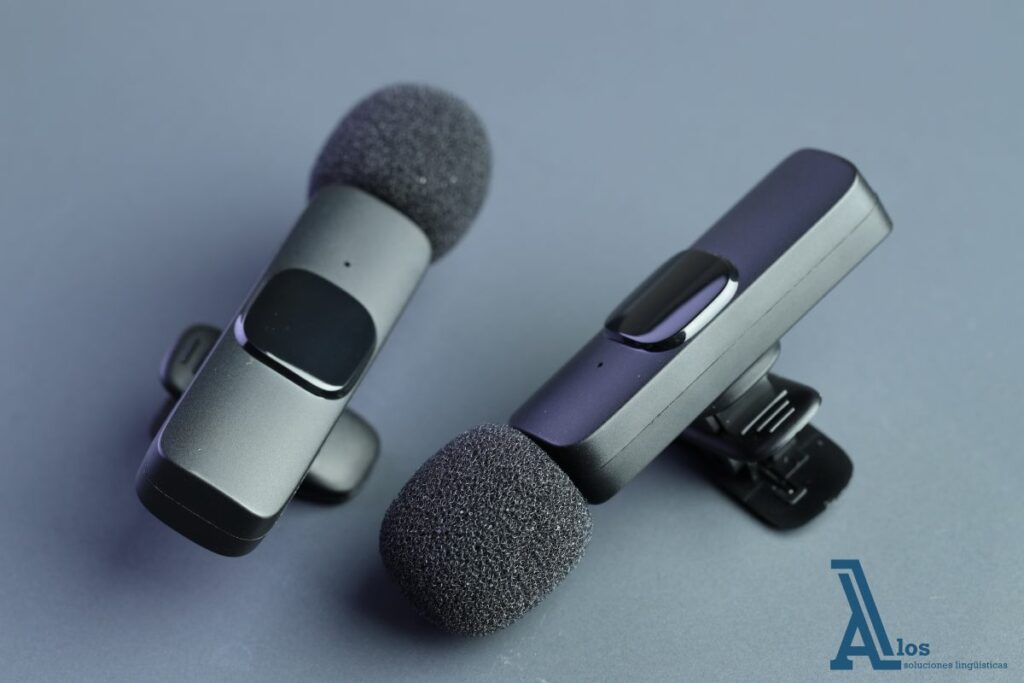
If the training is delivered to a group — an English communication workshop for whole teams, for instance — you may want a tabletop microphone with an omnidirectional pattern to pick up several voices. Alternatively, where there is one main presenter, a lavalier (clip-on) microphone improves mobility and clarity without cables cluttering the screen.
This kind of set-up is especially useful when the training is combined with other techniques, such as the practical conversation activities covered in our guide on 5 reasons why you should invest in language training for your team which explains how language training strengthens internal communication.
3. Microphones for recorded content
In programmes that combine live sessions with recorded content, such as asynchronous language lessons, it is important to invest in microphones with good frequency response and noise cancellation. These ensure that content which will be reused many times has professional quality.
Features a microphone for online training should have
Recording quality
Look for microphones that deliver clear, crisp sound, with the ability to filter out side noise. This is essential for long sessions, where attention can drop because of irritating noise or echo.
Compatibility with virtual platforms
Make sure the microphone integrates easily with common video-conferencing tools (Zoom, Teams, Google Meet) and does not require complicated set-up from the end user.
Portability and everyday use
If your HR team organises training frequently, the ideal is to have devices that are easy to carry and set up, with no need for external technicians at every session.
A rechargeable wireless mouse is another of those accessories you appreciate in long sessions: no cables, no batteries to change and ready to use anywhere with no configuration.
Fitting the equipment into corporate training processes
When designing a training plan for your company, such as those ALOS offers online or in person, it is essential that the technical equipment supports the learning objectives. In our programmes of language training for companies and professionals, for example, teaching methodology is combined with the right technology to maximise results.
Delivering a general English class is not the same as running a session where the microphone captures phonemes and intonation correctly — aspects that are fundamental to acquiring a second language. That is why investing in the right audio equipment is part of the instructional design.
Investing wisely: which models to consider?
Here is a practical guide to microphone types by need:
USB microphones:
- Ideal for individual sessions.
- They connect straight to the computer with no complex drivers.
- Good performance for conferences and tutorials.
Lavalier microphones:
- Perfect for presenters or trainers who move around.
- They deliver consistent sound without interference.
Omnidirectional tabletop microphones:
- Useful in group meetings, round tables or debates.
- They pick up voices from several angles.
When choosing the equipment, think about who will use it, where, and how it will fit into the training HR coordinates.
Frequently asked questions
No. For informal meetings or short internal sessions, a decent basic USB microphone will do. For structured training, however — especially in languages — the improvement in quality is clearly noticeable in the learning experience.
USB models tend to be bulkier and sit near the computer, while lavalier models clip onto clothing and allow movement without losing vocal clarity.
Built-in microphones tend to pick up ambient noise and echo, which can make comprehension harder in long sessions or with technical vocabulary, for example in specialised language courses.
Choosing the right microphone for your online classes is not a technical luxury: it is a decision that directly affects the quality of the training, how much participants retain and how professional your programme appears. If you are planning language or digital skills programmes from HR, the right equipment will help you get the most out of them.
Would you like to design a training plan that combines effective methodology with the right technology? At ALOS Idiomas we can help you structure online training programmes tailored to your team and your objectives. Contact us for personalised advice.