





The rise in travel by unaccompanied minors
In Spain it is increasingly common for under-18s to travel without their parents or legal guardians. Whether for academic reasons, student exchanges, visits to relatives or sporting and cultural activities, these journeys require rigorous legal preparation. In this context, the sworn translation of travel consent for minors has become an essential requirement when the minor’s destination is a country whose official language is not Spanish. Making sure this paperwork is correctly issued, translated and validated can prevent a good many problems at airports or international borders.
According to data from the Resident Tourism Survey carried out by Spain’s National Statistics Institute (INE) in 2023, 7.2% of journeys made by residents in Spain were by children under 15. Although the survey does not specify how many of these journeys were made by unaccompanied minors, there is a clear upward trend in travel by minors for personal reasons, such as visits to relatives or educational activities.
Given this situation, it is essential to understand the requirements and procedures needed to safeguard the safety and wellbeing of minors travelling alone, including the need for properly formalised travel consent that has, in many cases, been translated by sworn translators.
General requirements for a minor to travel alone
The requirements for a minor to travel alone vary depending on the country of origin and destination, as well as the airline. There are, however, some common criteria:
- Minimum age. Minors generally have to be at least 5 years old to travel alone. At Iberia, for instance, children aged 5 to 11 must use the accompaniment service, while for those aged 12 to 17 it is optional.
- Documentation. A valid passport or national identity card, a visa where required, and travel consent signed by both parents or legal guardians.
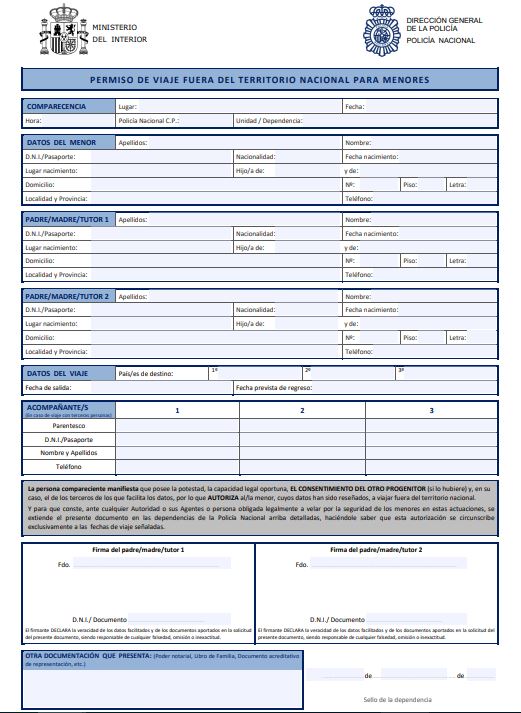
- Travel consent. In Spain, minors travelling alone or with third parties need signed consent from their legal representatives, which can be formalised before the Policía Nacional (national police), the Guardia Civil or a notary..
When is travel consent for minors required?
According to Spain’s Ministry of the Interior, Spanish minors travelling abroad without their parents or legal guardians must present travel consent signed by both parents or guardians. This consent can be formalised before the Policía Nacional, the Guardia Civil or a notary.
Where can you obtain travel consent?
There are several ways to formalise travel consent for minors:
- Policía Nacional or Guardia Civil. This is the most common option and it is free. At least one parent or legal guardian must attend in person, together with documents proving parentage and parental responsibility for the minor. Remember to bring the identity card or passport of both the minor and the parents, as well as the family record book or birth certificate.
- Notary. Although this option has a cost, it can be quicker and more flexible in terms of appointment times. Notarised consent is also useful if the Hague Apostille is required for the document to be valid abroad.
- Consular offices. If you are abroad, parents or guardians can go to the nearest Spanish consular office to formalise the travel consent. An appointment must be booked in advance and the parent or guardian giving consent must attend in person.
Who can apply for consent?
Travel consent must be applied for by the minor’s parents or legal guardians. If the minor is travelling alone, consent is required from both parents, unless one of them has sole parental responsibility.
If the minor travels with one of their separated parents, the rules do not require the other parent’s permission. In practice, however, many parents prefer to sign the consent to avoid possible difficulties during the trip.
Sworn translation of travel consent for minors and apostille of documents: our recommendations
When a minor travels to a country whose official language is not Spanish, it is essential that the travel consent is translated by a sworn translator. This ensures that the authorities in the destination country fully understand the content of the document.
In addition, if the destination country requires the Hague Apostille, it is advisable to have the consent drawn up before a notary so that it can be apostilled afterwards.
Bear in mind that some countries require travel consent translated into English by a sworn translator, along with other documents such as the birth certificate and certified copies of passports.
In the case of countries that use non-Latin alphabets, such as Cyrillic or Arabic, it is advisable for the minor’s passport to include the transliteration of their name into the Latin alphabet. This avoids inconsistencies in the translation and possible problems at passport control.
Tips for avoiding problems at the airport
- Non-Latin alphabets. If the destination country uses a different alphabet, such as Cyrillic or Arabic, it is advisable for the minor’s passport to include the transliteration of their name into the Latin alphabet. This avoids inconsistencies in the translation and possible problems at passport control.
- Consistency in names. Make sure the minor’s name is written consistently across all documents (passport, travel consent, plane tickets and so on).
- Additional documents. Bring copies of the family record book, the birth certificate and any other document proving the relationship between the minor and their legal guardians.
Common obstacles to minors travelling alone
There are various reasons why a minor may be prevented from travelling alone:
- Lack of proper documentation. Failing to present the relevant travel consent, or presenting one that has not been properly translated and apostilled.
- Inconsistencies in the details. Differences in the minor’s personal details across the various documents.
- Safety risks. If the authorities consider that the journey may put the minor’s safety at risk.
We strongly recommend that, before setting off on any trip with minors, you check the specific requirements of both the country of departure and the destination country. That includes checking with the competent authorities (such as the Policía Nacional, the Guardia Civil or consulates) as well as with the airline operating the flight. Each country may have its own rules on the documents required for minors travelling alone or with accompanying adults who are not their guardians, and airlines may also impose additional conditions (such as specific forms or compulsory accompaniment services). Checking in advance is key to avoiding setbacks on the day of travel, particularly as regards the validity of travel consent, sworn translations and any additional documents required.
How can we help you?
At our translation agency in Valencia you can request a quote for the sworn translation of any document; we work with official translators accredited by the Spanish Ministry of Foreign Affairs. We offer sworn translations of travel consent for minors in more than 500 language pairs, including English, French, German, Italian and Portuguese..
We can also help you with the Hague Apostille and with translating other documents needed for the trip, such as birth certificates, passports and family record books.
If you need a sworn translation of travel consent for minors, do get in touch. We respect every document we translate and take care over every translation.
(FAQ) Frequently asked questions about the sworn translation of travel consent for minors
In Spain, under-18s travelling abroad without their parents or legal guardians must have travel consent signed by both parents or guardians. This consent is needed to prove that the minor has permission to leave the country. We recommend checking the specific requirements with the competent authorities and the airline before travelling.
Consent can be formalised at:
– Policía Nacional stations
– Guardia Civil posts
– Notary offices
When abroad, it can be arranged at Spanish consular offices. Remember to bring documents proving the family relationship and the minor’s identity.
It depends on the destination country. If Spanish is not an official language there, a sworn translation of the travel consent is likely to be required. South Africa, for example, requires the consent to be translated into English by a sworn translator.
As well as the travel consent, sworn translations may be required of:
– Birth certificates
– Family record books
– Passports or identity cards of the parents and the minor
It is advisable to check with the authorities in the destination country to find out the specific requirements.
A sworn translation must be produced by a sworn translator accredited by the Spanish Ministry of Foreign Affairs. The translation must bear the translator’s stamp and signature, together with a certification attesting to its official status. For more on sworn translations, see our blog article on How to request a quote for a sworn translation
The time can vary depending on the complexity and volume of the documents. Many agencies, however, offer urgent services that deliver the translation within 24 to 48 hours.
If the destination country is a party to the Hague Convention, the travel consent may need to be apostilled. In that case, it is advisable to have the consent drawn up before a notary so that it can be apostilled afterwards.
Although it is not always legally compulsory, we recommend that the parent not travelling with the minor signs a travel consent to avoid possible difficulties during the trip.
At Alos Soluciones Lingüísticas we are sworn translators and interpreters appointed by the Spanish Ministry of Foreign Affairs, in any language pair. Ask us, with no obligation.
It is essential to check with the competent authorities in the destination country, such as embassies or consulates, and with the airline, to find out the specific requirements and avoid problems on the day of travel.