





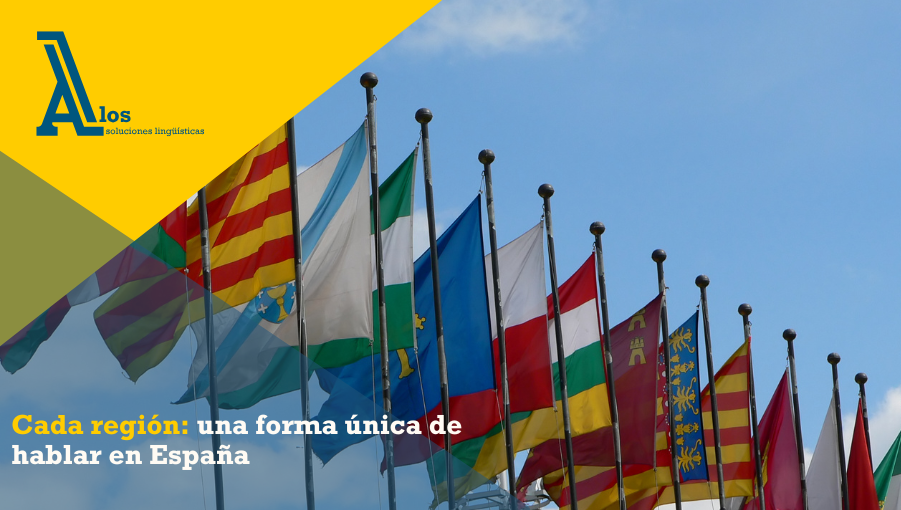
Spain is a country of linguistic contrasts. Although Castilian Spanish is the official language, each autonomous region has shaped its own way of speaking, with expressions, turns of phrase and words that reflect its history, culture and character. These differences not only enrich the language, they also offer a window onto the identity of each region.
In Galicia, for example, the word “morriña” expresses a deep longing for one’s homeland, a feeling that is hard to translate precisely. In Madrid, “mazo” is used to intensify a statement, much like “a lot” or “very”. In the Valencian Community, “¡ché!” is an interjection that can express surprise, annoyance or enthusiasm, depending on the context (source).
These expressions are not merely linguistic curiosities; they are living witnesses to Spain’s cultural diversity. Learning them means stepping into what makes each region distinctive and understanding its people better.
Typical expressions by region
| Autonomous region | Typical expression | Meaning or common use |
|---|---|---|
| Galicia | Morriña | Deep longing for one’s homeland |
| Asturias | Guaje | Child or young person |
| Cantabria | Tierruca | An affectionate way of referring to the home region |
| Basque Country | Aupa | A greeting equivalent to “Hello!” or “Come on!” |
| Valencian Community | ¡Ché! | Interjection expressing surprise or emphasis |
| Murcia | Acho | Interjection similar to “Hey!” or “Oi!” |
| Andalusia | Illo | Short form of “chiquillo” (lad), used to get someone’s attention |
| Madrid | Mazo | Intensifier equivalent to “a lot” or “very” |
| Castile and León | Macho | Colloquial term used to address someone (mate) |
| Canary Islands | Muyayo | Child or young person |
As well as enriching the language, each region’s typical expressions work as markers of belonging. Using or recognising certain words can create an immediate sense of connection between speakers from the same area. It is not unusual to hear someone say proudly that a phrase is “very much from here”, because speaking the way people speak at home is also a way of preserving collective memory, oral tradition and values handed down through the generations.
In times of globalisation and linguistic homogenisation, these particularities matter even more. Regional expressions remind us that language is not static but a living reflection of how we think, feel and relate to one another. Far from being an obstacle, this diversity invites us to explore new ways of communicating, with humour, warmth and a touch of local identity in every word.

A notable case: a foreigner’s surprise
A recent example of how these expressions can surprise visitors is the case of Nicholas Rohaidy, an American living in Catalonia. In a viral TikTok video, he expressed his amazement at the sheer variety of ways Spaniards describe someone as “mad”. From “le falta un tornillo” (a screw loose) to “está como una cabra” (mad as a goat), he collected 16 different expressions, many of them humorous or poetic (source).
Experiences like this highlight how colloquial speech and regional expressions can baffle foreigners, while also offering a unique opportunity to learn about local culture and humour.
Language, culture and territory: a Spanish mosaic
Spain’s linguistic diversity reflects its rich history and cultural variety. Each regional expression is a piece of the mosaic that makes up the national identity. Knowing and appreciating these differences not only enriches our vocabulary, it also brings us closer to the people and traditions of every corner of the country.
As the linguist and academic Francisco Moreno Fernández:
put it: “Spain is a state with a rich, deep-rooted and living linguistic diversity that constitutes a cultural heritage we must preserve and promote.”
Francisco Moreno Fernández
See also, to explore this fascinating subject further:
Frequently asked questions (FAQ)
They are colloquial phrases or words commonly used in a specific autonomous region. They reflect local customs, culture and history, and are often not understood outside their own region.
Because of its cultural, historical and linguistic diversity. Several co-official languages (such as Catalan, Galician and Basque) coexist in Spain, along with dialects that have influenced the Castilian spoken in each area.
Yes, they are perfectly valid in colloquial and regional speech. Many are part of the oral heritage and are accepted as part of everyday usage in their own context.
On linguistics blogs, in regional dictionaries, in social media videos and by talking to native speakers from different regions. You can also explore resources such as the Instituto Cervantes or projects like Varilex.
Generally not in formal texts, but they do appear in regionalist literature, on social media, in comics and in informal written conversation, where the aim is to convey authenticity or a local tone.