





When we speak Spanish, we rarely stop to think how many of our everyday words come from other languages of the Iberian Peninsula. And yet there they are: morriña, meiga, carallo, furancho. They are Galician words that have crossed regional borders and slipped quite naturally into Spanish.
This influence is no accident. Galician and Spanish have lived side by side in Galicia for centuries, in a setting of constant bilingualism that has encouraged a rich flow of vocabulary. What is curious, though, is that a good number of those words have travelled across the whole of Spain.
In this article we look at some of those “travelling” words, with examples, origins and a few linguistic anecdotes that will make you see your everyday vocabulary in a new light. Because sometimes, understanding how we speak also means understanding who we are.
List of terms
- Morriña
- Feitiño
- Carallo
- Meiga
- Grelo
- Queimada
- Vieira
- Furancho
- Albariño
- Botafumeiro
You can find more words here.
Etymology, literary use and differences from Spanish
The Galician language has not only lent musicality and richness to Spanish; it has also passed on a set of terms we use day to day without pausing to think where they came from. Below we look at ten Galician words that have crossed linguistic borders and settled into Spanish, many of them keeping their original form. We explore their etymology, their literary use, how their meaning differs from Spanish and where else they are found.
- Morriña
This feminine noun comes straight from Galician and refers to a deep nostalgia, especially the kind tied to one’s homeland. In Galician, morriña expresses more than simple sadness: it is a feeling of emotional emptiness with deep affective roots. Emilia Pardo Bazán used it in her stories to describe what Galician emigrants felt. Its use has also been documented in Asturias and León with the same melancholy sense.
- Feitiño
An affectionate diminutive of feitizo (“spell”), this word appears frequently in Galician popular poetry to describe something or someone with charm. In phrases such as “ten un feitiño que prende o corazón”, it conveys tenderness and attraction. In Galician it is in common use, whereas in Spanish it sounds exotic or literary. Similar expressions are found in León, although with less poetic weight.
- Carallo
A colloquial and vulgar term in Galician. It is a multi-purpose interjection used to express surprise, anger or astonishment. Although in Spanish it comes across as a simple insult, in Galician it carries a very wide range of contextual nuances. It appears in popular theatre and is part of everyday speech in Galicia. It has also filtered into rural speech in regions such as Zamora and Asturias.
- Meiga
From the Latin magica, meiga denotes in Galician the traditional witch, but not necessarily an evil one: she may be a healer, a wise woman, a protector or a spiritualist. In works such as Meigas, las brujas sabias: curanderas, chamanas y mujeres de poder en Galicia she appears as a central figure of the Galician imagination. In Spanish, however, the notion of “bruja” (witch) tends to be negative. The term is also recognised in León and rural areas of the north.
- Grelo
Very present in Galician cooking, the grelo is the turnip shoot, the star of the famous lacón con grelos. In Galician the term is used more broadly, covering various edible green leaves. It appears in traditional recipe books and in literature of manners. It is also eaten in León, where it has been worked into winter dishes.
- Queimada
The word queimada, the past participle of the Galician verb queimar (“to burn”), gives its name to a ritual drink made with aguardiente, sugar, lemon and coffee, which is set alight while an incantation is recited. It is less a cocktail than an act of magic. Writers such as Álvaro Cunqueiro include it in their tales drawn from oral tradition. In Spanish its use is usually confined to the culinary, without the ritual context it keeps in Galicia. Similar celebrations are found in western Asturias.
- Vieira
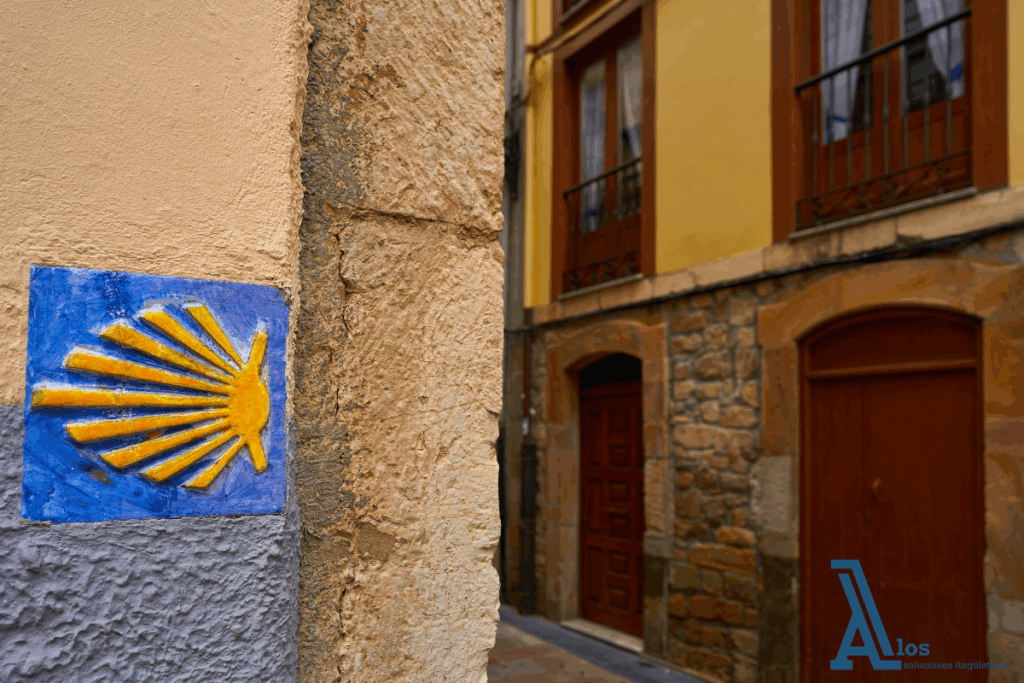
From the Latin veneria, adapted as vieira in Galician, this mollusc is one of the emblems of the Camino de Santiago. In Galicia it retains a religious and symbolic meaning, whereas in general Spanish it is known mainly as a food product. Its cultural importance has made the scallop shell a visible icon throughout Spain, especially among pilgrims.
- Furancho
Furanchos are rustic spaces where home-made wine is served alongside traditional tapas. The term comes from a popular blend (foro + rancho) and refers to a Galician tradition that appears in rural tales as a place to meet and socialise. It is little known in the rest of Spain, although similar practices exist in areas such as El Bierzo, León.
- Albariño
Albariño is both a white grape typical of Galicia and the wine made from it, especially in the Rías Baixas. In Galician the word can refer either to the fruit or to the drink. In Spanish it is known above all as a wine, and its reputation has crossed borders. It has been cited in poems, in songs and on restaurant wine lists alike.
- Botafumeiro
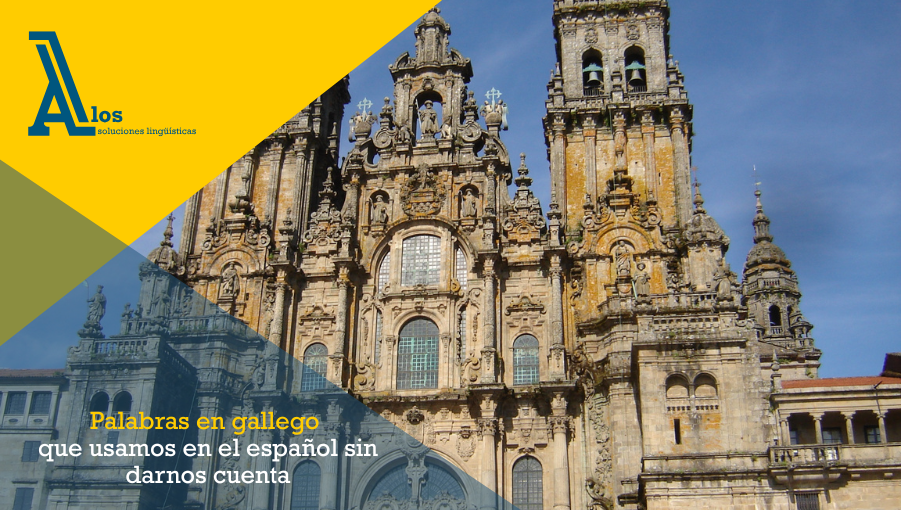
One of the most internationally famous Galician words, the botafumeiro is the great censer of the Cathedral of Santiago de Compostela. Its name is formed from botar (“to throw out”) and fume (“smoke”). It is a unique liturgical object, described in religious chronicles since the Middle Ages. Spanish has no exact equivalent, so the term is kept in its original language. Its fame has made it known throughout Spain as an essential part of the Camino de Santiago experience.
Galicia has left a deep mark on Spanish. Words such as morriña, meiga, albariño or botafumeiro are not simple loanwords: they are living expressions of a culture that has been in dialogue with Spanish for centuries.
Rediscovering these words and their Galician origin not only enriches our vocabulary, it also fosters respect for the linguistic diversity of Spain. They are terms that tell of customs, emotions, landscapes and spirituality. They are proof that Galician is not only heard: it is also spoken, read and felt throughout the Spanish-speaking world, even when we do not realise it.
If you would like to discover more Galician words, nuances and cultural contexts, there are reference works that help you get a better grasp of its lexical richness and its relationship with Spanish. A good dictionary or a general-interest book lets you go beyond the colloquial use of these terms and appreciate their origin, their development and the culture they carry.
Put your trust in Alos Soluciones Lingüísticas
At Alos Soluciones Lingüísticas we specialise in bringing out the value of all the languages spoken in Spain. Our team of linguists, translators and teachers works every day with Galician, Catalan, Basque and Spanish on publishing, institutional, academic and cultural projects.
We offer:
- Translations from Galician by native professionals with experience in cultural, tourism, administrative and literary texts.
- Proofreading and linguistic review in Galician, following official standards and appropriate style.
- Courses in Spanish and other languages for translation professionals, with content geared to legal, literary and technical settings.
- Linguistic consultancy for multilingual publishing, museum and institutional projects.
Would you like to translate a literary work into Galician? Does your company work in Galicia and need to communicate properly with its local audience? Are you a language professional looking for specialist training? Get in touch with us. At Alos we believe in translation with soul, with identity and with rigour.
At Alos we handle Galician-Spanish translation, copy-editing in both languages and the localisation of cultural content.
Yes. We have native translators who are specialists in Galician. We translate into Galician from Spanish and other languages, adapting the message to the target audience and to the right register.
We offer multilingual translation of tourism materials, leaflets, signage and digital content.