





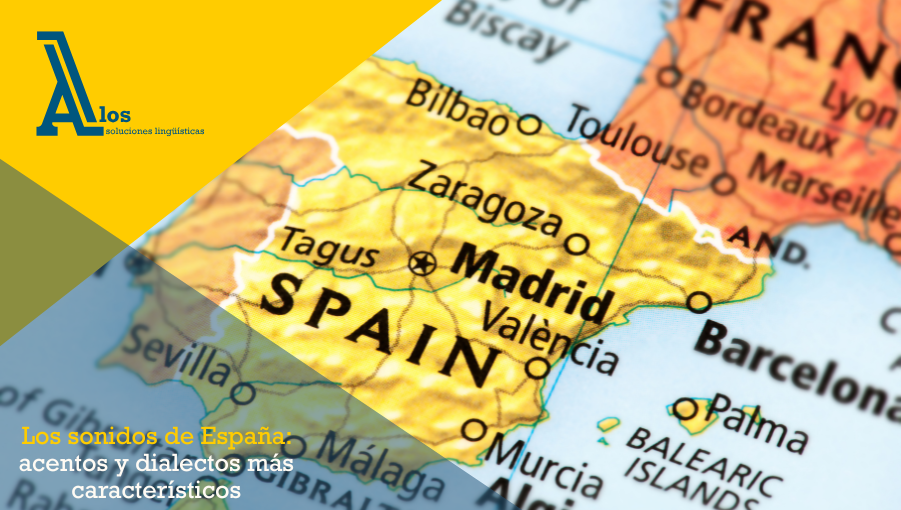
Spain is a country of extraordinary linguistic diversity. Spread across its geography you will find not only different co-official languages such as Catalan, Basque, Galician and Valencian, but also a wide variety of Spanish accents and dialects. This dialectal wealth is the result of centuries of history, a range of cultural influences and particular linguistic developments in each region. According to figures from the Instituto Cervantes (2023), Spanish has more than 489 million native speakers worldwide, and within Spain each region contributes its own phonetic, lexical and grammatical features, which enrich this shared linguistic heritage (Instituto Cervantes, 2023).
The co-official languages recognised by the Spanish Constitution include Catalan (and its variety, Valencian), Galician and Basque. Each has its own grammar, phonology and body of literature, as well as bodies responsible for promoting and standardising it, such as the Acadèmia Valenciana de la Llengua, the Instituto de la Lengua Gallega or Euskaltzaindia. These languages are taught in the school systems of their respective regions and are used by the public administration. Resources such as the educational portal unProfesor.com and media outlets such as La Razón or the Diario AShelp to spread awareness of this multilingual reality across the country.
One particularly singular case within this diversity is la fala, a Romance language spoken only in three small towns in the Jálama Valley (San Martín de Trevejo, Eljas and Valverde del Fresno), in the province of Cáceres. This language, with influences from Galician and Portuguese, has been recognised as a Bien de Interés Cultural (an officially listed cultural asset) by the regional government of Extremadura because of its ethnolinguistic value and its singularity among Europe’s minority languages. La fala even has its own dictionary and is kept alive by being passed from one generation to the next, as a report in the HuffPost.

The main Spanish accents and dialects in Spain
1. Northern or standard Castilian
Northern Castilian, often regarded as “standard” Spanish, is the dialect that originated in Castilla y León, La Rioja and parts of Cantabria. This variety, which serves as the basis for prescriptive Spanish, is characterised by its clear pronunciation of every consonant, especially the distinction between the /s/ and /θ/ sounds (a phenomenon known as “distinción”), which makes words such as “casa” (house) and “caza” (hunt) sound different.
The RAE (Real Academia Española) has historically taken this variety as its reference for setting the educated standard of the language, although it now recognises the validity of every dialectal variant. Northern Castilian has a relatively flat intonation compared with other varieties, with an unhurried rhythm and careful articulation of final consonants.
Some of its main features:
- A clear distinction between /s/ and /θ/
- Every final consonant is pronounced
- Less marked intonation than in other varieties
- Limited use of regional vocabulary
- Intervocalic /d/ is preserved in past participles (-ado)
2. Andalusian
Andalusian is probably the most recognisable and most clearly differentiated dialect of Peninsular Spanish. It is spoken throughout Andalusia, with several internal varieties (western and eastern). Its main characteristic is a tendency towards economy of articulation, which shows up in features such as:
- Seseo/ceceo: In parts of Seville, Cádiz and Málaga you find “seseo” (pronouncing /θ/ as /s/, so that “Zaragoza” sounds like “Saragosa”). In other areas, especially rural parts of Cádiz, Málaga and Granada, you find “ceceo” (pronouncing /s/ as /θ/, so that “casa” sounds like “caza”).
- Aspiration or loss of final and syllable-final /s/: “Los niños” is pronounced almost as “loh niñoh”.
- Yeísmo: No distinction is made between the sounds written “ll” and “y”.
- Aspiration of /x/: The “j” is pronounced with less tension, as a simple aspiration.
Beyond these phonetic traits, Andalusian has a rich vocabulary of its own. Expressions such as “pisha” (mate), “malaje” (someone with bad intentions) or “quillo” (a shortening of “chiquillo”, kid) are typical of Andalusian speech.
3. Canarian
The Canarian dialect shares many features with Latin American Spanish, especially Caribbean Spanish, because of the historical links between the Canary Islands and the Americas. Its most notable traits include:
- Generalised seseo: There is no distinction between /s/ and /θ/.
- Aspiration or loss of final /s/: Similar to Andalusian, but less pronounced.
- Voiced pronunciation of /ch/: Softer than in standard Peninsular Spanish.
- Use of “ustedes” instead of “vosotros”: As in Latin America, “ustedes” is used for the second person plural in every context, both formal and informal.
Canarian vocabulary is influenced by Portuguese, because of historical migration from Madeira and mainland Portugal, and it preserves guanchismos (words of Guanche origin, the pre-Hispanic inhabitants of the islands). Terms such as “guagua” (bus), “millo” (maize) or “gofio” (toasted flour) are specific to Canarian speech.
4. Extremaduran or castúo
The speech of Extremadura, also known as “castúo”, combines elements of Castilian with influences from Leonese and features shared with Andalusian. It is spoken across the provinces of Cáceres and Badajoz, with significant variation between the north and the south of the region. Its main characteristics:
- Aspiration of the initial Latin /f/: Words such as “hacer” (to do) can be pronounced with a slight initial aspiration (something close to “jacer”).
- Closing of final vowels: A tendency to close final vowels, especially “o”, which comes out close to “u” (“perru” for “perro”, dog).
- Preservation of archaisms: It keeps words and expressions that have already disappeared from other varieties of Spanish.
The district of La Vera and the Jerte valley have very distinctive varieties, with a stronger Leonese influence. Extremaduran vocabulary contains terms of its own such as “jurdano” (an inhabitant of Las Hurdes), “entrehijo” (a frail person) or “esmagar” (to squash).
5. Murcian or panocho
The Murcian dialect, also called “panocho” in some areas, is spoken across the Region of Murcia and neighbouring parts of Alicante and Albacete. It represents a transition between Andalusian and Valencian, with characteristics of its own that make it unique:
- Loss of final consonants: Especially /d/ and /r/ (“verdá” for “verdad”, truth; “comé” for “comer”, to eat).
- Opening of vowels: A tendency to open the vowels /e/ and /o/ in certain contexts.
- Aspiration of syllable-final /s/: Similar to Andalusian.
- Specific vocabulary: Words such as “abancalar” (to build terraces), “bajoca” (green bean) or “zaragüelles” (traditional Murcian trousers).
6. Madrid Spanish
The speech of Madrid, especially in certain traditional neighbourhoods, has distinctive features that set it apart from standard Castilian, despite the capital’s administrative centrality:
- Laísmo: Use of the pronoun “la” for the feminine indirect object (“la dije” instead of “le dije”).
- Weakening of intervocalic /d/: Especially in past participles ending in “-ado” (“he estao”, “he comío”).
- Expressive vowel lengthening: Emphatic pronunciation of certain vowels to convey intensity.
- Castizo vocabulary: Terms such as “guay” (cool), “molar” (to like) or “garrulo” (a coarse person) that have spread to other parts of Spain.
Traditional Madrid speech, known as “habla cheli” or “castizo”, has lost ground among younger generations because of the standardising influence of the media and the arrival of people from other regions.
7. Manchegan
The Manchegan dialect, spoken in Castilla-La Mancha, is a transitional variety between northern Spanish and the southern varieties:
- Mild aspiration of syllable-final /s/: Less marked than in Andalusia, but present in certain areas.
- Neutralisation of syllable-final /l/ and /r/: Especially in eastern La Mancha.
- Distinctive intonation: With particular rises and falls in pitch.
- Preservation of lexical archaisms: Words such as “aguardar” (to wait), “lindo” (pretty) or “endenantes” (before).
8. Leonese and the Spanish of León
In the historical region of León (León, Zamora and Salamanca), alongside Asturleonese as a language of its own in decline, there is a variety of Spanish with specific characteristics:
- Preservation of the distinction between /ʎ/ and /j/: No yeísmo across large areas.
- Use of the article before possessives: “La mi casa” instead of “mi casa”.
- Diminutives in -ín/-ina: “Casina”, “pequeñín”.
The vocabulary includes Leonese words such as “apalpar” (to touch), “chiflar” (to whistle) or “esgalamido” (famished).
9. Cantabrian or montañés
The Spanish spoken in Cantabria, traditionally known as “montañés”, has characteristics of its own derived from the Cantabrian substrate and from Asturleonese influence:
- Vowel metaphony: Similar to Asturian, although less widespread.
- Occasional preservation of the aspiration of /h/ from Latin /f/: “jacer” for “hacer”.
- Distinctive intonation: With particular cadences, especially in the inland valleys.
- Use of diminutives in -uco/-uca: “Pequeñuco”, “casuca”.
The vocabulary includes terms such as “esquilar” (to ring the cowbell), “escullar” (to serve broth) or “jujear” (to shout for joy).
Would you like to improve your Spanish? We offer Spanish courses tailored to your needs:
One country, many voices
The dialectal diversity of Spain is one of the richest linguistic legacies in Europe. Far from being a problem for the unity of the language, these accents and dialects are evidence of the vitality of Spanish and of its ability to adapt to different geographical, historical and cultural realities. As we have seen throughout this tour, each dialectal variety contributes unique elements that enrich the shared linguistic heritage.
The way Spanish dialects are developing today reflects the tensions of a globalised world: on the one hand, homogenising trends that favour standard varieties; on the other, a cultural resistance that claims the local as a mark of identity. Far from being destructive, this tension is producing a dynamic balance in which standardised forms coexist for formal contexts and dialectal forms for the expression of regional identity.
Social attitudes towards dialects are changing too. Varieties that were traditionally stigmatised, such as Andalusian or Murcian, now enjoy growing prestige, fed by the presence of their speakers in cultural, media and academic circles. This “dialectal democratisation” helps to create a society that is linguistically more respectful and more diverse. If you would like to explore this subject further, we recommend our articles on:
- Las Fallas of Valencia: history, culture and language
- The 10 hardest languages for Spanish speakers: challenges and benefits
- Is it possible to be 100% bilingual?
Do you need translation or interpreting services that respect the dialectal nuances of Spanish?
❓ Frequently asked questions (FAQ)
According to surveys of students of Spanish as a foreign language, Andalusian (especially in its ceceo varieties or those with heavier consonant aspiration) tends to be the most challenging for non-native speakers.
In linguistic terms there is no “correct” Spanish. The Spanish spoken in Madrid has dialectal characteristics of its own and does not necessarily represent the standard. Standard Spanish is more a convention based on certain features of north-central Spanish, and it is becoming ever more flexible and more inclusive of features from other varieties.
They are phonetic phenomena in which the letters “s”, “c” and “z” are pronounced in a similar way; they are common in Andalusia and the Canary Islands.
The different accents and dialects reflect the history, traditions and values of each region, enriching the cultural identity of Spain.