






Who would not like to be fully bilingual? Command of several languages has become a highly prized skill. The question, though, is this: is it feasible to achieve absolute, balanced command of two languages? This article explores whether full bilingualism is possible, looking at the decisive factors, the cognitive benefits and the associated challenges, drawing on scientific and academic research.
Defining bilingualism
The term “bilingualism” refers to a person’s ability to communicate effectively in two languages. There are, however, different degrees and types of bilingualism:
- Simultaneous bilingualism: this occurs when someone acquires two languages in parallel from childhood.
- Sequential bilingualism: this happens when a second language is learned after the first has been established.
Whether absolute command of both languages is achievable may depend on the type of bilingualism and on individual factors.
Factors that influence bilingual command
Several elements determine the degree of competence in two languages:
- Age of acquisition: learning two languages from childhood makes more balanced command easier.
- Socio-cultural environment: living in communities where both languages are widespread encourages constant use and practice.
- Use and practice: how often and in which contexts both languages are used affects the level of competence.
Scientific perspectives on full bilingualism
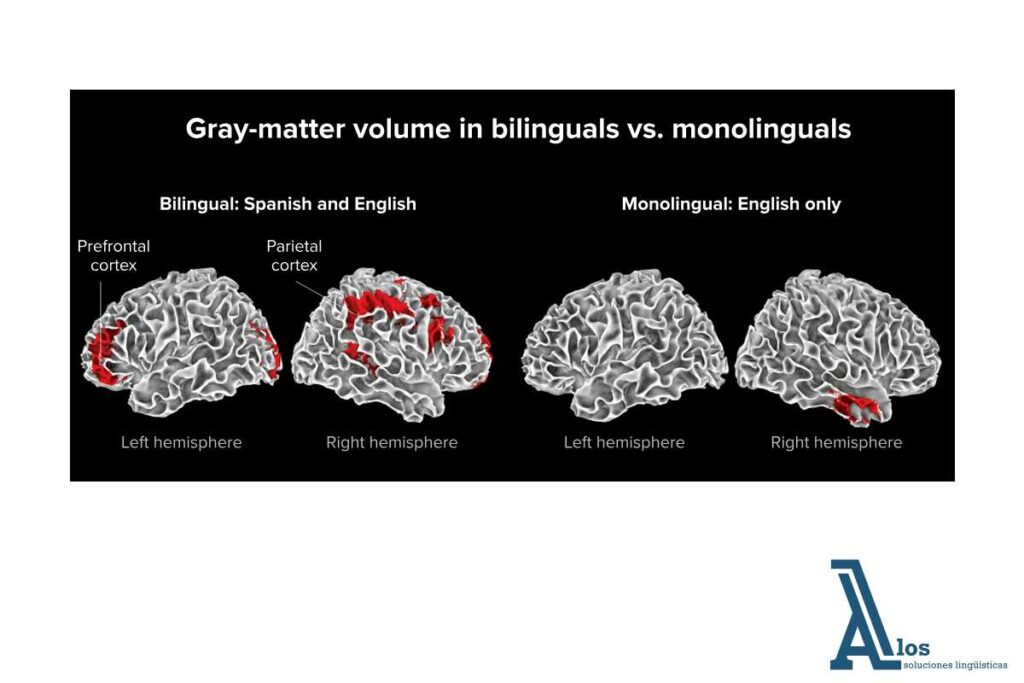
Research has shown that the brain processes several languages using the same neural areas, such as Broca’s area and the basal ganglia. The additional activation in these areas can vary, however, according to competence and the age at which the second language was acquired. Functional MRI studies have shown that, although the same brain regions are involved in processing both languages, efficiency and activation can differ depending on fluency and on when the second language was acquired.
Cognitive benefits of bilingualism
Beyond the question of absolute competence, being bilingual brings a number of cognitive advantages:
- Improved executive function. Having to switch between two languages strengthens skills such as attention and problem solving. Studies have shown that bilingualism is associated with better metalinguistic and metacognitive skills.Source.
- Slower cognitive ageing. Research suggests that bilingualism may delay the onset of neurodegenerative diseases such as Alzheimer’s. An article published in Letras Libres notes that between 60% and 75% of the world’s population speaks two or more languages, and that bilingualism is linked to significant cognitive benefits.
The challenges of full bilingualism
Despite the benefits, achieving perfect bilingualism comes with challenges:
- Linguistic interference. Bilinguals commonly mix words or structures from both languages, a phenomenon known as “interference”.
- Uneven command. Bilinguals frequently have a dominant language, depending on the setting they move in.
- Maintaining both languages. . This calls for constant effort to avoid losing skills in one of the two languages..
Curious facts about bilingualism
- Multiple personalities. Some bilingual people say they feel they take on different personalities or behaviours depending on the language they are using.
- Brain processing. The brains of bilingual people show a higher density of grey matter in areas associated with executive control and attention.
So… can you really be 100% bilingual?
Achieving perfect, 100% bilingualism is a complex ideal and depends on many individual and contextual factors. Yet beyond perfection, command of two languages brings countless benefits and enriches both personal and professional life.
Would you like to know where you stand with your languages? You can put your level to the test right now with our free, quick tests. We have specific tests for the most widely spoken languages:
- Level test in English
- French level test
- German level test
- Spanish level test for foreign learners
- Portuguese level test
- Valencian level test
And if you are looking to improve your language skills with a more professional, academic or specialised focus (medicine, business, tourism or law, for example), get in touch with no obligation for more information about our language courses for specific purposes.
Why being bilingual is good for your brain
To look more closely at how bilingualism affects the brain, we recommend the following video:
(FAQ) Frequently asked questions about being bilingual
Being bilingual means being able to understand, speak, read and write in two languages. The degree of command can vary, however: some people have a native level in both languages, while others use one more fluently.
Although some people, especially those who learn two languages from childhood (simultaneous bilingualism), can have a very high command of both, most have a dominant language. Being 100% bilingual is possible in certain cases, but it is rare for command to be exactly equal in every area (vocabulary, grammar, pragmatics).
Numerous studies have shown that bilingualism improves attention, working memory and cognitive flexibility. It has also been linked to a delay in the onset of conditions such as Alzheimer’s and to greater brain plasticity.
No. Scientific research has disproved this belief. Bilingual children may mix languages (code-switching) in the early stages, but this is a natural part of learning and does not harm their linguistic or cognitive development.
Neither is better in absolute terms. Simultaneous bilingualism tends to produce more balanced command from an early age, while sequential bilingualism can offer metalinguistic advantages when learning the second language. Each has its own benefits.
The most common ones include interference between languages, maintaining fluency in settings where one of the languages is not often practised and, in some cases, social pressure or a divided sense of identity depending on the linguistic environment.
Yes. Bilingualism is a highly sought-after skill in a globalised job market. It opens up opportunities in sectors such as education, diplomacy, translation, healthcare, customer service and many more.