





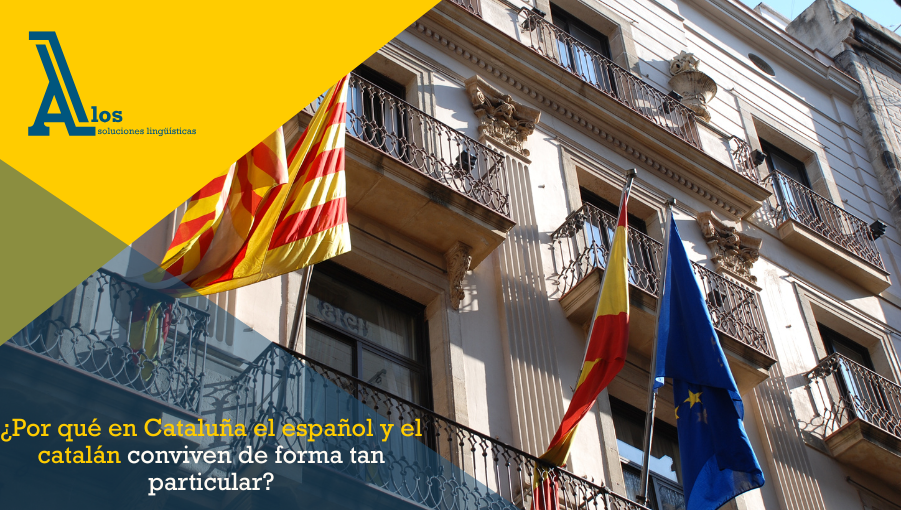
The coexistence of Catalan and Spanish in Catalonia is one of the most complex and fascinating sociolinguistic phenomena in Europe. According to figures from the Statistical Institute of Catalonia (IDESCAT), roughly 94.4% of the Catalan population understands Catalan, while 81.2% can speak it. Spanish, for its part, is understood by practically 100% of Catalans and spoken by 99.9%. This reality creates a situation of social bilingualism that goes well beyond the mere coexistence of two languages.
The most recent data from the Survey of Language Use of the Population (EULP) 2018 show that 36.3% of the population habitually uses Catalan, 48.6% mainly uses Spanish, and 8.8% uses both languages equally. These figures reflect a linguistic dynamic in constant flux, shaped by demographic, educational, generational and migratory factors. The Generalitat de Catalunya has introduced a range of policies to encourage the use of Catalan, particularly through the school system and the public administration.
One particularly telling case that illustrates the tensions and complexities of this coexistence was the dispute that arose in 2021 over the ruling of the High Court of Justice of Catalonia (TSJC) requiring 25% of lessons in Catalan schools to be taught in Spanish. That episode sparked an intense debate about the Catalan language immersion model and brought out the different views on the balance between the two languages in education. The case showed how the language question goes beyond schooling to become a matter of deep social and political significance.
Historical roots: the foundations of a dual language setting
The present-day coexistence of Catalan and Spanish in Catalonia has its roots in centuries of shared history and political conflict. Catalan, a Romance language that developed in the territories of the former Crown of Aragon, enjoyed considerable prestige in the medieval period. However, the Nueva Planta Decree of 1716, issued by Philip V after the War of the Spanish Succession, marked the start of a policy of Castilianisation that officially pushed Catalan aside.
During the 18th and 19th centuries, Catalan went through a process of diglossia, in which Spanish dominated formal settings (administration, education, the courts) while Catalan was mainly kept up in family and popular use. The 19th-century Renaixença brought a cultural and literary revival of Catalan, with figures such as Jacint Verdaguer and Joan Maragall helping to restore the language’s standing.
The 20th century brought alternating periods of repression and recovery. During the Second Republic (1931-1939), Catalan achieved a degree of official recognition, but the Franco dictatorship (1939-1975) imposed harsh linguistic repression. The 1983 Act on the Use of Catalan and subsequently the 1998 Language Policy Act laid the legal foundations for the normalisation of Catalan in the democratic period.
The school system: the epicentre of the language debate
The Catalan education model is the most contested and at the same time the most decisive element in shaping the current language landscape. Language immersion in Catalan, in place since the 1980s, establishes that teaching is delivered mainly in Catalan, with Spanish as a subject.
Supporters of this model argue that it is necessary in order to offset the lower social use of Catalan and to guarantee that all pupils, whatever language they speak at home, reach full command of both languages. The language competence data appear to bear out that view in part: Catalan students achieve similar levels in both languages in the PISA tests.
Spanish-speaking families, however, have brought numerous legal challenges arguing that their children have the right to be taught in Spanish. Discover our Catalan courses and ask for a personalised quote on our website! Take the first step towards bilingualism today.
The media and cultural consumption
The Catalan media landscape shows a clear division between outlets in Catalan and in Spanish, reflecting the language preferences of the audience. TV3 and Catalunya Ràdio, the regional public broadcasters, transmit exclusively in Catalan and hold significant audiences, especially among habitual Catalan speakers.
Private media outlets follow varied strategies. While La Vanguardia keeps its historic Spanish-language edition but has strengthened its digital presence in Catalan, El Periódico ran parallel editions in both languages for years until its recent crisis. Commercial radio stations such as RAC1 have shown that a successful business model in Catalan is viable.
In the digital sphere, social media and streaming platforms have changed patterns of cultural consumption. Young Catalans consume a huge amount of Spanish-language content through YouTube, Netflix and Twitch, which has raised concern about the future of Catalan among the coming generations.
Sociodemographic dynamics and their linguistic impact
Migration flows have profoundly shaped the sociolinguistic development of Catalonia. The internal migration of the 1960s and 1970s, coming mainly from Andalusia and Extremadura, brought in a large contingent of Spanish speakers who concentrated in certain metropolitan areas and industrial towns.
More recently, international migration has added further complexity to the picture. Data from Idescat show that people of foreign origin make up roughly 15% of the Catalan population, with significant communities from Latin America, Morocco, Romania and China. These communities tend to adopt Spanish as their vehicular language, which reinforces its social position.
The territorial distribution of language use shows clear patterns: Catalan predominates in rural districts and medium-sized inland towns, while Spanish is in the majority in the Barcelona metropolitan area and the southern districts. This geographical separation combines with socioeconomic factors to create relatively homogeneous areas of linguistic predominance.
Business and professional life
The Catalan business world reflects both the tensions and the opportunities of bilingualism. Multinationals and large companies based in Catalonia tend to use Spanish (or English) as their working language, citing the need to communicate with the rest of Spain and abroad. The Language Policy Act, however, establishes that employees have the right to carry out their professional activity in Catalan.
The sectors most closely tied to the local area, such as neighbourhood retail, local government and public services, show greater use of Catalan. Family-run SMEs tend to keep language patterns that reflect the origins of their owners and the profile of their customers.
The tourismsector, a cornerstone of the Catalan economy, has developed specific strategies for managing linguistic diversity. Hotels and restaurants in tourist areas habitually use Spanish, English and, to a lesser extent, Catalan, adapting to the international profile of their customers.
Towards a sustainable model of coexistence
The coexistence of Catalan and Spanish in Catalonia is a case unique in Europe for its complexity and for the tensions it generates. Current figures show a society that has reached very high levels of bilingual competence, but with patterns of use that reflect distinct social, generational and territorial dynamics. The success of the education model in terms of language competence contrasts with concern about how the social use of Catalan is developing.
Catalan institutions have shown they can adapt to new realities without giving up their language normalisation objectives. The digitalisation of public services in Catalan, policies to encourage its use in specific settings and communication strategies aimed at diverse audiences all point to a more sophisticated and less confrontational approach than in previous decades.
The future of this linguistic coexistence will depend on the ability to find balances that respect both the rights of language communities and spontaneous social dynamics. The Catalan experience offers valuable lessons for other European territories with official bilingualism, showing that it is possible to maintain minority languages in a globalised context without creating social exclusion. To explore specific aspects of this subject further, you can read our articles on:
- Understanding a language without studying it: mutual intelligibility
- Language training: the hidden driver of efficiency in logistics and transport
- What is happening with the recognition of the C1 in Valencian?
Frequently asked questions (FAQs)
There is no general legal obligation, but many jobs, especially in the public sector and in services, require competence in Catalan. The level required depends on the post and the sector.
It is possible, especially in urban areas where Spanish is widely used. Knowing Catalan can nevertheless make it easier to settle in and to access certain services.
In some cases, Catalan legislation makes the use of Catalan compulsory on signage and in official communications, and failing to comply can lead to penalties.
Catalan-Spanish bilingualism opens up opportunities in translation, public administration, education, the media and specialist professional services in Catalonia.