





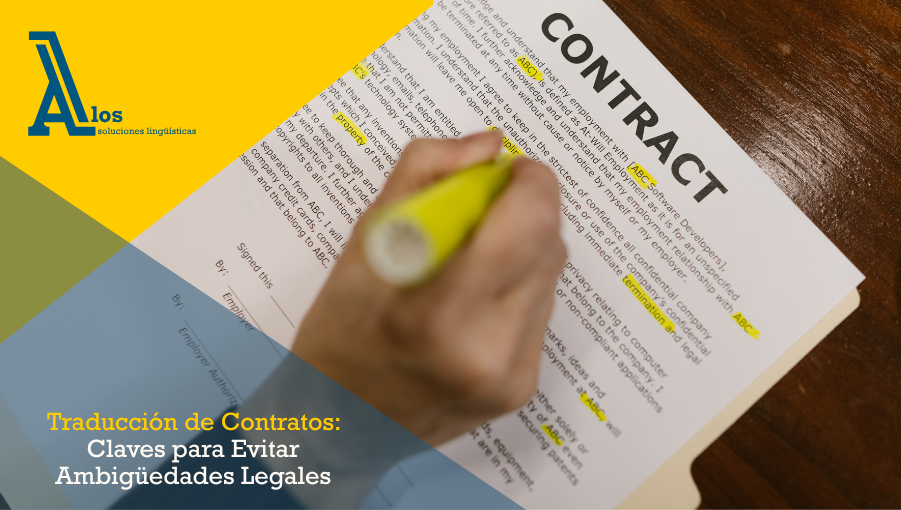
Translating contracts so as to avoid ambiguity is a high-responsibility task that goes far beyond language skills. It involves understanding the legal systems of the signatory parties, interpreting legal terms correctly and conveying the commitments made with complete accuracy. Getting the translation right is therefore essential if agreements are to hold firm in any jurisdiction.
Translating a contract is far more than converting words: it calls for interpreting contexts and anticipating how each clause will be understood in the target language. When you work with legal documents, even one ambiguous phrase can trigger costly court proceedings. A contract translation designed to avoid ambiguity is the best tool you have for preventing misunderstandings between the parties.
Studies by the Council of Europe and the American Translators Association show that a significant share of international disputes originate in translation errors source source. These findings confirm the need for specialist professionals who can render contractual content faithfully and make sure there are no double readings that undermine the legal force of the text.
Keys to avoiding legal ambiguity in contract translation
1. Know the legal systems involved
The translator needs a solid grasp of both the source and the target legal systems (civil law versus common law, for example). Knowing the languages is not enough: you have to understand the regulatory context in which each clause sits.
2. Do not translate literally
Word-for-word translation is a common mistake. The approach should be functional and adaptive, seeking legal rather than merely linguistic equivalents. Rendering “damages” as “daños” instead of “indemnización” can carry significant legal consequences.
3. Spot and resolve ambiguity
Ambiguities fall into two classes: patent (explicit) and latent (hidden). Both have to be handled precisely, adapting the translated text so that it is clear, unequivocal and legally watertight.
4. Use glossaries and translation memories
Computer-assisted translation (CAT) tools keep terminology consistent. That matters a great deal when you are working on long contracts or on sets of related documents.
5. Have the text professionally reviewed
Review by a second specialist translator reduces the risk of error and improves the quality of the final text. Involving a bilingual lawyer is also advisable when the contract spans complex jurisdictions.
6. Take cultural and legal nuance into account
Legal interpretation can vary from country to country, even when the language is the same. That is why certain clauses need to be adapted to the legal framework of the country the contract is destined for.
7. Choose specialist and sworn translators
Experience and qualifications are decisive. In many cases a contract translation must be produced by a sworn translator in order to be legally valid.
Ten common abbreviations in contract translation
- pár. – Paragraph
- sec. – Section
- art. – Article
- inc. – Subsection
- cfr. – In accordance with
- ds. – Provision
- ej. – Example
- tt. – Tax treatment
- v.º – Seen and approved
- obs. – Remark

Frequent mistakes in contract translation and what they cost
Translating contracts demands far more than language skills: it requires command of legal terminology, experience in legal settings and cultural sensitivity. Without those competences it is easy to make errors that look minor yet change the meaning of the text entirely. One of the most common failings is the literal translation of legal expressions. The term “shall”, for instance, is often rendered wrongly as “deberá” in every context, disregarding the fact that it sometimes carries a legal obligation and sometimes only a recommendation.
Another critical error is failing to recognise so-called “false friends”. Terms such as “consideration” do not mean “consideración” in the everyday sense but “contraprestación” in a common law context. A misreading can leave clauses with no legal effect. You also see key elements of the contract omitted because the translator is unfamiliar with the typical format of the source document, which can leave essential conditions out.
In practical terms, these errors lead to misunderstandings between the parties, delays in performing the contract, needless renegotiation and even litigation. In high-value or cross-border contracts the consequences can be disastrous. Prevention therefore means working with specialist translators who can anticipate such situations and resolve them before they turn into conflict.
Sworn translation and specialist translation: the difference
Contract translation may call for different approaches depending on what the document will be used for. Two of the main options are sworn translation and specialist translation. Both are used in legal settings, but they differ in nature, purpose and validity.
A sworn translation is produced by an officially authorised translator (a sworn translator) who certifies that the content is faithful and accurate by signing and stamping it. This type of translation is mandatory when the document has to be submitted to official bodies or courts, as with notarial contracts, powers of attorney, wills or deeds. Its purpose is to guarantee that the translated document carries the same legal weight as the original.
Specialist translation, by contrast, requires no certification, but it must be carried out by a professional with legal training and experience in legal texts. It is essential for contracts between private parties, international agreements, commercial terms and conditions or employment agreements. Here the priority is terminological precision and a clear message that leaves no room for misunderstanding.
The two approaches often complement each other: a specialist translation is produced first and then certified if a sworn version is needed. Understanding the difference lets you choose the right service for the legal and administrative context.
Translating complex clauses and clauses open to two readings
Legal contracts frequently contain clauses that are ambiguous or open to several layers of interpretation. These passages, known as double-meaning clauses, call for particular care in translation, since the wrong choice of term can alter the parties’ original intention and affect the legal outcome of the agreement.
Terms such as “best efforts”, “force majeure”, “material adverse effect” or “liquidated damages” (damages agreed in advance) are just a few examples of expressions whose meaning depends on the legal system. Translating them literally can introduce ambiguity or lead to mistaken readings in the destination country.
To deal with this, the translator needs a thorough knowledge of comparative law and should work closely with legal advisers where necessary. Consulting case law, style manuals and specialist glossaries is also advisable. This ensures that the translated wording preserves the original intention and avoids clauses that are vague or open to contradictory readings.
The translator should also be equipped to identify clauses of this kind early in the project, to raise interpretation queries with the client and to justify the terminology chosen. That proactive approach is key to delivering a legal translation that is safe, clear and valid in both jurisdictions.
Our services: put your trust in Alos
Alos Soluciones Lingüísticas offers end-to-end solutions for companies, lawyers and private clients who need contracts translated accurately. Our services include:
- Professional legal translation by specialists in comparative law
- Sworn translation services
- Language courses focused on legal language
- Quality control with double review
- Bespoke glossaries for regular clients
Our clients trust us because we combine technical knowledge, a commitment to quality and close support throughout the translation process. We make a point of understanding what each project needs so that we can offer precise language solutions tailored to each client’s legal context. For more information, visit our website at:
Frequently asked questions (FAQs)
The risks range from contractual misunderstandings to serious legal consequences. An error in a key clause can invalidate the agreement, trigger costly court disputes or create unforeseen legal liabilities. That is why every word has to be chosen with precision.
A translator must know the legal terminology in both languages, understand the legal systems involved and be able to interpret technical clauses. They also need to spot vague terms and place their meaning in context according to the country and the type of contract.
Ambiguity is identified by analysing expressions open to several readings, long clauses with no clear definition, or uses of tense that may shift from one language to another. Experience in legal drafting is key to anticipating potential conflicts.
It is mandatory when the contract has to be submitted to public bodies, official registers or courts. It is also required in tender procedures, in company internationalisation and when validating documents before foreign authorities.
Literal translation seeks a word-for-word match, whereas functional translation adapts the legal sense so that it is comprehensible and legally valid in the target language. Functional translation is the better fit for avoiding legal ambiguity.
Yes. Our translators have experience in sectors such as energy, technology, foreign trade, construction and healthcare. That specialisation allows them to understand technical clauses and translate them with legal accuracy.
You can fill in the form on our website or email our team. We will reply quickly with a proposal tailored to your needs.
Alongside legal contract translation, Alos Soluciones Lingüísticas provides sworn translation, interpreting at legal and corporate events, localisation of digital legal content and language training specialising in legal terminology. We also develop bespoke terminology glossaries for companies that need consistency across their multilingual documents. All these services are designed to reinforce clarity and legal certainty in international settings.