





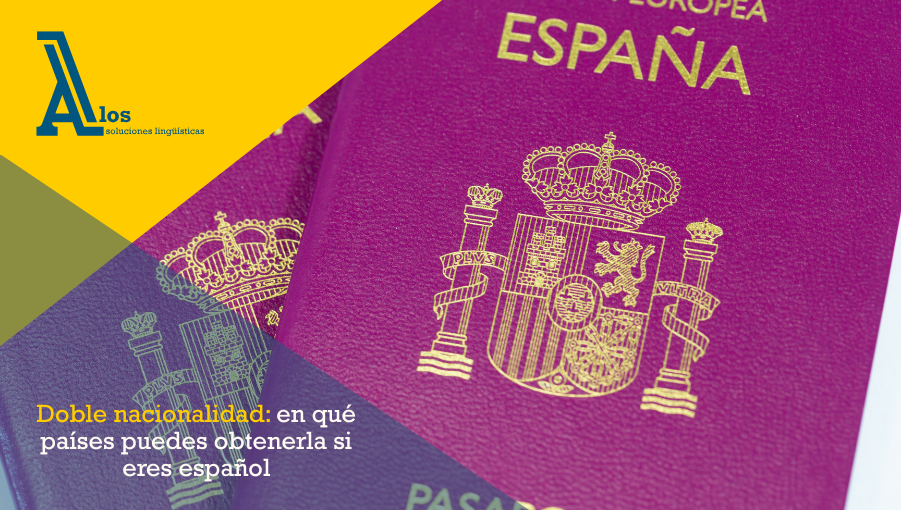
Did you know that the Spanish passport is one of the most powerful in the world? According to the Henley Passport Index of April 2024, it allows visa-free entry to 194 destinations, placing it first in the world for travel freedom. This does not only make tourism easier, it also opens doors to work, study and residence opportunities on practically every continent.
Interest in dual nationality has also kept growing. According to the Spanish National Statistics Institute (INE), more than 183,000 Spanish citizens were living abroad in 2023, and almost 70% were living in countries with which Spain has dual nationality agreements, such as Argentina, France, Mexico and the United States (INE, EANER 2023). This growing international mobility has prompted thousands of citizens to apply for a second nationality, both to make integration easier and to gain access to employment, education and social benefits.
For its part, the Ministry of Justice also reflects this trend: in 2023, more than 120,000 people obtained Spanish nationality through residence, and many of them kept their nationality of origin thanks to agreements that allow dual citizenship.
More and more Spanish citizens are looking for a life with more options, greater freedom and an international presence. Obtaining dual nationality is no longer an exceptional procedure but an appealing way to extend your rights, explore new career opportunities and belong legally to two countries. In this article you will discover which nations allow it, what steps you need to take and what advantages the process can offer you.
What is dual nationality?
Dual nationality is the legal status that allows a person to be a citizen of two countries at the same time. In Spain’s case, this right is recognised through agreements with specific countries, most of them Latin American, which share historical and cultural ties.
Spanish citizens living abroad
According to the Register of Spanish Residents Abroad (PERE), as at 1 January 2024, 2,908,649 Spanish citizens were living abroad, a significant increase on previous years. The countries with the largest numbers of Spanish residents are:
- Argentina: 482.176
- France: 310.072
- United States: 206.278
- United Kingdom: 189.779
- Germany: 188.250Diario AS
It is worth noting that more than 58% of Spanish citizens living abroad are in the Americas, especially in countries with which Spain has dual nationality agreements, such as Argentina, Mexico and Colombia.
Which nationality suits your profile best?
Although the countries that have signed the agreement all offer benefits, they are not all alike. If you are an entrepreneur, Chile and Mexico stand out for their access to markets and digital ecosystems. If you are looking at retirement or a quieter life, Uruguay or the Dominican Republic may be more favourable in terms of cost of living, climate or tax benefits.

Countries with a dual nationality agreement with Spain
| Country | Is there an agreement with Spain? | Do you have to renounce Spanish nationality? |
|---|---|---|
| Argentina | Yes | No |
| Mexico | Yes | No |
| Colombia | Yes | No |
| Peru | Yes | No |
| France | Yes | No |
| Ecuador | Yes | No |
| Equatorial Guinea | Yes | No |
| Philippines | Yes | No |
| Venezuela | Yes | No |
| Dominican Republic | Yes | No |
| Portugal | Yes | No |
| Andorra | Yes | No |
Documents commonly required
Although each country has its own specific requirements, these are the most common documents:
- Full birth certificate
- Criminal record certificate
- Proof of residence or municipal registration
- National identity card and passport
- Marriage certificates, children’s birth certificates or proof of family ties
Do you need to translate official documents to apply for dual nationality and not sure where to start? One of the trickiest steps in a dual nationality application is submitting the documentation required by the receiving country correctly. Many refusals or delays are caused by errors in unofficial or incomplete translations. Using sworn translations and specialist language advice not only ensures your documents are valid, it also speeds up the process and reduces unnecessary risk.
SECURE YOUR NATIONALITY PAPERWORK WITH OFFICIAL TRANSLATIONS
Avoid refusals or delays in your dual nationality application with certified sworn translations and tailored language advice.
General requirements for obtaining dual nationality
| Requirement | Description |
|---|---|
| Legal residence | You are generally required to have lived legally in the country for 2 to 5 years. |
| Command of the language | In most countries you must prove a functional level of the language. |
| Cultural integration | Knowledge of the country’s history, culture or basic laws may be required. |
| Criminal record | No serious offences committed and no pending court proceedings. |
| Connection with the country | In some cases you are asked to prove a family or economic connection. |
Obtaining dual nationality involves not only gathering legal documentation but also demonstrating linguistic and cultural integration in many countries. For example, Spain requires you to pass the DELE A2 exam or higher to certify your command of Spanish, as well as the CCSE test on constitutional and sociocultural knowledge. Likewise, countries such as France, Germany, the Netherlands and Denmark require you to pass language and culture exams as part of the naturalisation process. Preparing properly for these tests is essential if you want to avoid delays or refusals in your nationality application.
PREPARE FOR THE LANGUAGE AND CULTURE EXAMS
Secure your success in the dual nationality process with specialist training to pass the required language and culture tests.
Legal translations: the keys to the process
Legal or sworn translations ensure that your documents keep their legal validity when used in other countries. In Spain, only sworn translator-interpreters accredited by the MAEC (the Spanish Ministry of Foreign Affairs) may issue valid legal translations. This is essential if you are applying for nationality in a country that requires, for example, legal English or specific legal formats in its own language.
Benefits of obtaining dual nationality
| Benefit | Impact |
|---|---|
| International mobility | Travel visa-free to more countries. |
| Right to work | Work legally in two countries. |
| Education | Access to public universities and grants in both countries. |
| Property and residence | Makes it easier to buy property and reside indefinitely. |
| Political participation | Vote or even stand in local elections. |
Useful tips before starting the process
- Consult official sources: visit the websites of the Ministry of Foreign Affairs and the consulates.
- Seek professional advice: immigration lawyers or expert agents.
- Find out about deadlines: in some countries you must ratify the nationality after 3 or 5 years.
- Keep certified copies: both physical and digital. They will save you trouble.
- Check whether it affects your taxes: in some countries you will have tax obligations in both.
- Assess the language and the culture: so you integrate better and get through interviews.
Expert opinion
According to immigration lawyer María Gutiérrez Ortega,
«Dual nationality does not only provide legal protection, it also offers a second professional, tax and family opportunity in international settings.»
– María Gutiérrez Ortega
More and more young Spanish citizens, she notes, are interested in this option as part of a strategy to settle in countries with better employment or education prospects.
Is dual nationality worth it?
Dual nationality is one of the most powerful tools for extending your rights, your international mobility and your quality of life. If you are Spanish, you have the advantage of agreements that allow you to keep your citizenship while gaining access to new opportunities.
Would you like us to help with translating the documents?
At Alos Soluciones Lingüísticas we do not only teach you languages, we support you at every important step of your international life. If you are applying for dual nationality or need to submit documents in another country, we help you with specialist classes and official sworn translations.
(FAQ) Frequently asked questions about dual nationality procedures
Only where an agreement exists or where the country allows it without renunciation. Spain has dual nationality agreements with Latin American countries, Andorra, the Philippines, Equatorial Guinea, France and Portugal. In other cases it will depend on whether the country allows both citizenships to be held without requiring renunciation.
Common requirements include legal residence in the country, a clean criminal record, passing culture or language exams (depending on the country) and submitting official documentation that has been translated and apostilled. Each country has its own specific conditions.
Yes, many countries require you to prove a minimum level in the official language before granting nationality. For example, Spain requires the DELE A2, while France, Germany and Italy also require you to pass language exams. Preparing with classes focused on the specific exam can make all the difference.
👉 Do you need to prepare for the language exam to obtain nationality?
Request your free consultation here and get tailored classes adapted to each country’s official requirements.
Yes. For documents to be valid internationally, many countries require official sworn translations produced by accredited translators, as well as an apostille. Birth, criminal record and marriage certificates must meet this format to avoid refusals during the procedure.
👉 Looking for a sworn translator for your dual nationality application?
Contact us here and we will help you with official translations ready to submit to any consulate.
Yes. If you acquire another nationality, you must declare it to the Spanish Civil Registry or the relevant consulate. Failing to do so can, in some cases, lead to the loss of Spanish nationality.
Yes: if you acquire the nationality of a country that has no agreement with Spain and you do not properly notify your intention to keep Spanish nationality, you could lose it. Always consult a legal expert before starting the procedure.
It depends. Some countries have double taxation agreements, while others do not. It is advisable to consult a tax adviser specialising in international law to understand your specific situation.
You can start at the consulate of the country where you live or at the immigration office of the country whose nationality you want to acquire. In Spain, you can check the process through the Ministry of Justice or the Ministry of Foreign Affairs.