





Taking part in international trade fairs is one of the most widely used strategies for opening new markets, generating business contacts and showing products to potential clients. Yet many organisations arrive at these events without having properly prepared their team to work in other languages.
When people do not feel comfortable communicating with visitors from abroad, business opportunities are lost. In this article we look at how to prepare a team to use languages at international trade fairs, which situations typically come up at these events and how the right language preparation can make the difference.
Why language is decisive at an international trade fair
International trade fairs are fast-moving environments where conversations happen spontaneously. Unlike a scheduled meeting, visitors from different countries can turn up at your stand at any moment.
Within a few minutes, the team has to be able to explain what the company does, present a product, answer technical questions or open a commercial conversation.
When the language is not handled with enough confidence, situations like these are common:
- Pitches that are too short or too vague
- Difficulty explaining competitive advantages
- Conversations that never get past small talk
- Potential contacts lost for lack of fluency
These situations are more common than they seem. Many companies discover that language becomes an obstacle precisely when they start expanding internationally.
For that reason, language preparation ahead of a trade fair can have a direct effect on the results of the event.
Real situations where languages are used at international trade fairs
To prepare a team properly, you first need to identify the kinds of conversation that tend to happen during the event.

The quick company pitch
One of the most frequent moments is the first contact with a visitor. In a matter of seconds, the team has to explain what the company does and why its offer might be of interest.
This short pitch, along the lines of an elevator pitch, calls for clarity and sector-specific vocabulary.
Product or service demonstrations
Many visitors come to the stand to understand how a particular solution works. At that point the team has to be able to explain technical features, applications and competitive advantages.
If the language is shaky, the explanation can become confusing or incomplete.
Commercial conversations with potential clients
When a visitor shows genuine interest, the conversation usually moves onto commercial ground. The discussion turns to needs, possible projects or the markets the company works in.
In these situations it is important to be able to ask the right questions, explain solutions and keep the conversation flowing.
Exchanging contacts and following up
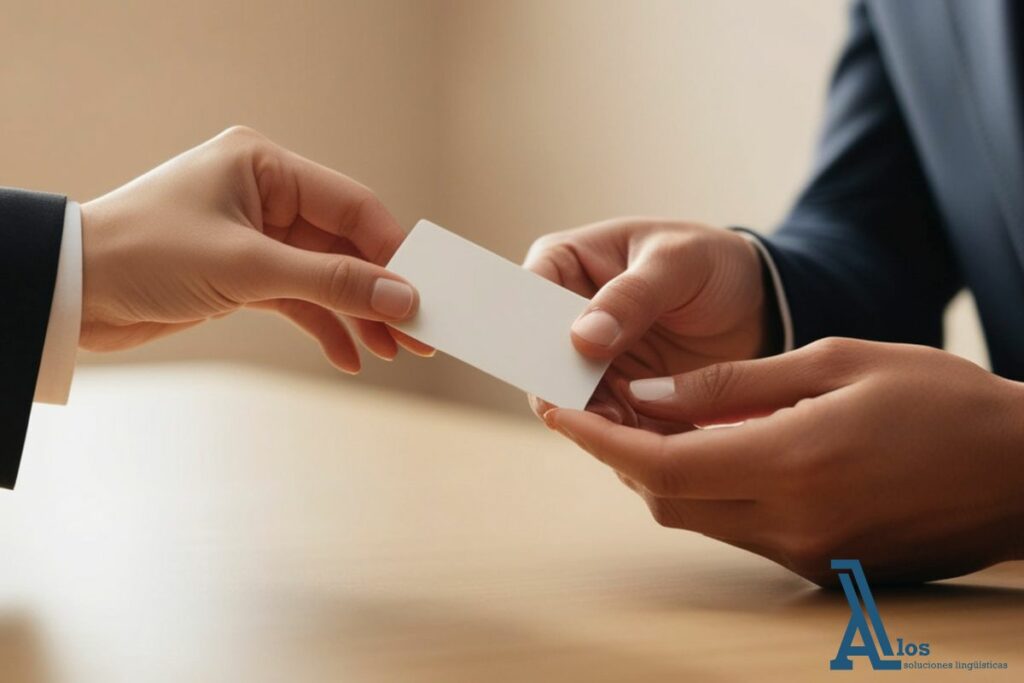
Trade fairs also serve to build relationships that will continue after the event. Knowing how to close a conversation, exchange information and leave a professional impression is essential for future opportunities.
At fairs where dozens of contacts are made in a few hours, a professional Siegel-style card holder keeps your own cards within reach and the ones you receive in order, so no contact goes missing at the end of the day.
This kind of communication is closely related to using the language in business meetings and negotiations.
How to prepare a team before an international trade fair
Good language preparation is not just a matter of revising vocabulary. What works best is training the team in the real situations likely to arise during the event.
Practising short pitches
The team needs to work on explaining the company clearly and directly in another language.
That includes rehearsing different versions of the pitch: a short one to catch attention and a more detailed one for interested visitors.
Role-playing conversations at the stand
An important part of the preparation is recreating typical trade fair situations. For example:
- A visitor asking for general information
- A potential client interested in the product
- A distributor looking for new brands
These simulations help build confidence and improve how quickly people can respond.
Sector-specific vocabulary
Every industry has its own terminology. Preparing the language around products, services or processes makes explanations far clearer.
Getting ready for frequently asked questions
At most fairs, visitors ask similar questions: prices, delivery times, which markets the company operates in or product specifications.
Working through these questions in advance means answering them with more confidence.
The benefits of preparing languages before a fair
When the team arrives well prepared, the effect is usually noticeable from the first day of the event.
The most common benefits include:
More natural conversations with international visitors
The team feels more comfortable starting conversations and presenting the company.
A greater ability to generate qualified contacts
When communication flows, it is easier to spot genuine business opportunities.
A better international image for the company
The way people communicate directly shapes how visitors perceive the organisation.
Getting real value from the investment in the fair
Taking part in an international trade fair involves considerable costs. Good language preparation helps you get the most out of that effort.
It depends on the type of event and the target markets. English is often the main language, but for certain fairs it can also be worth preparing French, German or other languages relevant to the sector.
Ideally you should start several weeks before the event so there is time to practise pitches, conversations and specific vocabulary. Even intensive preparation over a short period can improve the team’s confidence.
Not necessarily. Many fairs also involve technical staff, product managers or directors who have to explain solutions or answer specialist questions.