





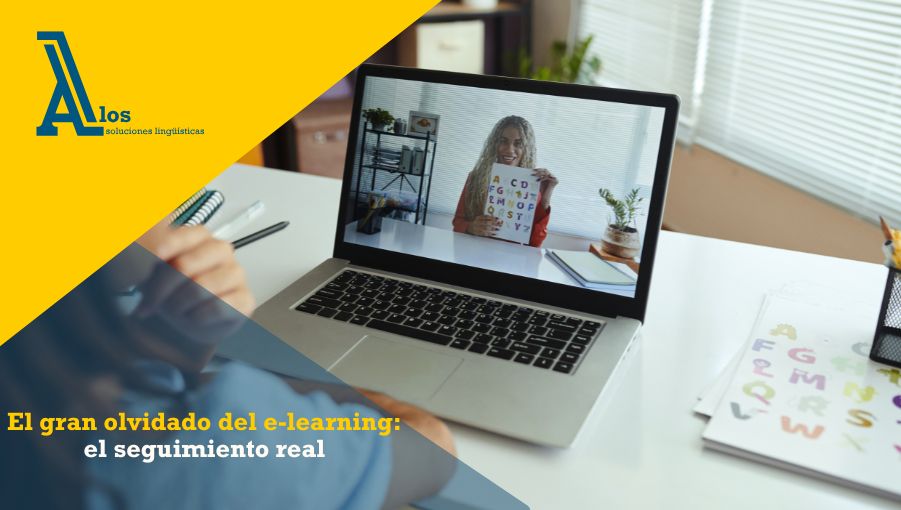
Many training initiatives start with motivation and high expectations, only to run out of steam halfway. It is rarely down to the content or the platform, but to something simpler and more critical: follow-up. In this article we look at why following up on training makes the difference, how to apply it in practice and what real impact it has on learners and organisations.
Why follow-up is the forgotten part of training
In training, especially online or in corporate settings, the effort usually goes into designing the course: syllabuses, videos, downloadable materials. All of that matters, but it is not enough.
Where there is no follow-up, recurring problems appear: learners who do not complete the modules, concepts that never consolidate, or learning that never reaches the job. The result is a feeling of “we ran the course, but it did not achieve much”.
This problem crops up frequently in language training, where real progress depends more on practice and continuous correction than on simply consuming content, something regularly analysed in the language learning articles on the ALOS blog: https://alosidiomas.com/blog/.
What we mean by following up on training
Talking about training follow-up does not mean sending automatic reminders or reviewing statistics once a month. It is a continuous process that connects the learner with the learning and with the person or team guiding them.
Good follow-up combines three key elements:
- Observing real progress, not just access to content.
- Human interaction, whether through tutorials, feedback or personalised messages.
- Adjusting the learning pathway to real needs.
In language training, this approach is closely tied to tutoring and personalised support, aspects ALOS develops in depth in various pieces on its educational blog.
The real benefits of good training follow-up
When follow-up is well planned, the results show quickly. Some of the clearest benefits are:
- Higher course completion rates.
- More solid and lasting learning.
- Early detection of difficulties.
- Greater learner involvement.
- Better return on the training investment.
These benefits are especially visible in continuous training programmes, where support makes it possible to adjust objectives and pace, as explained in several articles on corporate training and applied learning on the ALOS blog: https://alosidiomas.com/blog/.

How to apply follow-up in online and in-person training
Follow-up does not depend on the format but on the intention. It can be applied effectively both in person and online, as long as it is planned from the start.
In online training, the key is to combine digital tools with human contact. Platforms that show progress are useful, but they need to be complemented with tutorials, personalised corrections or guidance messages.
In online sessions with active follow-up, one simple tool makes a real difference: a reusable whiteboard. It lets the learner practise structures, summarise ideas or answer questions in real time during one-to-one tutorials, allowing far more dynamic feedback than typing into the chat alone.
In in-person training, follow-up means watching how the group develops, asking questions, setting small practical assessments and offering frequent feedback.
This hybrid approach, very common in language teaching, draws on the active learning models ALOS works with and develops on its training blog.
The role of the tutor or trainer in follow-up
A tutor is not only the person who explains content. In a model with real follow-up, their role is to support, guide and adjust.
That means:
- Reviewing progress regularly.
- Giving specific rather than generic feedback.
- Suggesting personalised improvements.
- Keeping communication clear and approachable.
The tutor is key to making sure learners do not feel alone during the process, something reflected in the content on tutoring and language support published on the ALOS blog.
Common mistakes when setting up follow-up
Even with good intentions, there are frequent mistakes that reduce the effectiveness of follow-up.
One of the most common is confusing follow-up with surveillance. If learners feel they are merely being monitored, the result is resistance rather than commitment.
Another mistake is standardising the process too much. Not all learners progress at the same pace or face the same difficulties. Follow-up has to be flexible and adapted, especially in personalised training, a recurring theme in ALOS’s educational articles: https://alosidiomas.com/blog/.
It is also common to leave it until the end of the course. Follow-up works when it is constant, not when it amounts to a quick review as the training closes.
Useful indicators for effective follow-up
To make follow-up practical, it helps to rely on clear indicators. The point is not to accumulate data, but to use the data that tells you something real.
Some useful examples are:
- Pace of progress against the planned schedule.
- Results in practical tasks.
- Level of participation in activities.
- Ability to apply what has been learnt in real situations.
Indicators of this kind lead to better training decisions, which matters particularly in language programmes geared to professional objectives.

Follow-up and attracting leads in training
From the point of view of language schools and training centres, follow-up also has a direct effect on attracting and retaining learners.
A learner who feels supported is more likely to keep training, recommend the service or ask for tailored courses. Follow-up thus becomes a tool for trust and positioning, not only pedagogical but strategic, as ALOS’s training approach shows.
Frequently asked questions
No. Although it is especially visible online, follow-up matters just as much in person. The tools change, but the aim does not: supporting the learning.
It depends on the type of training and the number of learners, but it need not be a great deal. Well-organised follow-up saves time in the long run by preventing drop-outs and repeats.
Usually the tutor or trainer, although in corporate settings training or HR managers may also be involved. What matters is having a clear point of reference.
Training follow-up is not an extra; it is what turns a course into a useful, effective learning experience. Supporting, guiding and adjusting is the difference between “having done some training” and genuinely having learnt.
If you are looking for language training with a practical approach and real follow-up, at ALOS we can help you with programmes adapted to your needs. Get in touch with the team and find out how to build learning that is continuous and effective.