





Tax residence, income tax and double taxation: what you need to know if you move abroad
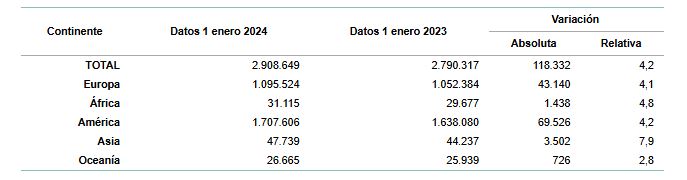
International mobility is increasingly common, and with it come formal requirements such as providing a sworn translation of your tax documents, among others. Whether for work, study or personal reasons, thousands of Spaniards decide to move to another country every year, and this carries significant tax implications. According to the latest figures from the Spanish National Statistics Institute (INE), more than 2.5 million Spaniards live outside Spain, spread across different continents, with the Americas and Europe as the main destinations.
Below we set out a table with the Population of Spanish nationality living abroad, by continent, according to the INE:
This phenomenon raises a number of questions, particularly regarding personal income tax (IRPF).. When you move to another country, are you still required to pay Spanish income tax? What happens to income earned abroad?How do you avoid being taxed twice??
In many cases you will also need to submit Spanish tax documents to the authorities in your new country of residence, which may call for a sworn translation. For example, to prove tax residence abroad and avoid double taxation, you will often be asked for a tax residence certificate issued by the Spanish tax authority. For this document to be valid outside Spain, it will probably need an official translation, depending on the destination country and its rules.
👉 Do you need a sworn translation of your income tax return? See our article on how to request a sworn translation of your tax return.
In this article we look in detail at the tax implications of moving abroad, the treaties designed to avoid double taxation and the importance of a sworn translation of tax documents. We also look at which documents usually need translating and which languages are requested most often.
Tax residence. Where do I have to pay tax?
Your tax residence determines the country in which you have to meet your tax obligations. In Spain, you are considered a tax resident if you meet any of the following conditions, according to the sources consulted:
- Spending more than 183 days in Spanish territory during the calendar year.
- Having in Spain the main base or centre of your activities or economic interests, whether directly or indirectly.
- Having a spouse from whom you are not legally separated, and any children who are minors, habitually resident in Spain.
If any of these conditions applies, you are considered a tax resident in Spain and must therefore pay tax on your worldwide income, that is, on all the income you receive, wherever it comes from.
Change of residence. Implications for income tax
When you move abroad, it is crucial to establish whether you remain a tax resident in Spain or become a tax resident in your new country. If you cease to be a tax resident in Spain, you will no longer pay tax on your worldwide income and will pay tax in Spain only on income obtained in Spanish territory, through non-resident income tax (IRNR).
To prove tax residence in another country and avoid double taxation, the Spanish tax authorities will usually ask for a tax residence certificate issued by the destination country. This document confirms that you are considered a tax resident in that country and therefore avoids double taxation, as is rightly pointed out on the blog of the sources consulted.
Treaties to avoid double taxation
Spain has signed numerous treaties with different countries to avoid double taxation. These agreements set out rules to determine which country has the right to tax particular types of income and how to proceed so that the same income is not taxed in two countries. For instance, if a Spanish national moves to a country with which Spain has such a treaty, the income obtained abroad may be exempt from tax in Spain or eligible for deductions.
It is essential to read the specific content of the treaty that applies to the destination country in order to understand the precise tax implications.
Sworn translation of tax documents. When is it needed?
When changing residence and meeting your tax obligations in the new country, you will often be required to submit tax documents issued in Spain. For these documents to be legally valid abroad, a sworn translation may be needed.
The most common tax documents that require a sworn translation
Tax documents that usually require a sworn translation include:
- Income tax returns (IRPF): To evidence income and tax position.
- Tax residence certificates: To prove tax residence in Spain or abroad.
- Certificates of withholdings and payments on account: Issued by employers or payers.
- Tax register status certificates: To evidence registration in the register of taxpayers.
- Certificates of being up to date with tax obligations: To prove that there are no debts owed to the Spanish tax authority.
These documents are usually required by the tax authorities of the destination country in order to verify the taxpayer’s position and prevent tax evasion.

Languages most often requested for sworn translations of tax documents
The most common languages for sworn translations of tax documents depend on the destination country. English, French and German, however, tend to be the most requested, because so many people move to English-speaking and European Union countries.
It is worth stressing that the sworn translation must be carried out by a translator authorised in the destination country or recognised by the competent authorities, in order to guarantee its legal validity..
Procedure for obtaining a sworn translation
The process of obtaining a sworn translation of tax documents generally follows these steps:
- Contact a translation agency or sworn translator. The signature and stamp of a translator authorised in the destination country or recognised by its authorities is required.
- Submission of documents.. Provide the original documents or certified copies that need translating.
- Carrying out the translation. The translator will produce a faithful and complete translation of the document.
- Certification of the translation.The translator will add their stamp and signature, certifying that the translation is faithful to the original.
- Delivery of the sworn translation. You receive the translated and certified document, ready to be submitted to the relevant authorities.
It is advisable to consult professionals in the field to find out the specific translation and legalisation requirements and to make sure your documents are accepted. Get in touch with specialists and make sure you meet every requirement that applies in your case. At Alos we can give you a hand, with no obligation.
Why sworn translation of tax documents matters and how it affects your tax residence
Moving abroad involves a series of tax considerations that have to be dealt with in order to meet your tax obligations and avoid penalties. Correctly establishing your tax residence, knowing the treaties that prevent double taxation and obtaining a proper sworn translation of your tax documents are fundamental parts of this process.
If you have decided to move abroad and need to submit Spanish tax documentation in another country, it is essential to make sure those documents are legally recognised. A sworn translation guarantees that your tax return, tax residence certificate or any other document is officially valid before foreign authorities.
At Alos soluciones lingüísticas we offer sworn translation of tax documents in the most requested languages, guaranteeing accuracy and compliance with legal requirements. If you are not sure which documents you need to have translated, see our guide to requesting a sworn translation or check whether your document requires an apostille and a sworn translation..
(FAQ) Frequently asked questions about sworn translation of income tax returns
Tax residence indicates the country in which a person has to meet their tax obligations. In Spain, you are considered a tax resident if you spend more than 183 days in Spanish territory during the calendar year, if the main centre of your economic activities is in Spain, or if your immediate family lives in Spain. When you move abroad, it is essential to check whether you acquire tax residence in the new country in order to avoid double taxation.
Double taxation occurs when the same income is taxed in two different countries. To avoid it, Spain has signed treaties with numerous countries setting out rules to determine which country has the right to tax particular types of income and how to proceed so that the same income is not taxed in two jurisdictions.
A sworn translation is required when you have to submit tax documents issued in Spain to foreign authorities. Because those documents are in another language, they need an official translation certifying their accuracy and faithfulness to the original, which guarantees their legal validity in the destination country.
Tax documents that commonly require a sworn translation include income tax returns (IRPF), tax residence certificates, certificates of withholdings and payments on account, tax register status certificates and certificates of being up to date with tax obligations.
The languages most requested for sworn translation of tax documents depend on the destination country. English, French and German, however, tend to be the most common, because so many people move to English-speaking and European Union countries.
A sworn translation must be carried out by an authorised translator, known as a sworn translator, recognised by the competent authorities of the destination country. With their signature and stamp, this professional certifies that the translation is faithful and complete with respect to the original document, giving it legal validity.
Depending on the destination country, tax documents may need to be legalised or apostilled before the sworn translation in order to guarantee their legal validity. It is advisable to check with the authorities of the destination country or with a sworn translation professional to find out the specific requirements.